

Christiane Reves, PhD, is Clinical Assistant Professor, Language Program Director in the Department of German, and DAAD Ortslektor at New York University, and recipient of NYU’s College of Arts and Science “Teaching Innovation Award” for her work on rethinking and redesigning writing assessments in the age of AI.
Source note: This is an edited interview adapted from a narrated video submitted to OpenAI. Watch the associated video in OpenAI Academy.
Intro
For language learners, the hard part is often not the grammar worksheet. It is finding enough chances to speak.
Christiane Reves built Language Buddy at Arizona State University to address that gap. The project began as a way to give German students an always-available conversation partner, especially in online, asynchronous, and lower-contact courses. But over time, the work shifted from simply refining the bot to teaching students how to use AI speaking tools with more agency. Now she is continuing her work at New York University within the GenAI Pilot Project.
The Interview
Q: You open with a very human learning problem: students need to practice before they are ready for real conversations.
Reves: Yes. Imagine wanting to practice before a trip to Berlin or before a real conversation, but not having a partner available. In language learning, interpersonal communication is central. Students need time speaking, listening, asking for clarification, and recovering when they do not understand.
Q: What problems were you seeing in your courses?
Reves: All language learners, but online students in particular, face challenges when it comes to opportunities to practice interpersonal communication. Some courses have reduced contact hours. Feedback can be delayed. Materials may not match a student’s exact needs. And in an online setting, some students feel greater anxiety about speaking with one another because they do not have the same opportunities to get to know each other as they would in a traditional classroom setting. AI can help by offering an always-available partner, unlimited speaking time, instant feedback, tailor-made tasks, and a private space to practice.
Q: How did the first version work?
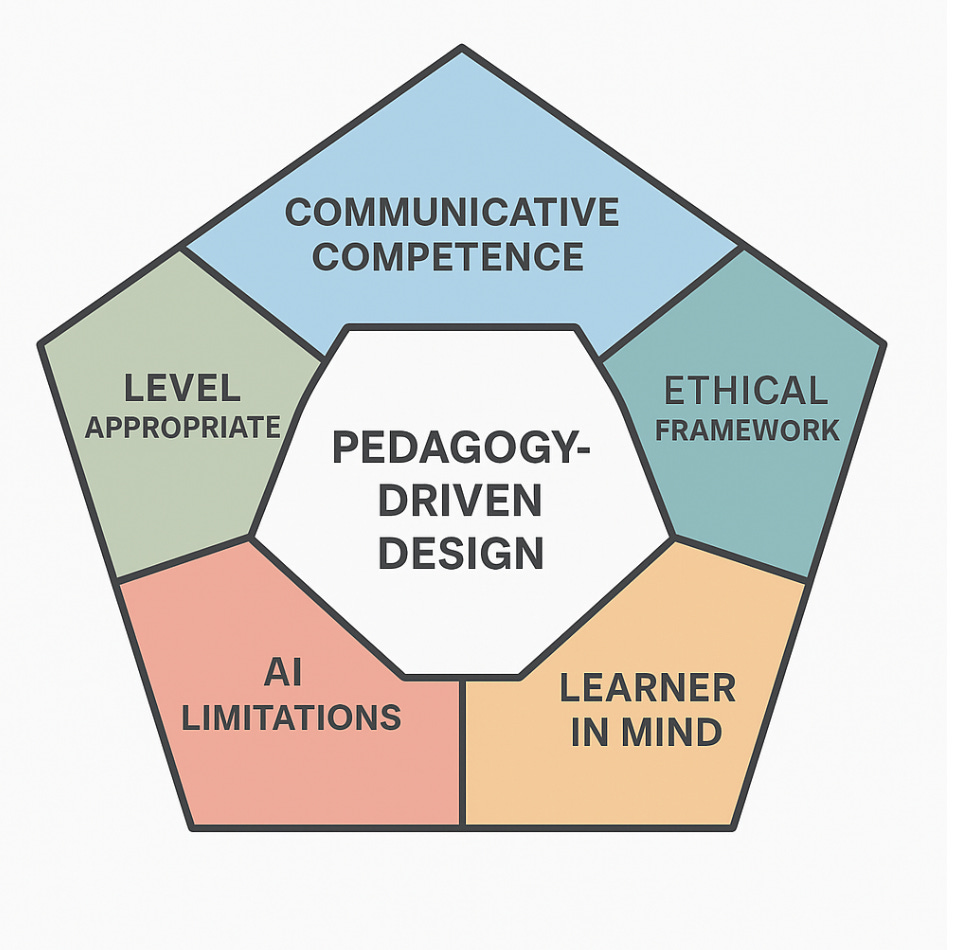
Reves: To build the first model, we started with a pedagogy-driven approach that prioritized the learner, communicative competence, level-appropriate interaction, an ethical framework, and careful consideration of the limitations of AI. Addressing the most immediate instructional needs, we focused on German 101 topics such as introductions, schedules, hobbies, family and friends, grammar, and vocabulary. Students interacted with Language Buddy through spoken conversation, received immediate AI-generated feedback, and produced transcripts that instructors could review to provide additional individualized feedback and support.
Q: What did students respond to?
Reves: Students appreciated the availability, the privacy, and the feeling of conversation. One student described it as helpful when they could not meet with others and said it gave them something that felt close to speaking with a native speaker or someone at a similar skill level.
Q: What did not work yet?
Reves: There were issues with level mismatch, speed, and accuracy. But most students said they would use it again once those issues were improved.
Q: You also mention that the project evolved. What changed?
Reves: At first, we focused on refining the bot. Then we realized that students also needed training. They needed instructions for how to prompt it, how to troubleshoot, how to stay in the target language, how to pause naturally, and how to ask for clarification.
That increased student agency. The tool became stronger when students knew how to use it.
Q: What does this give instructors?
Reves: It gives more documented practice, recordings, transcripts, and faster review. Instructors can also keep control over the content and align the speaking tasks with course goals.
Q: How has this work expanded since the original Language Buddy project?
Reves: I have expanded AI integration across many levels of instruction, from course preparation for interactive communicative assignments and role plays to scaffolded writing support.
I am also continuing my work on custom GPTs for conversation practice as part of NYU’s OpenAI GenAI Pilot Project. Faculty members from a variety of disciplines are collaborating to develop customized AI tutors and trainers tailored to course content and learning outcomes, while also creating opportunities to gather and evaluate student data for assessment, evaluation, and research.
Q: What comes next?
Reves: Better LMS integration, more languages, formal outcome studies, and richer cultural dimensions. I am interested in authentic visuals, regional dialects, and eventually immersive environments such as VR.
What Stands Out
Core idea: Language Buddy provides an always-available AI speaking partner to increase opportunities for German learners, especially online and asynchronous students, to practice interpersonal communication.
Classroom design: The tool’s effectiveness improves when students receive guidance on how to prompt, troubleshoot, and engage with the AI.
Student impact: Students experienced more speaking practice, a private space to build confidence, and timely feedback, especially when anxiety or limited peer contact made speaking harder.
Transferable lesson: Successful integration requires designing both the AI tool and accompanying student training to enhance learner agency.
Bio
Christiane Reves, PhD, is Clinical Assistant Professor, Language Program Director in the Department of German, and DAAD Ortslektor at New York University. Her work focuses on technology-enhanced language learning, intercultural learning, scaffolded writing support, and the use of custom GPTs to support authentic speaking practice. She developed Language Buddy, an AI-powered speaking tool that helps students practice interpersonal communication while giving instructors reviewable transcripts and opportunities for targeted feedback.
Reves also wrote an article reflecting on how she used a pedagogy-driven approach to develop the tool: Pedagogical Reflections on AI Speaking Practice.