At Lynwood Unified School District, Superintendent Dr. Patrick Gittisriboongul uses ChatGPT to help manage a full inbox. It helps him triage messages and draft responses, which he reviews before deciding what to send. For Gittisriboongul, AI does not replace the human side of leadership. It creates more time for him to be present with students, families, and staff.
“I spend less time trying to go to inbox zero and more time with relationships and being present and visible,” Gittisriboongul says.
Christina Ordonez, technology department chair at Hoffman Estates High School in Illinois’s Township High School District 211, has spent 25 years in education across English, reading, library services, technology, theater, instructional coaching, and professional learning. Both districts initially focus their ChatGPT deployments on faculty, administrators, and staff so adults can learn to use the technology responsibly in their own work and guide students when questions arise.
Although Lynwood and District 211 start in different places, both build a foundation with staff by establishing guardrails, building shared language, testing bounded workflows, and measuring how practice changes.
Why districts need an AI strategy now
Gittisriboongul frames the urgency plainly: “The question isn’t whether AI is coming to education. It’s already here. The question is what are we going to do with it?”
“Every school district needs an AI strategy, and it needs one now—one that connects policy, responsible-use guidelines, family communication, capacity-building, and a way to measure impact,” says Gittisriboongul.
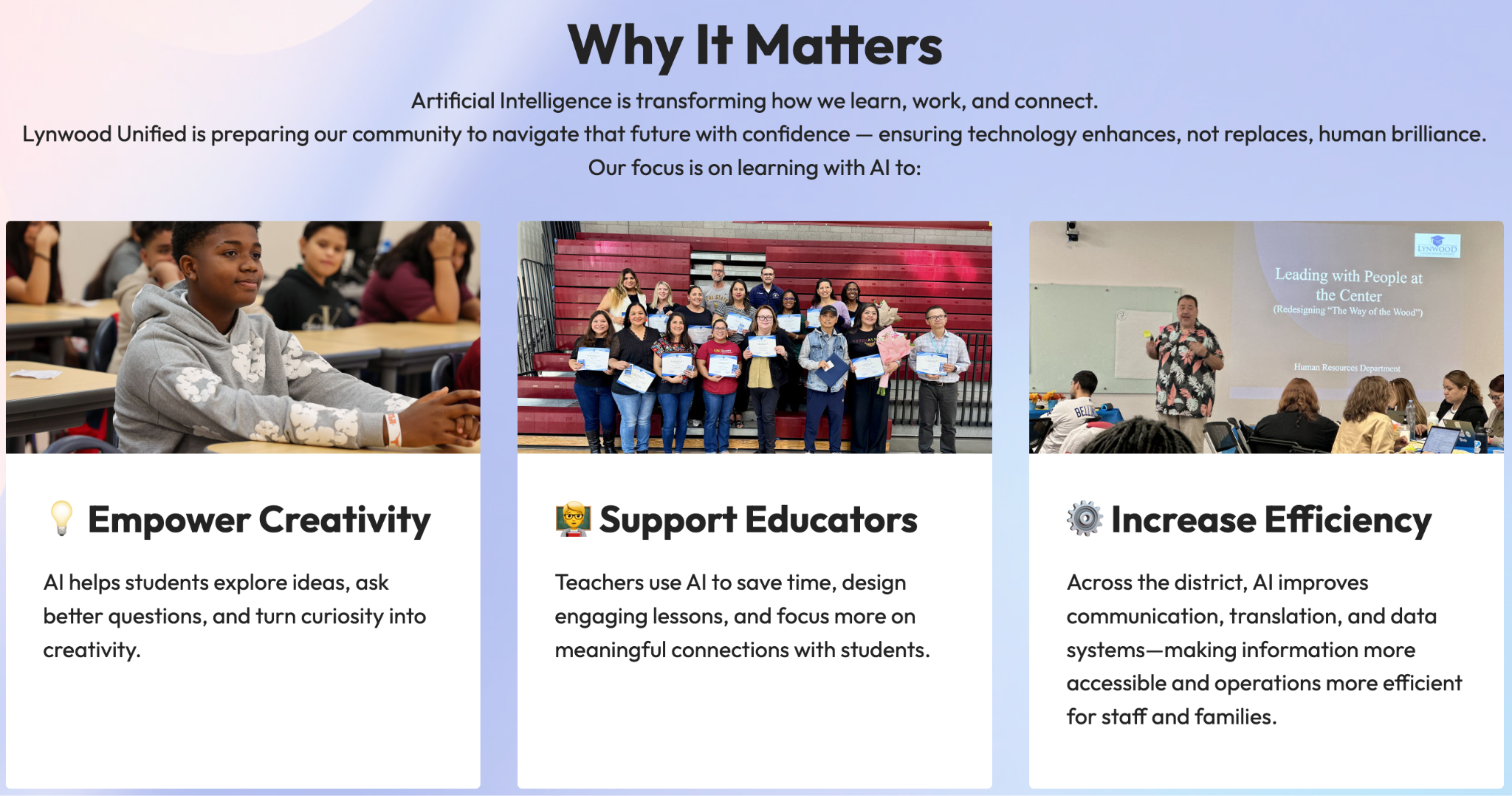
For Lynwood, waiting carries its own risk. Staff members already encounter AI in their work and in conversations with families. Without district-provided access and training, each person is left to evaluate the technology independently. Gittisriboongul connects that unevenness to equity: a shared foundation should not depend on who has the time, confidence, or personal subscription to experiment.
“We have to avoid two extremes: fear, where you simply block and avoid AI, and hype, where you rush without guardrails,” Gittisriboongul says. “There’s a third path: responsible innovation.”
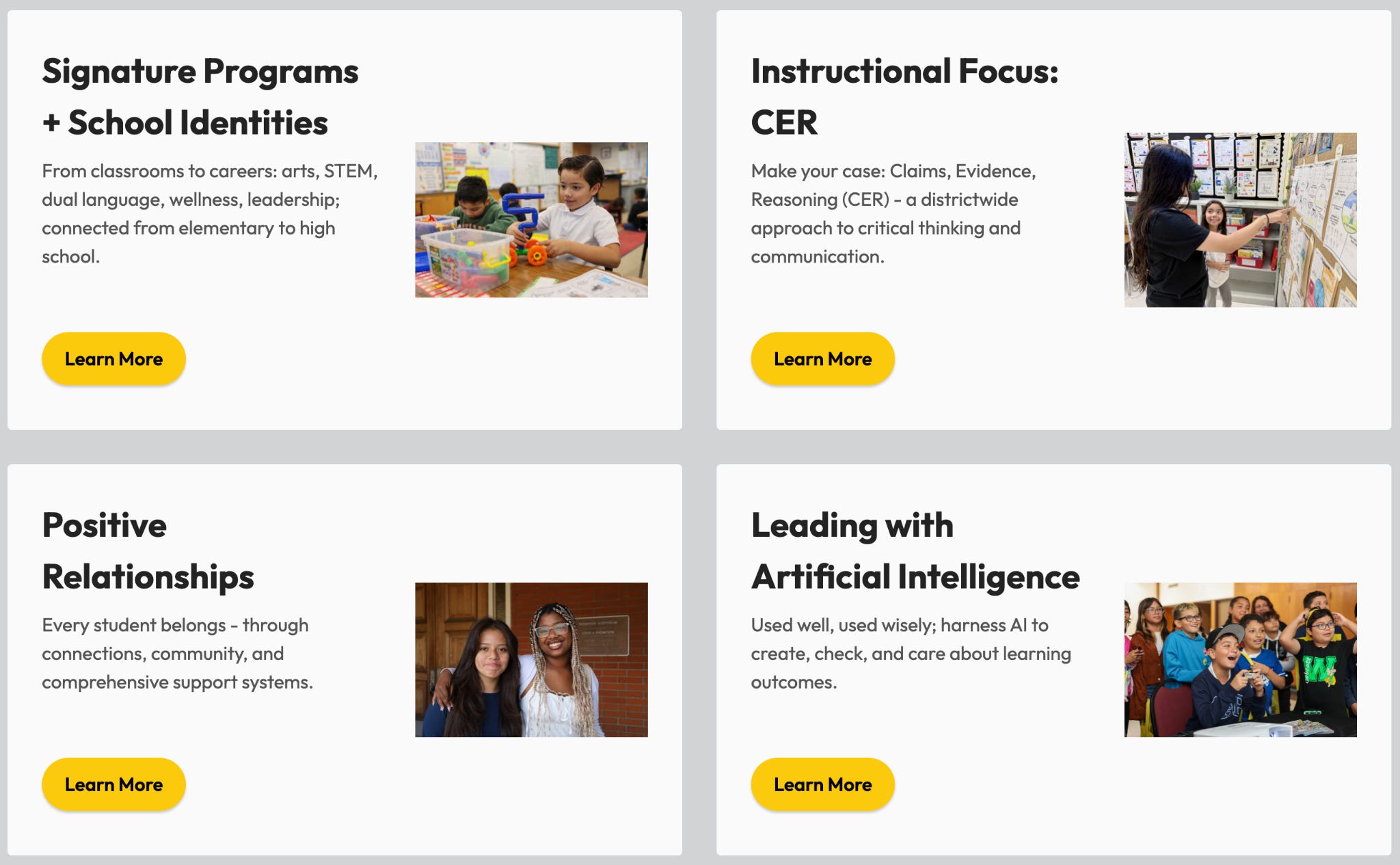
Lynwood forms an AI task force around equity, safety, and ethics. Its three-year roadmap begins with governance, staff awareness, and responsible-use policies, then moves into controlled educator pilots and a broader plan for faculty and staff fluency. AI is also one of the four tenets of the district’s Vision 2030. The roadmap gives staff a fixed point even as products change: build adult capacity, protect human judgment, and prepare educators to lead through a shift already under way.
Ordonez recalls an earlier technology rollout. During District 211’s one-to-one iPad work, staff receive a wide menu of tools. The district eventually accumulates what one leader calls 17 PDF makers—different products solving roughly the same problem, with teachers and students expected to keep track of them. District 211 chooses ChatGPT for Teachers as a shared AI platform so training, language, and oversight do not fragment in the same way. “We wanted a cohesive, strategic plan that added AI literacy, fluency, and deep learning over just adoption of a tool,” Ordonez says. “We worked to create a vision for the efficient, effective, ethical, and equitable use of AI, all while keeping the human-in-the-loop.”
Make privacy part of the implementation
For both districts, privacy is a condition of participation. Gittisriboongul says Lynwood chooses a managed district environment because faculty and staff need data protection and administrative oversight as they experiment. He points to OpenAI’s agreement with the California Student Data Privacy Alliance as part of what makes the deployment possible. As of August, OpenAI has data privacy agreements covering 16 states.
ChatGPT for Teachers is built for managed school use. Data shared in the workspace is not used to train OpenAI models by default, and school and district leaders have administrative controls for managing access. Those protections give educators a district-approved place to work with lesson materials, communications, and operational documents. They do not remove the need for local rules about what information belongs in a tool or who reviews the output.
Lynwood joined OpenAI’s first K–12 cohort. The cohort model includes onboarding, training, office hours, feedback loops, and conversations with peer districts. Gittisriboongul says the cohort helps Lynwood define priorities and surface the questions behind its AI literacy framework: how to enable staff, protect data and integrity, engage families, and make the work sustainable.
“Hearing and learning from other districts has been very beneficial for us,” he says. Continued support matters as much as access because staff arrive with different levels of experience. The cohort also gives district leaders a place to raise implementation problems and show OpenAI where training or product support needs more work.
OpenAI now works with 103 K–12 organizations across 30 states. Together, those systems employ more than 300,000 staff members.
What the work looks like
Gittisriboongul and his team asked departments where work stalls, repeats itself, or begins with a blank page. They identified roughly 48 use cases across district administration, curriculum and instruction, budget and finance, human resources, and technology.
In his own work, Gittisriboongul dictates school-visit notes into a playbook that helps him follow up with thank-you messages. He maintains files in Markdown for his weekly Friday community updates and uses departmental input to draft agendas. ChatGPT can also turn 100- or 200-page interim budget reports into one- or two-page summaries. In each case, a staff member checks the draft against the source and owns what happens next.
At Marco Antonio Firebaugh High School, educational specialist Rex Wang uses ChatGPT to help write code for a Google Sheets app that tracks individualized education plan compliance, giving teachers a dashboard of approaching deadlines. He also uses it to disaggregate discipline data by grade, student subgroup, day of the week, and month. Wang estimates that ChatGPT reduces a benchmark-analysis task from seven or eight hours to about 45 minutes.
Firebaugh Principal Larry Reed describes English and math coaches bringing Smarter Balanced Assessment Consortium question stems, released questions, district assessments, and the district pacing guide into a lesson-planning workflow. The coaches use the material to draft lessons that connect several requirements, including SAT preparation. “It brought a lot of things together quickly and swiftly,” Reed says.
Dayrin Flores, an English language arts teacher at Firebaugh, uses ChatGPT to brainstorm how to combine lessons or address several standards at once. For a unit on Frederick Douglass, she uses ChatGPT to prepare a contemporary-language version of an older text as a first read, then returns to the original with her class. The tool gives her another route into the material; Flores still decides what students read, how they compare it, and what they discuss.
Treat enablement as a system
District 211 uses its collaboration with OpenAI to address a similar organizational problem. “Partnering with OpenAI allowed us to bring every member of our staff into one protected environment,” Ordonez says. The district secured more than 1,000 licenses for certified staff and administrators and treats the shared workspace as the beginning of implementation rather than proof that adoption has occurred.
Planning begins before the licenses arrive. District and school leaders, instructional coaches, and discipline administrators discuss how generative AI differs from search, where it can support teaching or operational work, and what responsible use requires of adults. Staff guidance and common language move through the district’s formal approval process.
The district builds an organizational AI continuum, a staff continuum, and a skills matrix informed by professional-learning standards and its strategic and equity plans. The matrix lets staff locate their current practice and see which skills come next. It also gives leaders something more useful than a login count: a view of where people need help.
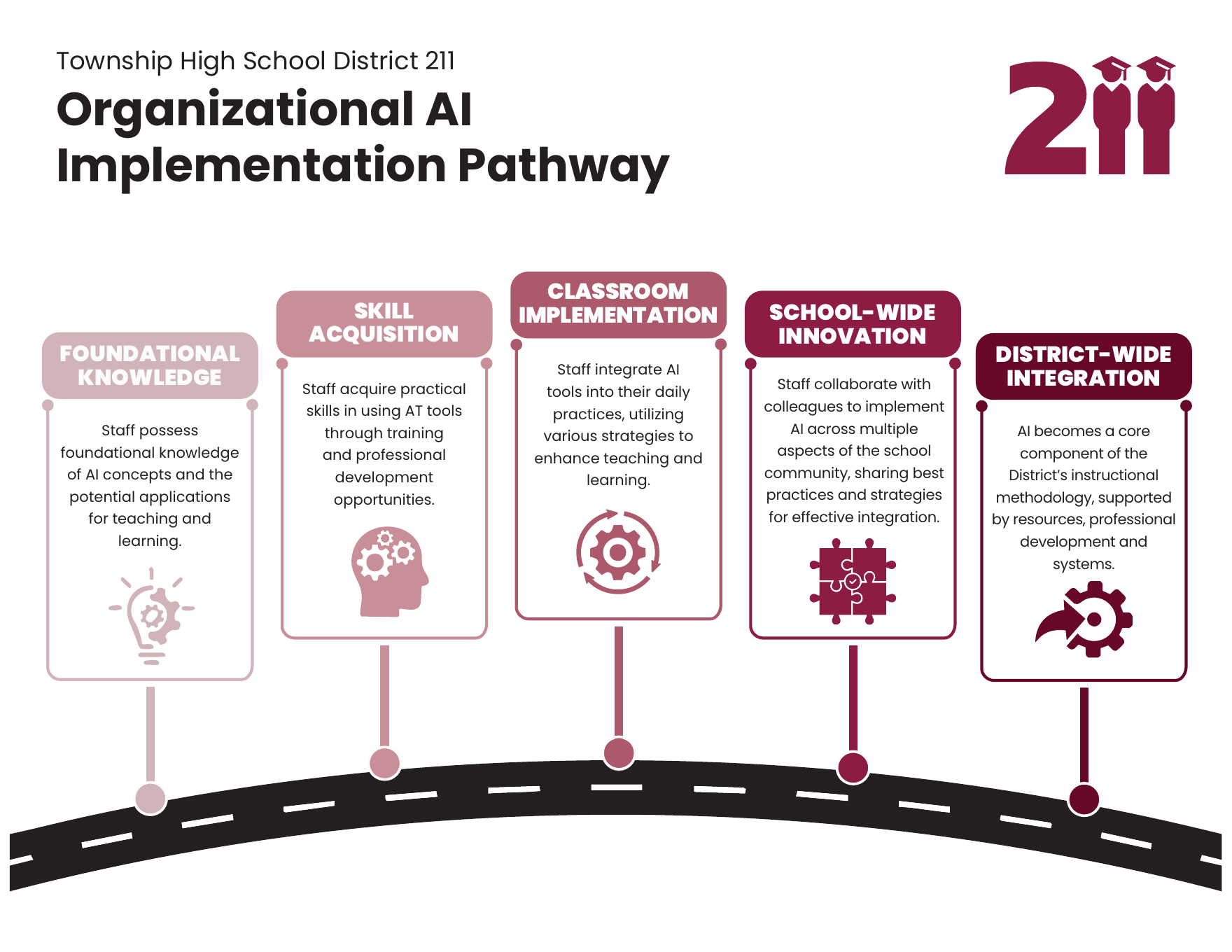
Source: D211 AI Continuum — Organization
District 211 also created a prompting framework called CGPT: Context, Goal, Persona, Task. The acronym gives faculty and staff a shared starting point. It asks them to name the situation, the intended result, the perspective the system should take, and the specific work to be done—then decide what professional judgment they still need to supply.
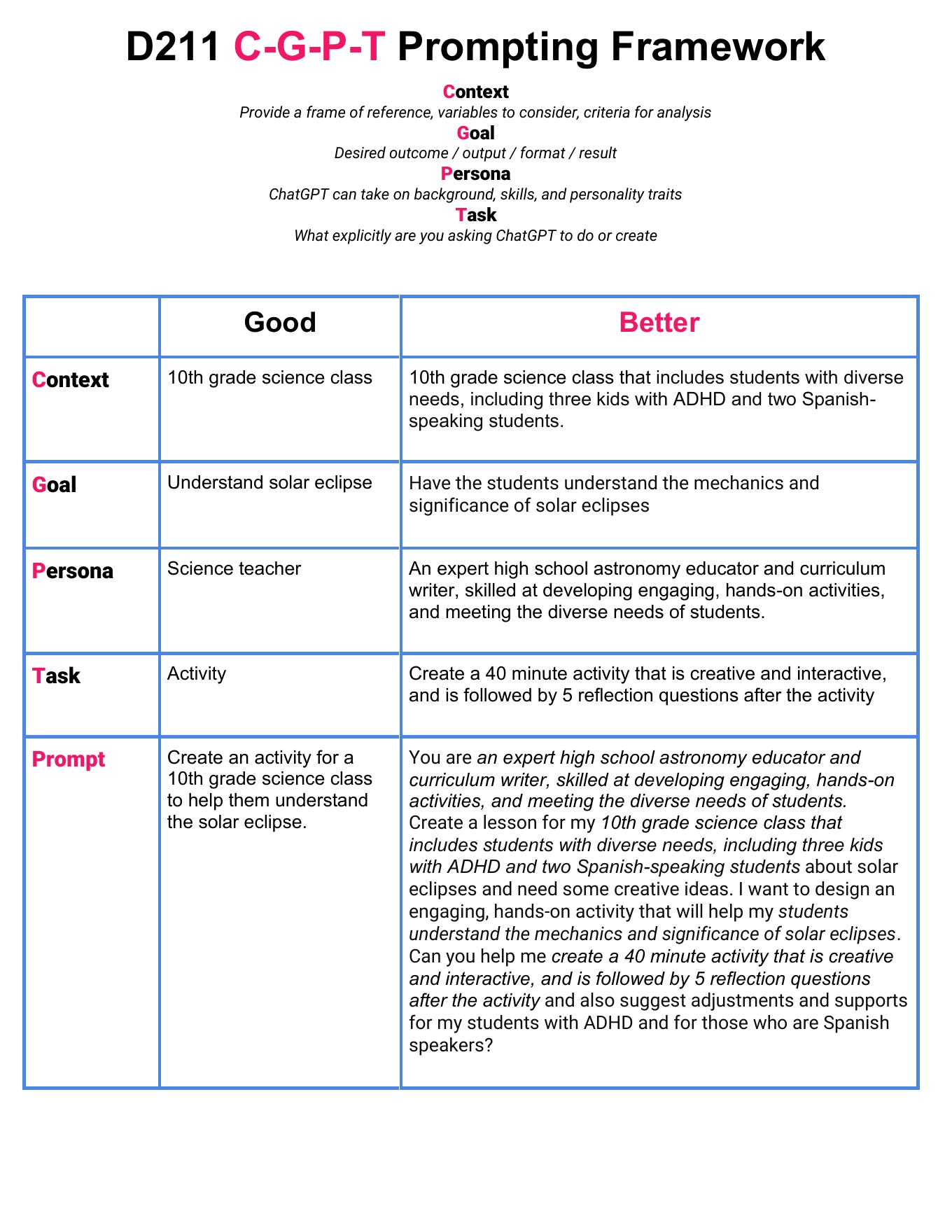
Source: D211 C-G-P-T Prompting Framework
OpenAI’s enablement work gives educators more than one way to learn. OpenAI Academy is a free online hub that teachers and staff can return to for practical guidance. AI Skills Jams provide a live counterpart: educators and district staff work alongside OpenAI mentors on tasks such as lesson planning, family communications, and recurring administrative work. District 211 hosts a Chicago Jam, extending the hands-on workshop model Ordonez and her colleagues already use.
More than 140 professional-learning sessions follow across ethical use, multilingual learners, college readiness, classroom practice, and administrative efficiency. Training reaches beyond teachers and administrators. Librarians, maintenance staff, switchboard operators, and principal secretaries learn how ChatGPT can support their jobs and how to respond when students raise questions about AI.
In District 211, choir teacher Matthew Schlesinger uses ChatGPT to research musical styles and historical context, helping preserve rehearsal time for singing. Art teacher Jonathan Schaefer uses it for research, brainstorming, and feedback while protecting class time for painting and sculpture. Multilingual Learner Department Chair Mauricio Orozco uses ChatGPT to create sentence frames that connect to students’ backgrounds and strengthen their sense of belonging. Ordonez describes the time this work gives back as a return to “the soul of their curriculum.”
District 211 has also begun looking beyond training attendance. “We measured how people grew from just being aware to actually using AI with purpose,” Ordonez says. From the first year to the second, among more than 700 staff members surveyed, the share of staff identifying as “AI Engaged” rose from 22% to 66%. The district now uses its skills matrix to identify priorities for further professional learning as AI capabilities evolve.
“I wasn’t as integrated as I thought. I was experimenting, not progressing,” one staff member says. “Seeing how the Continuum was designed made everything finally click; this is how we grow,” another says.
A practical path for other districts
Lynwood and District 211 come from different histories, but their early moves form a sequence other school systems can examine: name the purpose, choose bounded adult workflows, set privacy and review rules, train people on a common platform, and measure where practice is changing.
One way to begin is with work a staff member already owns: turning a school-visit note into a follow-up message, reviewing a long budget report, adapting a lesson from district materials, or drafting a family communication. The employee compares the result with the source material, revises it, and remains accountable for the final work. A useful pilot makes that review visible rather than counting every generated draft as a success.
Governance and training move together in both districts. Lynwood’s roadmap keeps pilots connected to policy and community goals. District 211’s continuum and skills matrix show where professional learning needs to deepen. A shared platform and prompting language reduce tool sprawl, while office hours, peer learning, and repeated training give cautious staff a way into the work.
The evidence is still early, but both districts are building the conditions for responsible adoption: a clear purpose, privacy protections, sustained professional learning, and ways to measure how staff practice changes.
“Our purpose is to help our students be prepared for wherever their path in life takes them next,” Ordonez says. “By continuing to develop our staff’s knowledge and use of AI, we give them time and tools to support each and every one of our students.”
Learn more about OpenAI resources for K12 Education.
Sources and further reading
District 211 Resources
District 211 Guidelines for Staff Use of Artificial Intelligence
Statement regarding AI in the District 211 handbook and syllabi
Engaging Everyone: Building AI Integration Through Strategic Leading
Lynwood Unified School District Resources