

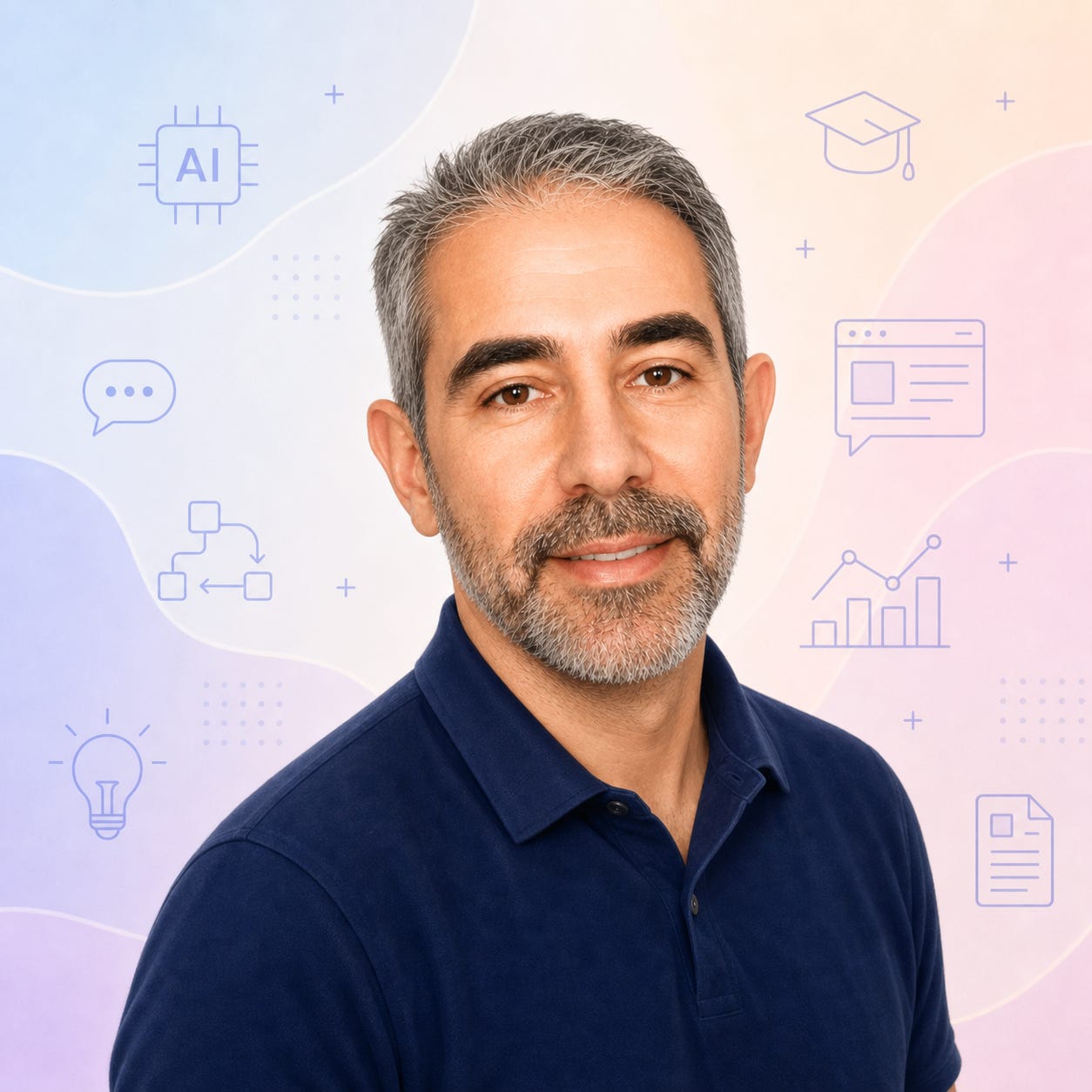
Nicos Savva teaches analytics and data science to MBA and leadership audiences at London Business School.
Source note: This is an edited interview adapted from a narrated video submitted to OpenAI. Watch the associated video in OpenAI Academy.
Intro
For nearly 20 years, Nicos Savva has taught analytics and data science to MBA students and executive audiences. His students are often experienced leaders with deep domain expertise, but not necessarily coding backgrounds or advanced mathematical training.
That created a familiar teaching problem: the people closest to business judgment were often separated from data analysis by technical tools.
Generative AI changed the shape of that problem. In his online course, Business Analytics in the Age of Generative AI, Savva explores what happens when executives can ask for a histogram, regression, confidence interval, or predictive model in plain language.
The Interview
Q: What problem were you trying to solve when you created this course?
Savva: For most of my career, when I was teaching analytics, I ran into the same wall. My audience was brilliant, but most of them were not coders and did not have advanced mathematical training.
That meant I was limited in what I could practically teach. I would spend part of my time explaining the intuition behind methods like data visualization, linear regression, k-means clustering, and their business impact. The other part was spent wrestling with no-code tools and workarounds.
Then tools like ChatGPT made analytics doable in plain language. Suddenly, my audience could ask for a histogram, a confidence interval, a logistic regression, or a power analysis without programming and without touching Python or R. My classroom shifted from the mechanics of how to do analytics to the more important questions: why we do it, what can go wrong, and what decision it supports.
Q: What did that change make possible for executives?
Savva: It changed access. In the course, we give executives real challenges and ask them to do the work. For example, we give them a London housing dataset and ask what happened to prices around Brexit and COVID.
In seconds, they can produce analysis that might previously have taken a data team hours. But the real transformation is not just speed. It is that an executive with 20 years of property investment experience can test their market intuition directly against data.
They can ask follow-up questions, slice the data by neighborhood, compare metrics, and do it in real time. The barrier between having a hypothesis, testing it, generating insight, and telling a data-driven story has collapsed.
The course asks executives to use generative AI to analyze business datasets and move quickly from question to evidence.
Q: You describe this as more than a technical upgrade. What’s the deeper shift?
Savva: The deeper shift is that analytics becomes a strategic thinking tool that leaders can use directly. Predictive models like logistic regression are useful for customer churn, loan default, drug effectiveness, or employee attrition. These models create enormous business value, but teaching busy executives how to run them and interpret the findings used to feel like teaching ancient Greek.
Now an executive can ask, in plain English, which loans are likely to default based on borrower characteristics and receive a working model with performance metrics. The ancient Greek has become plain English.
That does not make domain expertise less important. It makes it more important. The skill is not generating the histogram or model. The skill is knowing which questions to ask and how to turn insights into decisions.
Q: Where does responsibility come in?
Savva: With great power comes great responsibility. When anyone can build a predictive model in minutes, people need to recognize when a model is heading down the wrong path or when a result might be a hallucination.
It is not enough to know what questions to ask. You also need to know what a good answer looks like. Part of the course focuses on analytic intuition: when to be suspicious, how to spot leakage, and when sample size should make you nervous.
This is not about turning executives into statisticians. It is about helping them catch dangerous mistakes before those mistakes become business disasters.
Savva emphasizes that the goal is not just faster analysis, but better judgment about models, evidence, and decisions.
Q: Does this replace data teams?
Savva: No. The point is not to replace data teams with large language models or artificial intelligence. The point is to make senior leaders better partners.
They can prototype quickly. They can ask sharper questions. They can interpret results more responsibly. Analytics moves from a specialized function that leaders consume to a strategic thinking tool they can use directly.
Q: What has this changed in your teaching?
Savva: My teaching has not become about AI. It is still about analytics and what humans can do with evidence. AI removes the mechanical barriers so non-technical leaders can access data, think better, reduce uncertainty, and do it responsibly.
That is the real upgrade.
Bio
Nicos Savva is Professor of Management Science and Operations at London Business School, where he researches and teaches data science, operations, and healthcare management. His work has been published in leading academic journals and has influenced practice in industries including healthcare, retail, and technology. He is passionate about equipping leaders to harness analytics and AI to make better, evidence-based decisions.