
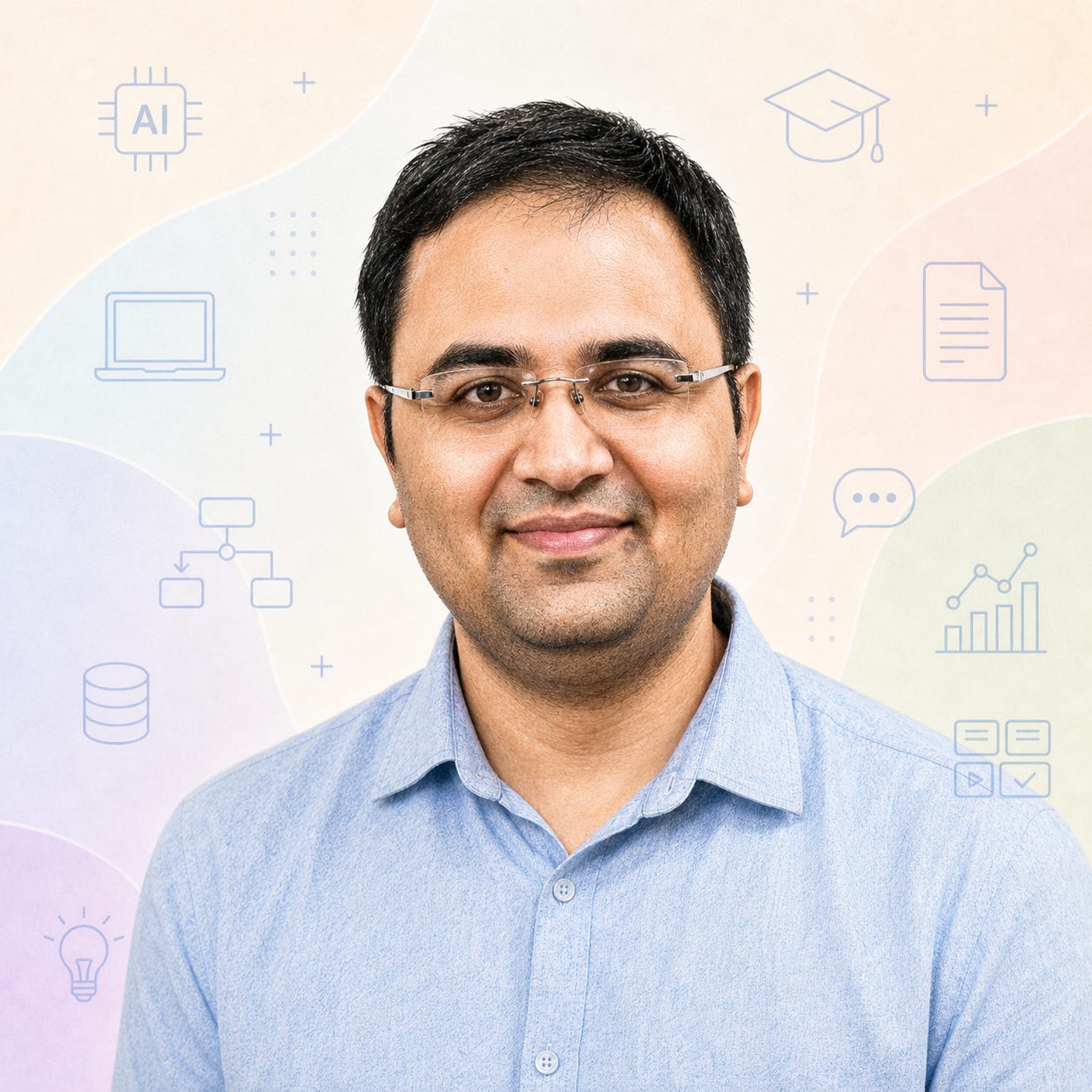
Dr. Mahipal Jadeja is an Assistant Professor at Malaviya National Institute of Technology Jaipur (MNIT Jaipur) and an advocate of AI-powered education. In this interview, Jadeja discusses how AI is being used in his Programming with Python course.
Source note: This is an edited interview adapted from a narrated video submitted to OpenAI. Watch the associated video in OpenAI Academy.
Intro
Teaching programming to first-year undergraduates in India brings unique challenges: language barriers, the need for personalized learning, and the struggle to make abstract concepts relatable. Dr. Mahipal Jadeja, Assistant Professor at Malaviya National Institute of Technology Jaipur, an Institute of National Importance in India, has tackled these challenges head on by developing Python Ki Pathshala, a custom GPT designed to meet his students where they are. In this interview, Dr. Jadeja shares the motivations, design, and impact of his AI-powered tutor, offering a glimpse into the future of inclusive, story-driven coding education.
The Interview
Q: Dr. Jadeja, you’ve spoken about three core challenges in education: language, personalization, and the lack of narrative. Why do these matter so much in your teaching context?
Jadeja: Teaching isn’t just about delivering content, it’s about connecting with learners. In India, language is often an invisible barrier. While higher education is mostly in English, many of my first-year students come from Hindi-medium backgrounds. If we explain concepts in a language they’re truly comfortable with, learning becomes more enjoyable and meaningful. Personalization is equally important. We can’t teach students well if we don’t know them well, yet most materials ignore students’ backgrounds, interests, or learning pace. Finally, narrative is often missing. Facts and theorems are necessary, but stories make concepts live in students’ hearts. That’s why I wanted to address all three challenges with Python Ki Pathshala.
Q: How does your custom GPT, Python Ki Pathshala, address these specific barriers?
Jadeja: The GPT’s default response language is Hindi, which aligns with the linguistic reality of my students. But it’s flexible: students can switch to English or Hinglish with simple commands. Personalization comes through features like metaphors and stories tailored to individual interests. For example, if a student loves cricket or Instagram, the GPT will use those as metaphors to explain programming concepts. The story feature is especially powerful: students can enter their name and hobby, and the GPT generates a story mapping their passion, like chess or dance, to the coding topic at hand. This makes abstract concepts concrete and memorable.
Q: Can you walk us through a typical student interaction with Python Ki Pathshala? What does the workflow look like?
Jadeja: Absolutely. A student might start by typing a Python topic, say “for loops.” The GPT responds with a mini-lesson: it starts by explaining why the concept matters, then uses metaphors aligned with student interests, followed by syntax, examples, a quiz, and recommended videos. If a student wants more relatable metaphors, they type “M” for more metaphors. For real-world applications, “R” generates practical use cases. The story feature, “S,” lets students enter their name and hobby, and the GPT crafts a story connecting their interest, like chess or a favorite web show, to the programming concept. There’s also a practice feature, “P,” for partially filled code, and language modes can be toggled for comfort. The system is trained on my own teaching materials, so it reflects my style and methodology.
Q: What kind of feedback have you received from students? Has it changed the classroom experience?
Jadeja: The feedback has been overwhelmingly positive. Students appreciate the revision support, video links, practice problems, interactive interface, and most of all the language and metaphor support. Many have said it’s the best resource they’ve found, especially because it relates concepts to real life. One student said, “It’s like it reads my mind.” That’s the ideal as a teacher: to bridge the knowledge gap by truly understanding what students need.
Our data shows a 4.58 out of 5 overall rating based on feedback from 73 students, with strong use of both English and Hinglish modes. Python Ki Pathshala has also supported more than 1,000 student learning conversations so far. The most valued features are real-world use cases and storytelling. It’s not just students, faculty are also using the GPT to bring personalized stories and applications into their own teaching.
Q: What do you see as the broader impact or potential of this approach? Could it work beyond Python or your own classroom?
Jadeja: The biggest advantage is limitless personalization. As a human teacher, I can only cover common interests in class. But the GPT can generate millions of personalized examples and stories, making learning deeply relevant for every student. While my GPT is designed for Python, the core ideas are universal. Any educator can use prompts or custom GPTs to generate personalized, story-based explanations in any subject. I’ve even seen students use it for physics concepts. This approach can transform how we teach, making education more inclusive, engaging, and effective.
What Stands Out
Core idea: Custom GPT Python Ki Pathshala demonstrates how AI tutors can break down language barriers, personalize learning, and make abstract concepts relatable through stories and metaphors.
Classroom design: The tool integrates language flexibility, topic-based mini-lessons, and story-driven examples, all modeled after the instructor’s own teaching style, to create a highly interactive and student-centered learning environment.
Student impact: Students report increased motivation, deeper understanding, and a sense of being truly “seen” by the tool, reflected in a 4.58 out of 5 rating from 73 students and more than 1,000 student learning conversations to date.
Transferable lesson: Personalization and narrative are not just nice to have, they are transformative. Any educator, in any subject, can leverage AI to create more inclusive and engaging learning experiences.
Bio
Dr. Mahipal Jadeja is an Assistant Professor at Malaviya National Institute of Technology Jaipur and an advocate of AI-powered education. He develops custom AI tutors and conducts workshops on coding, AI literacy, and prompt engineering.
I really like the comparison because it highlights something deeper than repetition.
Weight training works because each repetition provides feedback about where your current limits are. Good test preparation should do the same.
Too often, practice becomes an exercise in accumulating questions rather than diagnosing thinking.
The most valuable practice isn't the one that tells students whether they were right or wrong—it's the one that reveals why they struggled and which underlying concept needs strengthening before the next attempt.
Subject: AI in Education: The Case for Closed-System Learning Platforms
While I recognize the potential value of artificial intelligence in education, I remain cautious about the use of open AI platforms as a solution for closing educational gaps at any level.
Educators from middle school through post-graduate programs, including medical schools, technology programs, the sciences, and the liberal arts, are already raising serious concerns about academic integrity. Students are increasingly relying on open platforms such as ChatGPT, Claude, Grok, and others in ways that can blur the line between assistance and substitution.
For that reason, I do not believe open AI platforms are the best answer for structured education, particularly where measurable learning outcomes matter.
However, I strongly support and actively endorse the use of a closed-system AI tutor for the education of both children and adults working within a formal curriculum in rural Africa.
This type of tutor platform does not rely on the open internet and cannot access outside programs, platforms, or applications beyond its gated system. That distinction is critical. It allows AI to function as a true educational support tool rather than an unrestricted shortcut.
For anyone who has worked in the developing world, the challenges are obvious. Reliable Wi-Fi is often limited, unevenly distributed, or expensive. While many people may have access to some type of mobile phone, most devices are 4G, with limited 5G access generally available only to middle-class users. Many of the poorest communities do not have even the most basic digital tools necessary for consistent learning.
Through public-private partnerships, this model can be funded through shared contribution structures, such as 60/40 or 70/30 arrangements. These partnerships can support not only suitable learning devices, but also training, monitoring, and data analytics. This is where the platform becomes especially valuable.
Unlike traditional education models that often measure success by completed lessons, submitted papers, tests, or attendance, a closed-system AI tutor can measure individual learning progress in a more precise and meaningful way. It can track what each learner understands, where they struggle, how quickly they improve, and what support they need next.
That level of clean, individualized data is essential if we are serious about measuring actual learning rather than simply documenting participation.
This closed-system AI tutor is already being used in 17 different applications, ranging from primary education to workforce skills development across the EU and Africa, with active discussions underway in both Central Africa and India.
I would be happy to discuss this platform further with anyone interested in practical, measurable, and scalable solutions for education in rural Africa.
I can be contacted through direct communication on the LinkedIn platform.
David James Dunworth