

Luis Reyes is an Associate Professor of Chemical and Food Engineering at Universidad de los Andes, specializing in biotechnology, nanotechnology, and generative AI integration in education. In this interview, Reyes discusses how AI is being used in Project of Unit Operations.
Source note: This is an edited interview adapted from a narrated video submitted to OpenAI.
Intro
Artificial intelligence is rapidly reshaping higher education, but for many educators, the question remains: how do you harness these tools to deepen—not diminish—student learning? Luis H. Reyes, Associate Professor at Universidad de los Andes, faced this dilemma head-on in his Project of Unit Operations course. Rather than simply setting boundaries for AI use, Reyes and his colleagues developed the Cognitive-AI Synergy Framework (CASF), a practical system for aligning AI integration with students’ cognitive development. In this interview, Reyes shares the story behind CASF, its classroom application, and the measurable impact it’s had on student research and writing.
The Interview
Q: Luis, you describe a pivotal challenge: integrating generative AI into engineering education without undermining critical thinking. What first prompted you to tackle this issue?
Reyes: As an educator in chemical and food engineering, I’m responsible for preparing students for a field that’s changing rapidly. When generative AI tools like ChatGPT emerged, I saw their potential—but also the risk that students might rely on them in ways that bypass deep learning. The question became: can we design assignments where AI genuinely enhances student development, rather than replacing essential cognitive work? That’s what led me to this project.
Q: You mention frameworks like the Artificial Intelligence Assessment Scale. What gap did you see in those approaches?
Reyes: Those frameworks are a great starting point—they help set clear rules about when and how AI can be used in assignments. Our university even recommends them officially. But they don’t tell professors how to design activities that fit those rules, or how to account for where students are in their cognitive development. It assumes educators already know how to create tasks that use AI effectively, which isn’t always the case, especially with such new technology.
Q: So you and your colleagues created the Cognitive-AI Synergy Framework (CASF). What’s the core idea behind it?
Reyes: CASF is built on the premise that educators know teaching and learning, but not necessarily AI. So, rather than starting with technology, we start with how students learn. CASF maps the level of AI integration directly to established cognitive development stages. For example, at the propositional level, students are just starting to apply knowledge—here, AI can help them check their approach, but shouldn’t give them the answers. At the metacognitive level, where students reflect on their own learning, AI can become a true collaborator, helping them plan, evaluate, and refine their strategies.
Q: How do you make this framework practical for busy faculty?
Reyes: We developed the CASF Implementation Assistant, an AI-powered tool that guides professors through designing activities. You input your course details, the students’ cognitive level, and your learning objectives. The assistant then suggests tailored activity plans, proven examples, and ethical guidelines—all grounded in the CASF. This makes it much easier for faculty to confidently integrate AI, even if they’re not AI experts themselves.
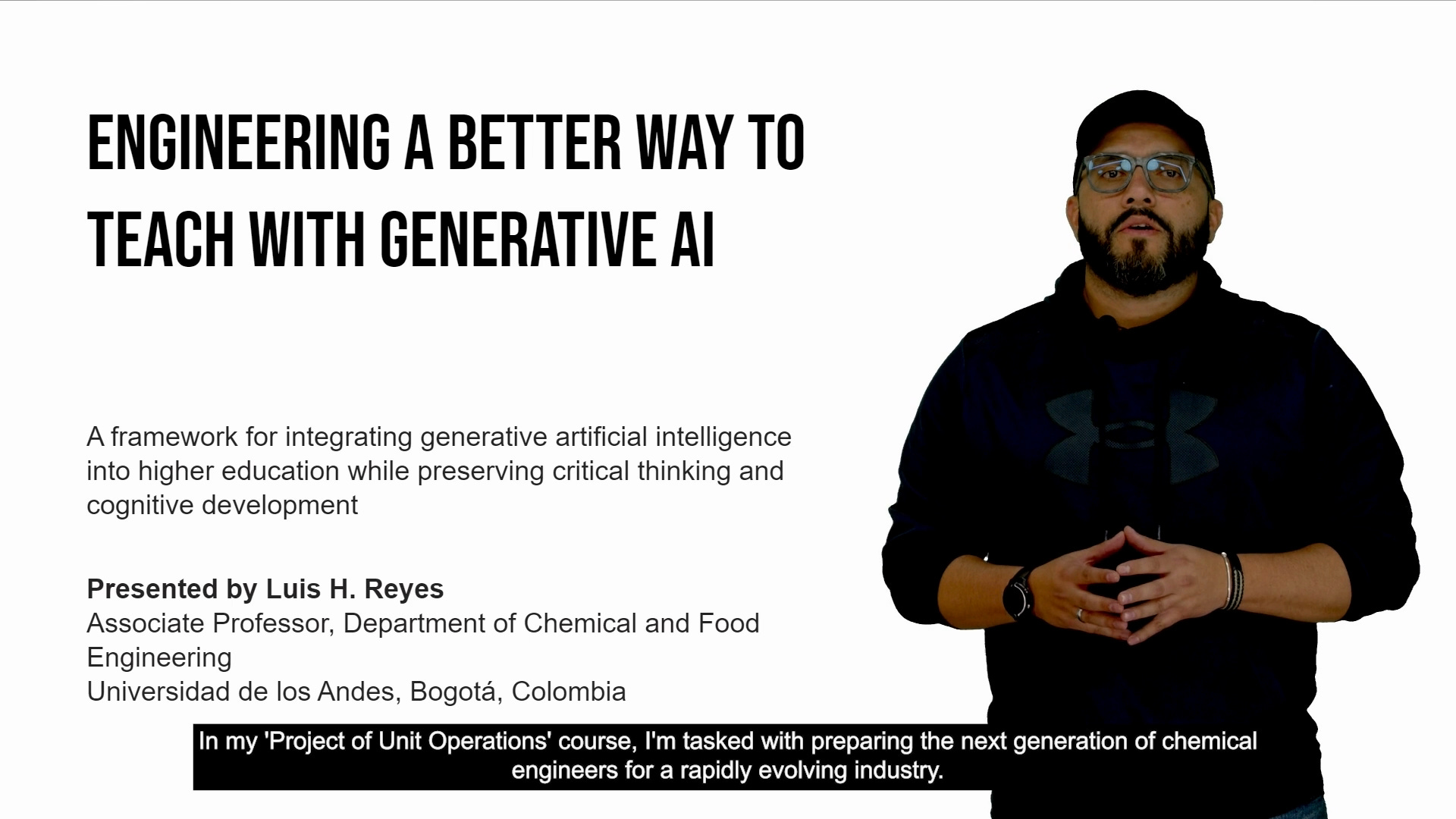
Luis H. Reyes demonstrates the CASF Assistant, which helps instructors turn course goals and student cognitive levels into guided AI-supported activities.
Q: Can you walk us through a concrete example from your own classroom?
Reyes: Certainly. One persistent challenge is helping students start a research project. Instead of simply assigning a literature review, I use CASF to design a guided activity. The assistant helps me set the right prompts and structure. For example, students use ChatGPT to brainstorm research questions, asking it to act as an expert professor and generate a set of strategic, increasingly complex questions about their chosen challenge—say, developing a unique sourdough starter from Colombian ingredients. The AI-generated questions provide a roadmap, but the key is that students and I review them together, revising and identifying core concepts.
For foundational questions, students might use ChatGPT to get quick answers. For more advanced or current topics, we turn to specialized AI tools like Consensus for peer-reviewed answers or Connected Papers to visualize the research landscape. This process not only builds digital literacy but also shows students how to use each tool’s strengths to construct a rigorous research foundation.
Q: What results have you seen from implementing CASF in your course?
Reyes: The impact has been remarkable. After redesigning my course activities with CASF, the quality of student research improved dramatically. The average number of references in their reports more than doubled, and the use of high-quality, high-impact sources nearly quadrupled. Students began employing real research methods, not just relying on surface-level information. We also saw major improvements in technical writing—scores for design clarity and justification jumped from around 65% to nearly 90%. These results show that when AI is integrated thoughtfully, guided by a pedagogical framework, it doesn’t just make students faster—it makes their work more rigorous and professional.
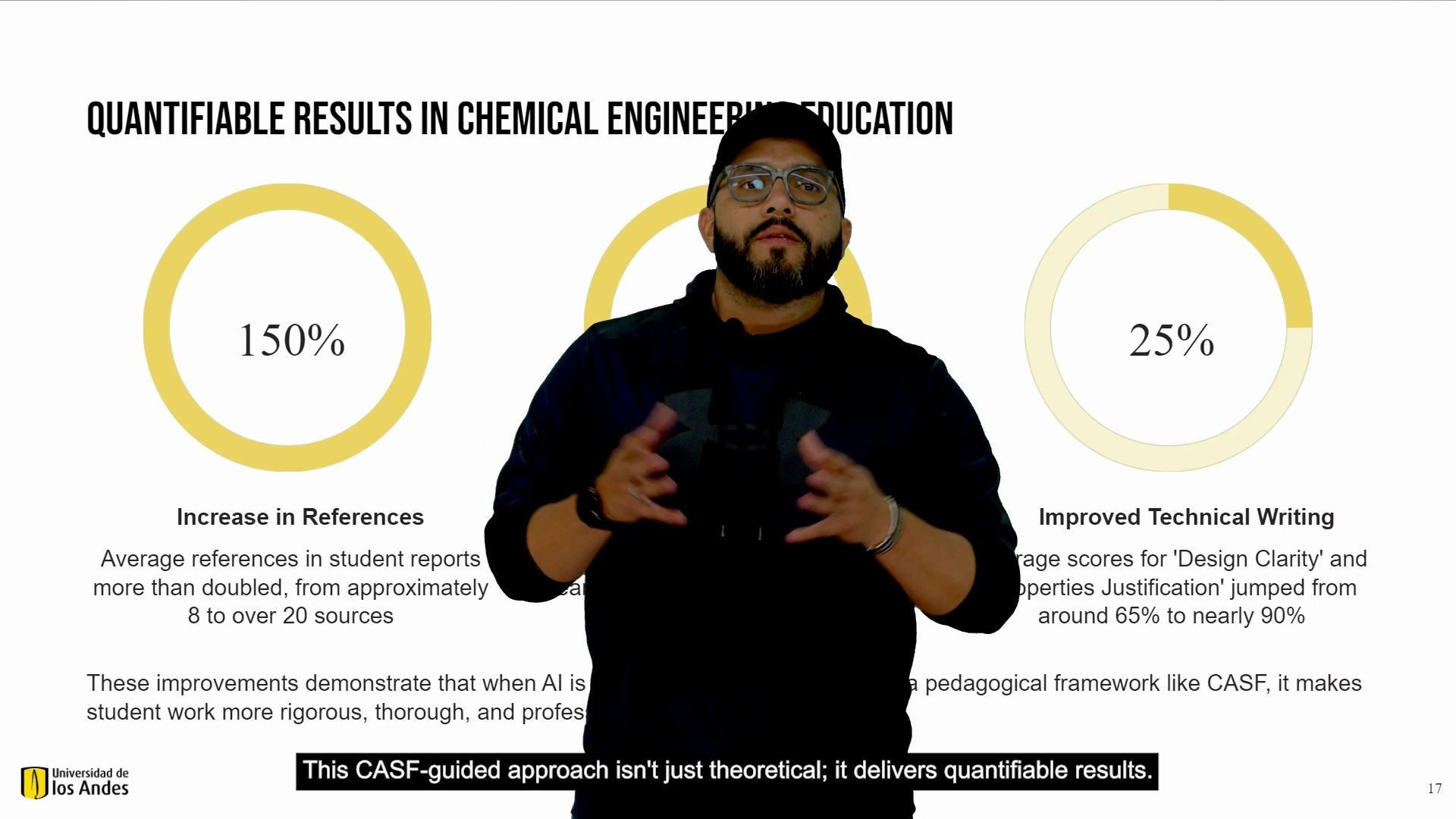
Luis H. Reyes summarizes quantifiable gains from CASF-guided activities, including more references in student reports and stronger technical writing.
Q: What’s the broader lesson for educators navigating AI in the classroom?
Reyes: The key is to shift from a technology-driven approach to a student-centered one. AI should be integrated in ways that match how students learn and develop. With a framework like CASF, we can ensure that our pedagogical principles—not just the latest tech—remain at the heart of education. That’s how we empower both educators and students to thrive in this new era.
What Stands Out
Core idea: The Cognitive-AI Synergy Framework (CASF) aligns AI integration with students’ cognitive development, ensuring that technology enhances rather than replaces deep learning.
Classroom design: CASF provides practical guidance for designing activities, including an AI-powered assistant that helps educators tailor assignments to students’ developmental stages and learning goals.
Student impact: After implementing CASF, students produced research with more—and higher-quality—sources, adopted authentic research methods, and significantly improved their technical writing.
Transferable lesson: A student-centered, pedagogically grounded approach to AI allows educators to confidently integrate new tools while maintaining academic rigor and fostering critical thinking.
Bio
Luis Reyes is an Associate Professor of Chemical and Food Engineering at Universidad de los Andes, specializing in biotechnology, nanotechnology, and generative AI integration in education. With over 80 scientific publications and leadership of the Product and Process Design Research Group, he advances research in biotechnology and nanotechnology while researching novel pedagogical implementations to improve student learning and engagement. He serves on the editorial board of Education for Chemical Engineers (Elsevier), contributing to the advancement of engineering education worldwide.
Published Work
Synergizing Minds and Machines: Harnessing Generative AI for Transformative Biotechnology Education
This article provides a brilliant and highly practical answer to the defining educational challenge of our time: how to integrate AI without sacrificing deep learning. By grounding technology in established cognitive development stages rather than letting the tech drive the pedagogy, the Cognitive-AI Synergy Framework (CASF) keeps genuine intellectual effort at the center of the classroom. Developing the CASF Implementation Assistant is a masterstroke, offering a highly scalable business and instructional model that empowers busy faculty who may not be tech experts.
The shift from using AI as a mere shortcut to using it as a "metacognitive collaborator"—guiding students to ask better research questions and visualize literature landscapes—is exactly how we preserve critical thinking. The quantifiable results speak for themselves; doubling reference counts and jumping technical writing scores from 65% to 90% proves that rigorous pedagogical design yields rigorous student output. This is the definitive blueprint for the future of higher education, showing that when we align human minds and machines thoughtfully, we don't lower the bar—we raise it.
A simpler framework may be more fundamental: seeing, thinking, and interpreting. Those are probably the key categories for understanding for both learning and creating with language models.
And by seeing, I mean something very basic: human learning begins with experience. Direct contact with reality is separate from, and fundamental to all later understanding.
There’s a deep connection here to American pragmatism, especially Charles Sanders Peirce and his view of meaning as an interpretive process rather than a fixed definition.