


“Student voice” can sound abstract until a learner has to speak in a seminar, write an official document, or defend a creative idea. In those moments, the barrier is often not a lack of ideas. It is the risk of expressing them before they feel ready.
Below we share the work and custom GPTs of three educators. Mudit Sharma, Nurullah Gungor, and Elettra Fiumi use AI as a private rehearsal space. Their designs give themselves and students structure and feedback while keeping the final act of expression—and the judgment behind it—human.
Mudit Sharma: Rehearsing the seminar before the room fills up

At the Harvard Graduate School of Education, Mudit Sharma wanted to prepare for inclusive seminar discussions. An instructor can design a engaging question and still discover that the conversation favors the quickest or most confident voices. Anticipating how different students might enter the discussion takes time, especially when a class includes varied experiences, language backgrounds, and levels of familiarity with the topic.
Sharma built a custom GPT that acts as a panel of simulated student voices. Each persona has a defined perspective, prior knowledge, participation style, and potential concern. Before class, Sharma tests a discussion prompt with the panel. One persona may misread a term, another may connect the issue to practice, and another may hesitate because the question assumes background knowledge. The responses are not predictions of actual students. They are prompts for the instructor to notice possible access points and barriers.
That distinction is important. The tool doesn’t caricature demographic groups or claim to represent a real student. Useful personas are grounded in learning conditions: a student new to the concept, a student with relevant work experience, a skeptical student, or a student who prefers time to formulate an answer. The instructor uses the range to improve the plan, not to label people in the room.
A practical workflow takes fifteen minutes. Enter the learning objective, the assigned material, and the main discussion question. Ask four personas to respond briefly, then ask the system to identify where the wording may exclude prior knowledge, where a follow-up would deepen reasoning, and which participation structure could widen access. Revise the question and prepare two entry points: a low-risk individual response and a deeper group prompt.
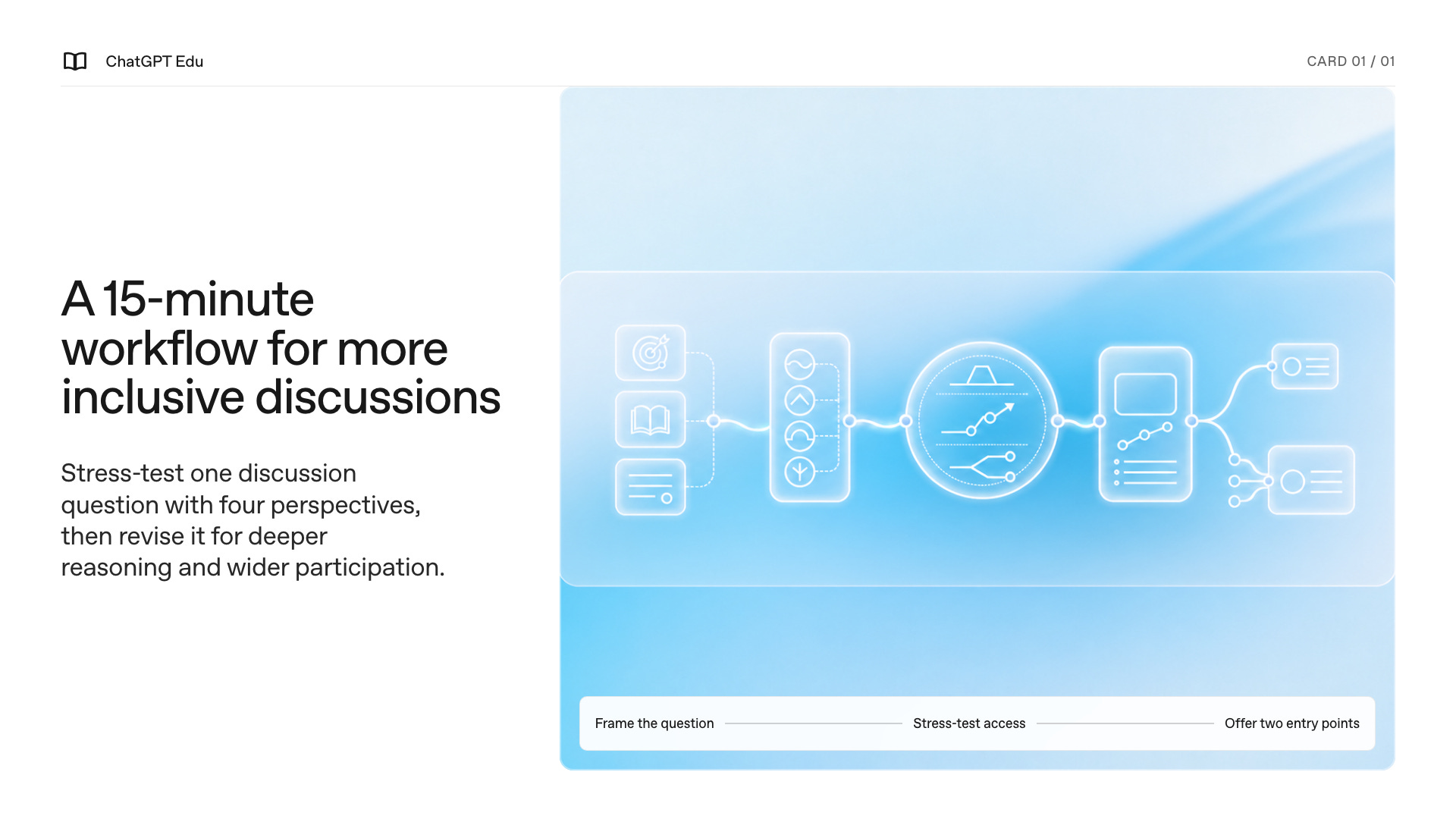
During class, the AI panel disappears. Students respond as themselves. The instructor can begin with a written minute, pair discussion, or anonymous poll before opening the full seminar. Sharma reports that this preparation can cut planning time roughly in half while helping quieter voices enter the conversation.
The value is not simulated diversity. It is better instructional anticipation. AI creates a fast rehearsal, and the teacher decides how to design the real room with more care.
Nurullah Gungor: Teaching official writing through guided revision

At Ankara Medipol University, Nurullah Gungor teaches a practical form of writing with little room for ambiguity: the official petition. Students must develop a request clearly while following institutional conventions, regulations, and templates. A generic chatbot can produce a polished-looking letter that uses the wrong form, omits required information, or invents a rule.
Gungor’s approach combines prompt training with an AI environment (a custom GPT) grounded in the relevant regulations and examples. Students don’t ask the system to “write my petition” and submit the result. They move through a cycle: identify the purpose and audience, draft, compare the draft with the requirements, revise, and make the final editorial decision.
The grounding material gives the feedback a stable reference. The custom GPT can ask whether the addressee is correct, whether the request is explicit, whether the supporting facts are ordered logically, and whether required elements appear in the expected form. Students then compare the suggestion with the source rather than treating the model’s confidence as proof.
Every week, students prepare a petition with ChatGPT. For example, they might be asked to write a petition to a district governorship about opening a library. Gungor provides them with more than ten prompt examples to use after they have written a draft, such as, “Revise the petition I provide according to the official correspondence regulation. Simplify the language, shorten sentences, but keep the legal meaning, show missing parts, and give suggestions.” In class, we discuss both the student’s and ChatGPT’s versions, making the learning interactive and practical.
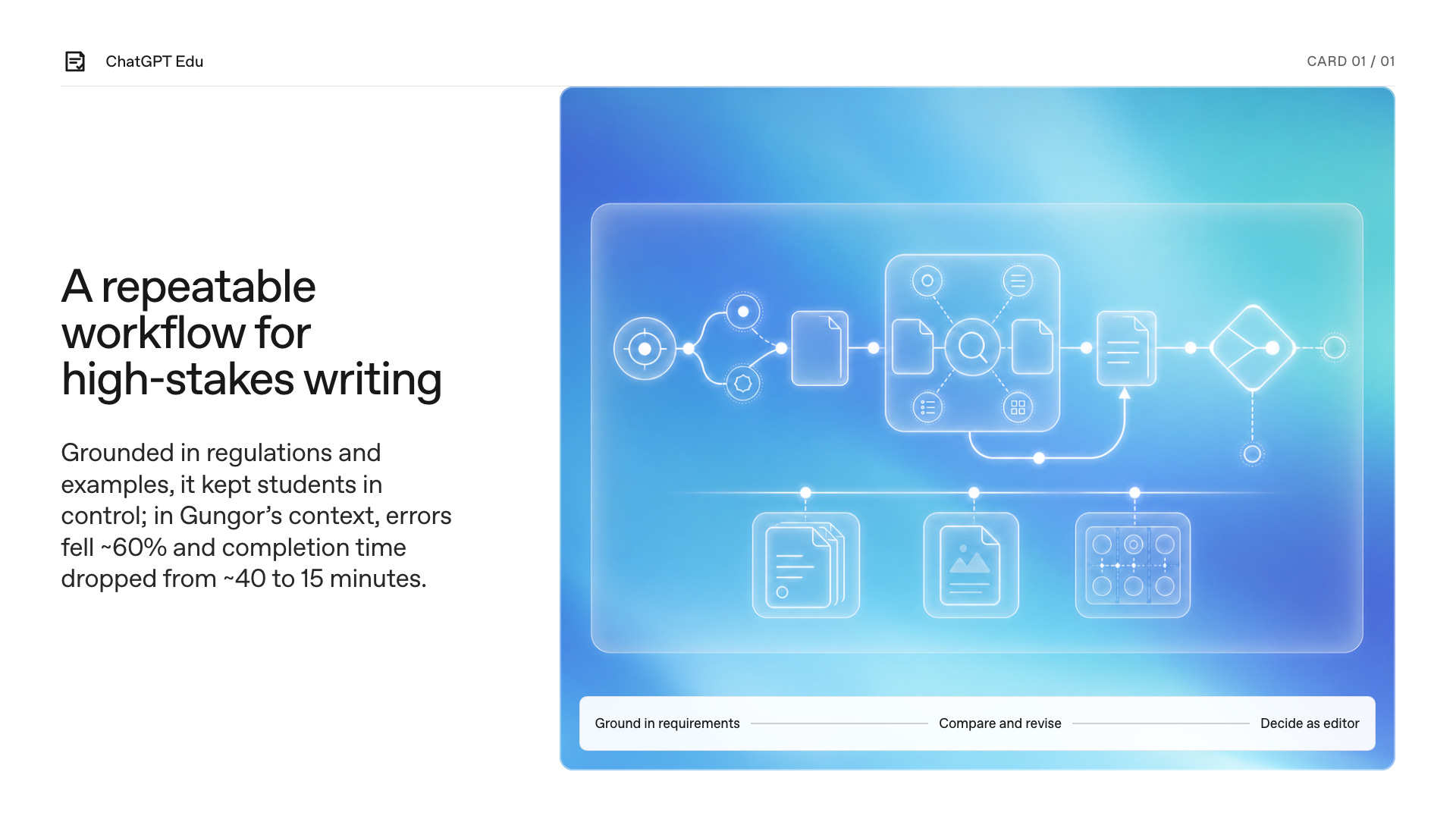
Gungor reports meaningful practical gains: errors fell by about 60 percent, and average completion time dropped from roughly 40 minutes to 15. Those figures should be presented as results from his context, not a universal promise. The more sustained outcome is that students learn a repeatable process for high-stakes institutional writing.
Keep the guardrails plain. Use public or instructor-created scenarios, not a student’s sensitive personal case. Do not let the AI invent policy. Require a final human check against the official source. With those boundaries, the tool becomes a revision coach that helps students express a real request accurately and efficiently.
Elettra Fiumi: Giving creative work room to grow

Elettra Fiumi works across AI cinema and creative education at institutions including Locarno, NABA, Franklin University Switzerland, and LAC. Creative students often face a different expression problem: an early idea may be too fragile to present, while a general-purpose chatbot may flatten it into familiar language. The challenge is to support experimentation without substituting the model’s taste for the student’s.
Fiumi creates module-specific custom GPTs for different stages of filmmaking, including script development, storyboarding, and editing. Each tool has a bounded craft role. A script assistant may question character motivation or scene purpose. A storyboard assistant may help translate an emotional beat into visual options. An editing assistant may ask what rhythm or point of view the cut should preserve. The student remains the director.
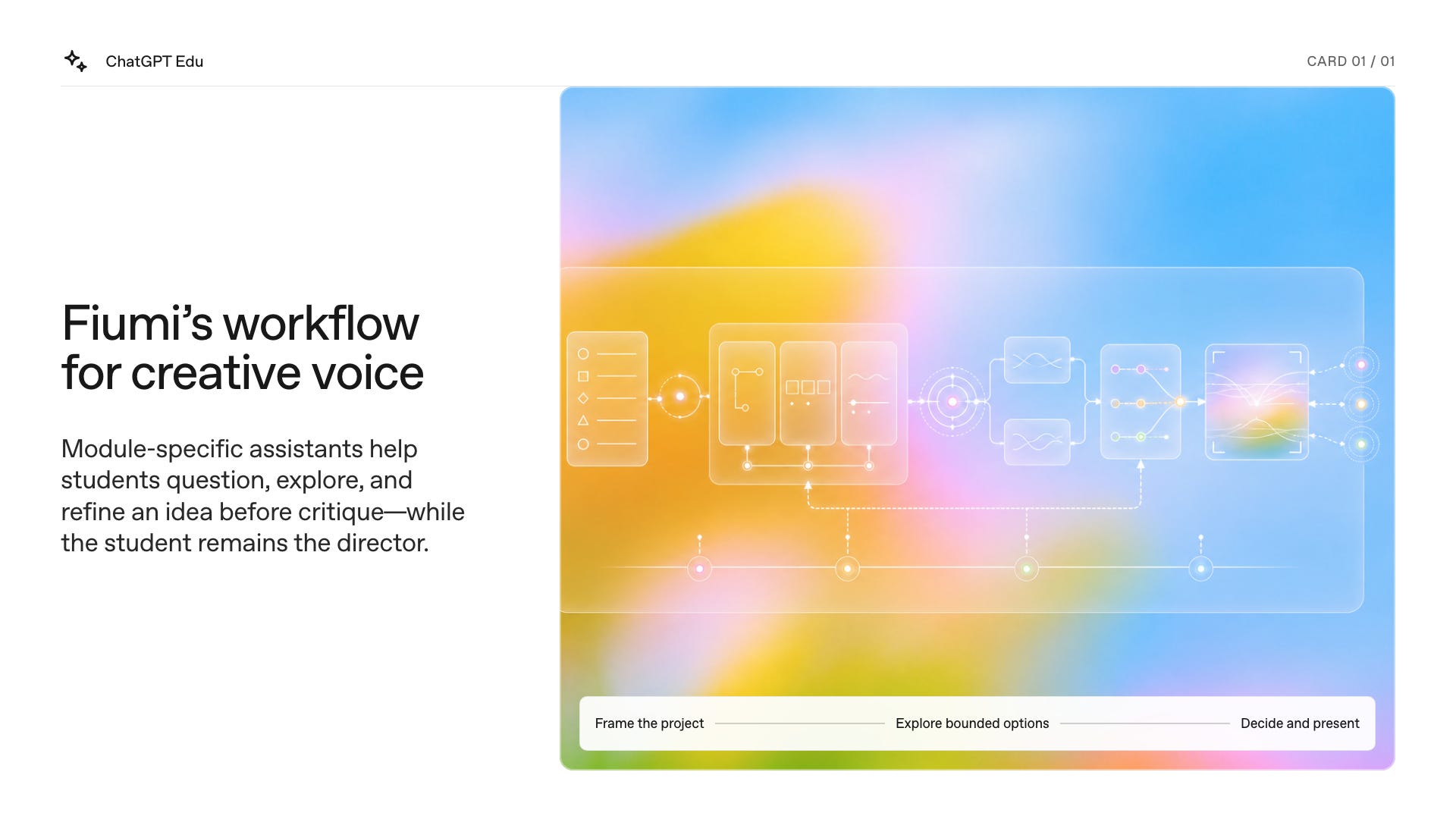
Students also build their own assistants around a project. That creates continuity across modules: the system can retain the project’s premise, aesthetic constraints, vocabulary, and unresolved questions.
Building the assistant is itself a design exercise. Students must decide what context is useful, what the tool may suggest, and where it should stop.
A practical pilot can begin with one stage of the creative process. Ask students to write a one-page project brief containing intent, audience, references, constraints, and three choices that define the work. Give the custom GPT a critic’s role: ask questions, offer two contrasting options, and never produce a final scene or shot list unless the student requests a limited example. Require students to keep a decision log showing which suggestions they accepted, rejected, or transformed.
The private interaction can matter for confidence. Fiumi describes a hesitant student using AI to work through ideas before presenting them. The tool did not supply the voice; it gave the student enough rehearsal to bring that voice into the room. Faculty critique and peer response then operate on a more developed idea.
Summary
Sharma, Gungor, and Fiumi use AI at three different thresholds: before speaking, while revising, and during creative exploration. The practical pattern is consistent. Give the student a private first attempt, provide structured feedback, and create a clear handoff to a real audience. The technology should make expression more possible—not make the expression less theirs.
Learn more.

Writing with AI becomes useful when human nuances are added. This means understanding deeper its utility, and this goes beyond prompts.
See the new business category around it, AI Coherence Calibration.
I’ve started treating ideas less like finished thoughts and more like evidence of where my attention keeps returning.
Especially with QUASAR EDU, a random idea might look tiny when it first appears, but once I write it down and come back to it, it can turn into a product decision, a framework, or a completely different way of seeing the problem.
So yes — losing an idea can be expensive. Not because every idea is valuable, but because you usually don’t know which one was until you gave it enough space to develop.