

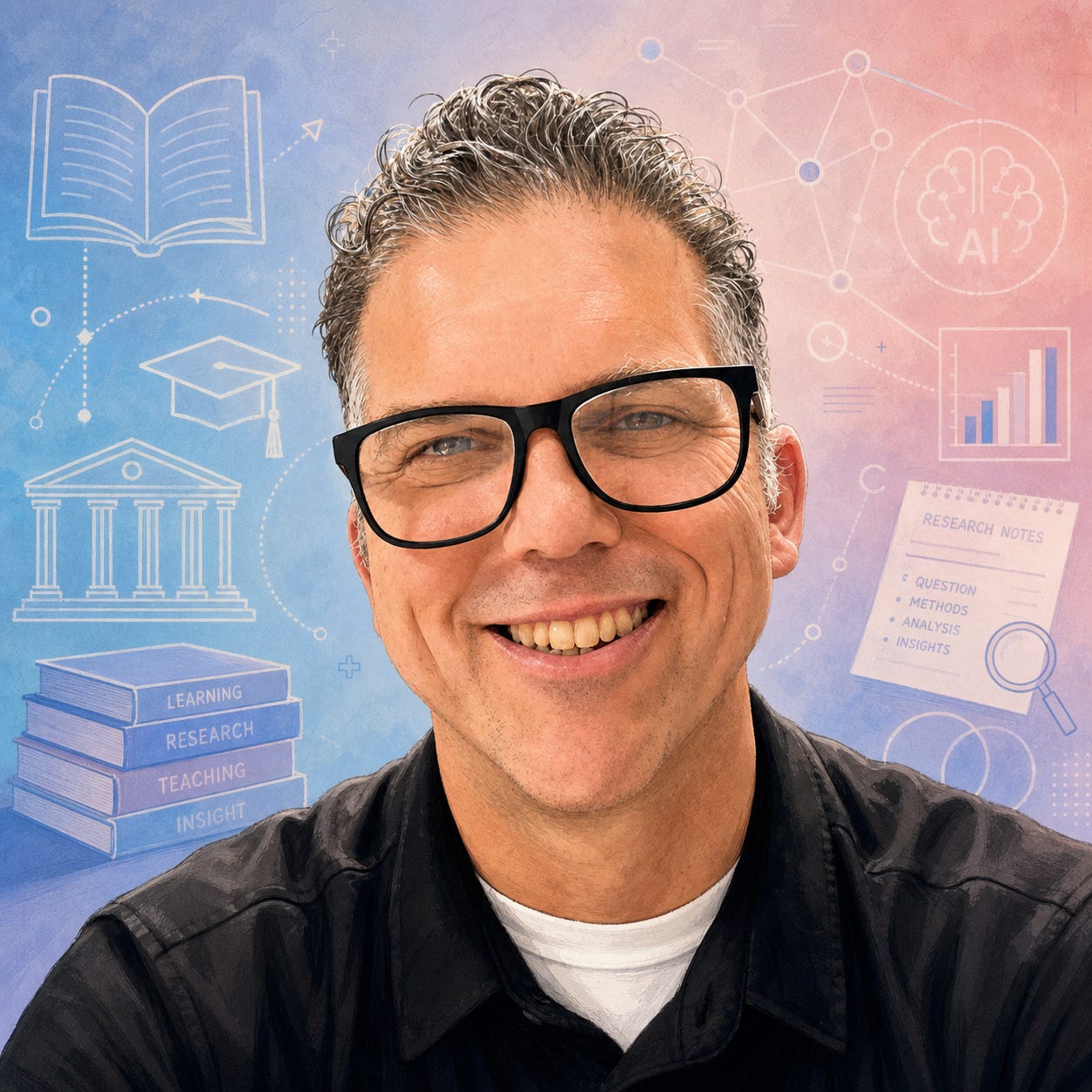
Dr. Robert Voss is an Associate Professor of History and Social Science Education Coordinator at Northwest Missouri State University, where he integrates artificial intelligence into teaching, research, grant writing, and faculty development. In this interview, Voss discusses how AI is being used in U.S. History since 1877, Digital Humanities, and educator professional development.
Source note: This is an edited interview adapted from a narrated video submitted to OpenAI. Watch the associated video in OpenAI Academy.
Intro
Dr. Robert Voss’s journey from early adopter of classroom tech to pioneering AI-first pedagogy is a story of curiosity, adaptation, and a deep commitment to student and faculty empowerment. At Northwest Missouri State University, a medium-sized, rural public institution, he’s not only reimagined how history is taught, but also how AI can democratize high-level research, planning, and professional development.
In this interview, Dr. Voss shares how AI became his teaching superpower, the practical ways it’s reshaping his courses, and why the humanities are essential to the future of AI in education. He also explains how custom GPTs have helped him support faculty compensation work, accelerate a major federal grant application, and train more than 500 educators across K-12 and higher education.
The Interview
Q: Dr. Voss, your background shows a long-standing passion for integrating technology into teaching. How did your early experiences shape your current approach to AI in the classroom?
Voss: Technology has always been more than a tool for me. It’s been a way to expand what’s possible. I remember the screech of a 2800 baud modem as the sound of opportunity, not just noise. As a high school teacher in the late ‘90s, I was building websites with second graders and experimenting with PalmPilots before smartphones existed.
That mindset, seeing technology as a means to empower students, laid the groundwork for how I approach AI now. When I first tried ChatGPT in 2022 and saw it generate a lesson plan for second graders on the first prompt, I realized AI wasn’t just another tool. It was a superpower that could fundamentally change how we teach and learn.
Q: You’ve described shifting from “technology-first” to “AI-first.” What does that look like in practice, especially for you and your students?
Voss: For me, AI isn’t just an add-on; it’s woven into everything I do. I have ADHD, and AI helps me organize my thinking. Conversations are saved, threads can be revisited, and ideas don’t get lost. That’s transformative for me and for neurodivergent students.
In class, I treat AI as a collaborator. I build custom GPTs to serve as research assistants, guiding students through primary source analysis, helping them locate archives, or even simulating interviews with historical figures. Assignments might involve translating handwritten Civil War letters or Swedish immigration records, then interpreting them in students’ own words.
The question I always ask is: What can AI do here that frees us to focus on higher-order thinking?
Q: Can you share some concrete examples of how AI changes the classroom experience for history students?
Voss: Absolutely. Take primary source analysis. AI can quickly summarize a dense academic article, so instead of spending class time just processing information, we can debate its implications. Or AI can generate a rough historical timeline, and students then verify details and interpret context.
In my digital humanities courses, students don’t just use AI. They learn to judge its accuracy, spot gaps, and recognize bias. In survey courses, they create comparative timelines, explore historical scenarios, and generate discussion prompts from complex readings. Even in our applied AI minor, AI is foundational from day one.
Custom AI workflows enable students to analyze sources, build timelines, and simulate historical debates in Dr. Voss’s courses.
Q: Many people don’t associate AI with the humanities. How do you see AI’s role in fields like history?
Voss: That’s a common misconception. People think AI is just for coding or data science, but digital history has always been about connecting traditional research with technology. AI supercharges that connection.
As historians, we’re already comparing perspectives, analyzing patterns, and building interpretations. AI just accelerates those steps. But it still requires human expertise to decide what’s accurate and meaningful. AI lets us do what we could already do, only faster and at a scale that was previously impossible for a small university like ours.
Q: What’s been the impact on your students and your institution, especially given your rural, resource-limited context?
Voss: The impact has been huge. We don’t have graduate assistants or fancy labs, but AI allows our undergraduates to do work that used to require a research team at a major institution. They’re running AI-assisted searches across digitized archives, translating sources, generating maps and timelines, and simulating debates.
Engagement is up because the work feels real and relevant. Class discussions are deeper, and everyone comes prepared with meaningful contributions.
And it’s not just students. Faculty across disciplines are adopting AI, from biology to art. I’ve led workshops, collaborated on state standards, and helped train more than 500 educators in AI across K-12 and higher education. Professional development is essential for educators, especially in a world where AI is changing so quickly.
AI has also helped me work on major institutional priorities. I used ChatGPT in a custom GPT to help negotiate a new compensation package, the first one our university had seen in over 20 years. It was absolutely successful for the faculty.
I also used a custom GPT in November and December of last year to create an application for a federal grant requesting $2.61 million for Rural AI and K-12 education. What would normally have taken multiple months and a large team took five days to author, coordinate, and submit, including the signatories. While the FISPE grant system has since been shelved, ChatGPT opened many new opportunities.
For us, AI isn’t just an upgrade. It’s a game-changer.
AI-powered projects have enabled students at Northwest Missouri State University to create interactive digital exhibits, conduct advanced research, and support larger institutional initiatives.
Q: Looking ahead, what’s your vision for AI literacy at your university and beyond?
Voss: My goal is to make AI literacy as fundamental as internet literacy. I want every graduate, in every major, to use AI effectively and responsibly. And I want faculty to feel confident integrating it into their teaching, research, professional development, and administrative work.
Because of my work using AI in education, I’ve been approached to help others with AI adoption. That need is only growing. AI has made my classes more engaging, my students more capable, and my own thinking sharper. If we can achieve this kind of transformation in a small town in Missouri, it can happen anywhere.
What Stands Out
Core idea: Dr. Voss’s shift from technology-first to AI-first teaching is rooted in the belief that AI can empower students, faculty, and institutions to achieve more with less.
Classroom design: By treating AI as a collaborator, building custom GPTs, designing AI-powered assignments, and integrating critical evaluation, Voss creates classrooms where students engage deeply with history.
Institutional impact: Voss has used custom GPTs beyond the classroom, including faculty compensation work and a $2.61 million Rural AI and K-12 education grant application.
Educator training: His AI adoption work now extends across K-12 and higher education, with more than 500 educators trained in AI.
Student impact: Students gain hands-on experience with advanced research methods, from AI-assisted primary source analysis to creating interactive exhibits, leading to higher engagement and more meaningful discussions.
Transferable lesson: The success at Northwest Missouri State University demonstrates that AI can democratize access to top-tier educational experiences and institutional capacity, no matter an institution’s size or budget.
Bio
Dr. Robert Voss is an Associate Professor of History and Social Science Education Coordinator at Northwest Missouri State University, where he integrates artificial intelligence into teaching, research, grant writing, faculty development, and educator training. A former high school social studies teacher, he has been an early adopter of educational technology for over two decades, from building websites with second graders in 1998 to leading AI adoption work across K-12 and higher education. He has helped train more than 500 educators in AI and has used custom GPTs to support faculty compensation work and major grant development. His work focuses on making AI literacy accessible across disciplines, empowering students, faculty, and institutions to achieve big results with limited resources.
Great to see history and AI coming together. I am starting to see historians using the AI historical baseline and then using local archival DAG data to force more out of the LLM’s. Is that part of your curriculum?