

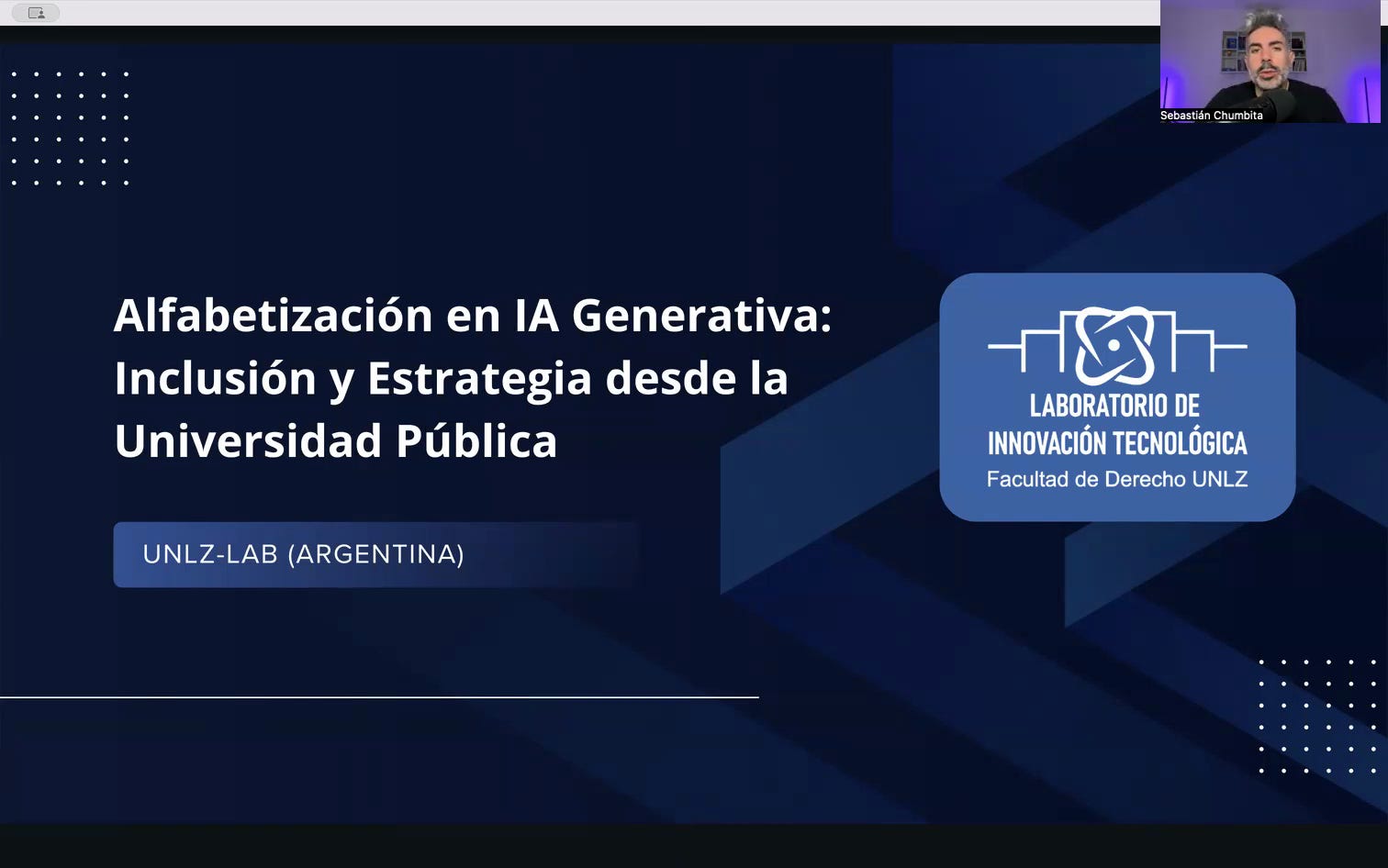
Sebastián C. Chumbita teaches Alfabetización en IA Generativa: Inclusión y Estrategia desde la Universidad Pública at Laboratorio de Innovación Tecnológica de la Facultad de Derecho de la Universidad Nacional de Lomas de Zamora (UNLZ-LAB). In this interview, Chumbita discusses how AI is being used in Alfabetización en IA Generativa: Inclusión y Estrategia desde la Universidad Pública.
Source note: This is an edited interview adapted from a narrated video submitted to OpenAI.
Intro
In Argentina’s largest province, the National University of Lomas de Zamora (UNLZ) is home to a unique innovation lab at the heart of its Faculty of Law. Sebastián C. Chumbita, director of the UNLZ-LAB, has spearheaded a comprehensive program to bring generative AI literacy to both faculty and students—bridging digital divides and reimagining what inclusion can mean in a public university context. In this interview, Chumbita shares the lab’s story, the theory behind their approach, and the impact of their work.
The Interview
Q: Sebastián, can you set the scene for us? What makes your context at UNLZ-LAB unique, and why did you focus on AI literacy?
Sebastián C. Chumbita: Our lab is the first of its kind in a law faculty in Buenos Aires province, which is the largest in Argentina. We’re multidisciplinary by design: jurists, technologists, and experts from other fields work together. The diversity of our student body is remarkable—many face significant technological barriers or limited access to information. This reality pushed us to act. We saw that without targeted intervention, the digital divide would only grow, so we made AI literacy, with a focus on generative AI, a strategic priority for inclusion and educational quality.
Q: What was your initial approach to tackling these challenges?
Chumbita: We started by mapping the needs of both faculty and students. This diagnostic phase was crucial. From there, we designed a robust literacy plan that balanced theory and practice. One of our key innovations was integrating GPT agents into the process. These agents were tailored to our context, with knowledge windows and content supervision to ensure relevance and quality. Human oversight was essential—AI is a tool, not a replacement for critical thinking or creativity.
Q: Can you give us a concrete example of how these GPT agents were used in practice?
Chumbita: Absolutely. One of our most successful cases was an agent designed to help users understand how generative AI works and how to integrate it into their tasks. For students, this meant learning how to craft effective prompts, use AI responsibly, and even build their own agents for specific subjects. The agent would guide them, but always with an emphasis on human validation, research, and critical judgment. We also set up safeguards—if someone tried to delegate their work entirely to the AI, the agent would not allow it. This maintained academic integrity while empowering users.
Q: What outcomes have you observed so far? Has this changed how your community works?
Chumbita: The impact has been significant. Faculty and students have adopted generative AI in a strategic, responsible way. It’s saved time, improved the quality of work, and even prompted us to rethink our evaluation methods. Most importantly, it’s democratized access to information and fostered greater educational inclusion. Now, our entire community has tools to evaluate, create, and validate content consciously and responsibly.
Q: What do you see as the broader lesson from your experience? Could this approach work elsewhere?
Chumbita: Definitely. The core of our experience is universal: in any human activity, there are tasks involving information search, content generation, and validation. Our model—combining tailored AI tools, human oversight, and a focus on inclusion—can be adapted to many contexts. The key is to empower people, not just with technology, but with the critical skills to use it wisely.
What Stands Out
Core idea: UNLZ-LAB’s program demonstrates that AI literacy can be a lever for both educational quality and social inclusion, especially in diverse and resource-constrained environments.
Classroom design: By combining faculty training, student workshops, and custom GPT agents—always with human oversight—the lab created a balanced, practical pathway for responsible AI adoption.
Student impact: Students and teachers gained not just technical skills, but also new ways to approach critical thinking, research, and creativity—democratizing access to powerful tools and information.
Transferable lesson: Any institution can adapt this model: start with a clear needs assessment, design for your context, and ensure that AI tools amplify—not replace—human judgment and inclusion.
Bio
Sebastián C. Chumbita is Director of the Laboratorio de Innovación Tecnológica at the Faculty of Law, UNLZ. He holds master’s degrees in Legaltech and Digital Management (University of Salamanca) and Artificial Intelligence (CEUPE). Chumbita teaches postgraduate courses in Argentina and abroad, writes on innovation and AI, and is a frequent speaker and columnist. Instagram: @scchumbita
Great and bravo to the entire team