

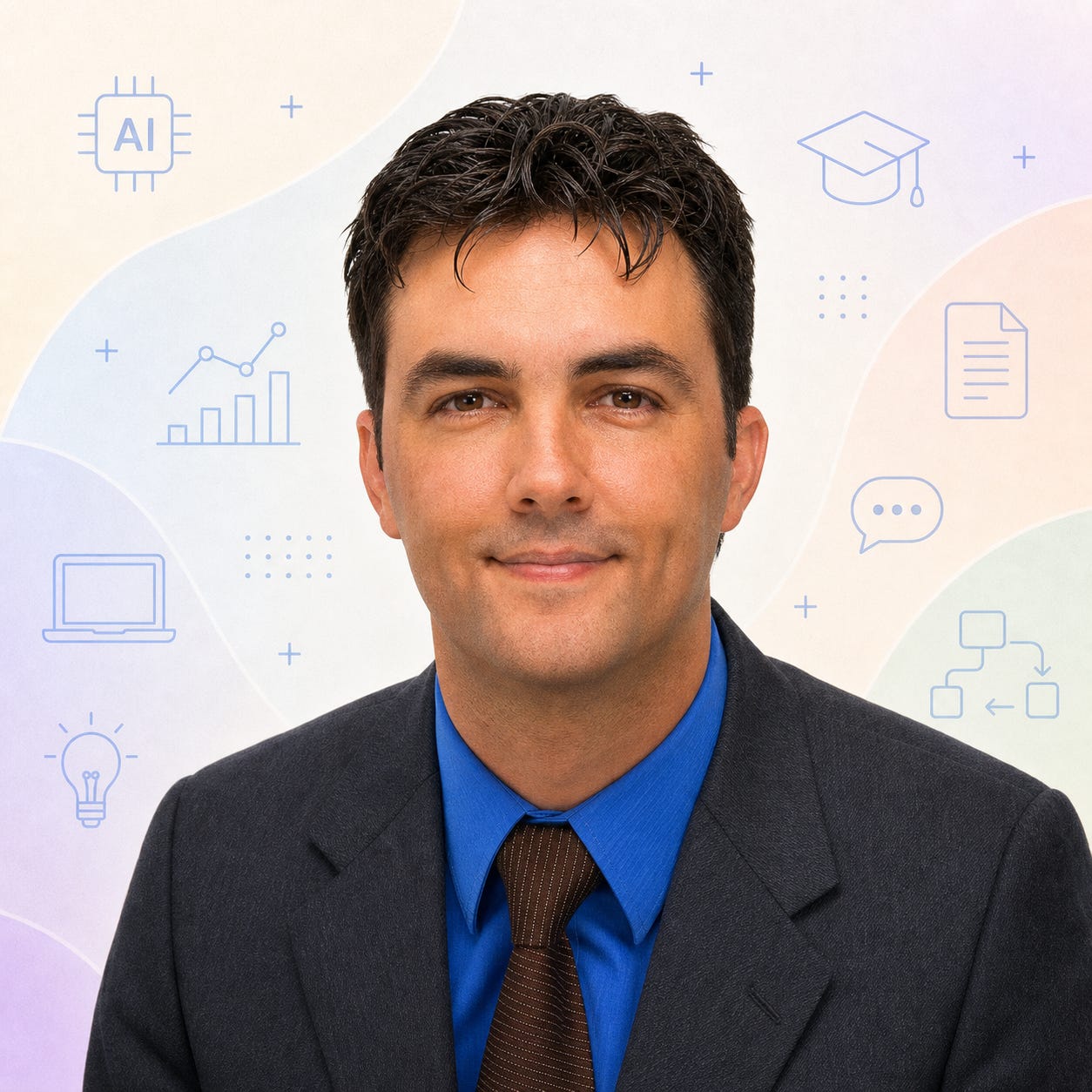
Dr. Michael Atkinson, educator and consultant, shares how he used GPT to transform his Management Communication course at BYU.
Source note: This is an edited interview adapted from a narrated video submitted to OpenAI. Watch the associated video in OpenAI Academy.
Intro
When Dr. Michael Atkinson took over a Management Communication course at Brigham Young University mid-semester, he faced a challenge familiar to many educators: disengaged students and a classroom that felt unusually quiet. Drawing on his expertise in instructional psychology and technology, Dr. Atkinson turned to an unconventional collaborator—ChatGPT—not just as a tool, but as a tutor and thought partner. What followed was a series of experiments that led to a remarkable turnaround in student connection, engagement, and learning outcomes. In this interview, Dr. Atkinson shares the story behind his approach, the theory and practice that guided it, and the impact he observed.
The Interview
Q: You walked into a class mid-semester and immediately sensed something was off. Can you describe that moment and what you noticed?
Atkinson: Absolutely. I love teaching, and I usually feel a strong connection with my students. But this time, the classroom was unusually quiet—almost like I was talking into a void. Even after introducing myself via video, the analytics showed only two students had watched. The instructional design was solid, but engagement was missing, and with midterms looming, I didn’t have time for a deep diagnostic.
Q: How did you decide to bring a custom GPT into the process, and what was your mindset?
Atkinson: I did what I encourage my students to do: I treated ChatGPT not just as a tool, but as a tutor and a thought partner. I laid out the problem as I would to a trusted colleague, even uploading the syllabus and describing the class dynamics. The key was to approach the conversation with ChatGPT as a dialogue, not just a search for quick answers.
Q: What did that back-and-forth with ChatGPT look like? What did you learn from it?
Atkinson: It was surprisingly rich. ChatGPT didn’t just give me static information—it asked me questions, pushed me to clarify, and brought in relevant research about discussion boards and student engagement. Some of my best ideas came from this iterative exchange. For example, ChatGPT helped me realize that the core issue was a lack of connection—between students and with me.
Q: Can you share a concrete example of how you used a custom GPT to personalize learning for your students?
Atkinson: One of the most impactful changes was introducing weekly check-ins where students identified a communication skill they wanted to improve. I’d paste their responses into a custom GPT I’d designed, which would generate a set of tailored “rules” or strategies for that student. For instance, a student wanting to work on listening skills would get specific, actionable advice—sometimes even contextualized to their major, like audiology. I’d review and personalize these further, adding my own voice and stories, and then send them back. It was individualized learning at scale.
Q: Why do you think this approach worked so well? What’s the theory behind it?
Atkinson: Personalization is powerful. When students feel seen and receive feedback that’s uniquely relevant to them, their motivation and engagement increase dramatically. Theoretically, it’s about moving from transactional to relational learning. GPT enabled me to do this at a level I couldn’t achieve alone—even as an expert in online learning. The AI acted as both a tutor, surfacing research and best practices, and a thought partner, helping me iterate and refine ideas.
Q: What was the impact on your students—and on you as an instructor?
Atkinson: The results were remarkable. My end-of-semester surveys showed a 12-20% increase in positive feedback compared to previous terms. More importantly, students reported real growth. They referenced specific “rules” they’d practiced and described tangible improvements in their communication. For me, it was deeply rewarding to see students so engaged and to witness their progress week after week.
Q: What advice would you give to other educators considering AI in their teaching?
Atkinson: Don’t limit yourself to seeing AI as just a tool. Treat it as a tutor and a thought partner. Imagine what’s possible if you approach it like a conversation with a human collaborator. Every subject and context is different, but with a bit of creativity, you can use AI to personalize learning and foster deeper engagement. We’re only limited by our imagination.
What Stands Out
Core idea: Dr. Atkinson transformed student engagement by treating ChatGPT as a tutor and thought partner rather than just a tool.
Classroom design: He used a custom GPT to generate personalized communication strategies for each student based on their individual goals.
Student impact: Students reported increased motivation, engagement, and tangible improvements in their communication skills.
Transferable lesson: Approaching AI as a collaborative dialogue enables educators to personalize learning and foster deeper connections at scale.
Bio
Michael Atkinson Dr. Michael Atkinson is an educator, advisor, and consultant focused on leadership development, learning design, and AI training. He is adjunct professor in the Marriott School of Business at Brigham Young University.