
Introducing ChatGPT Futures: Class of 2026
The next generation of AI leaders
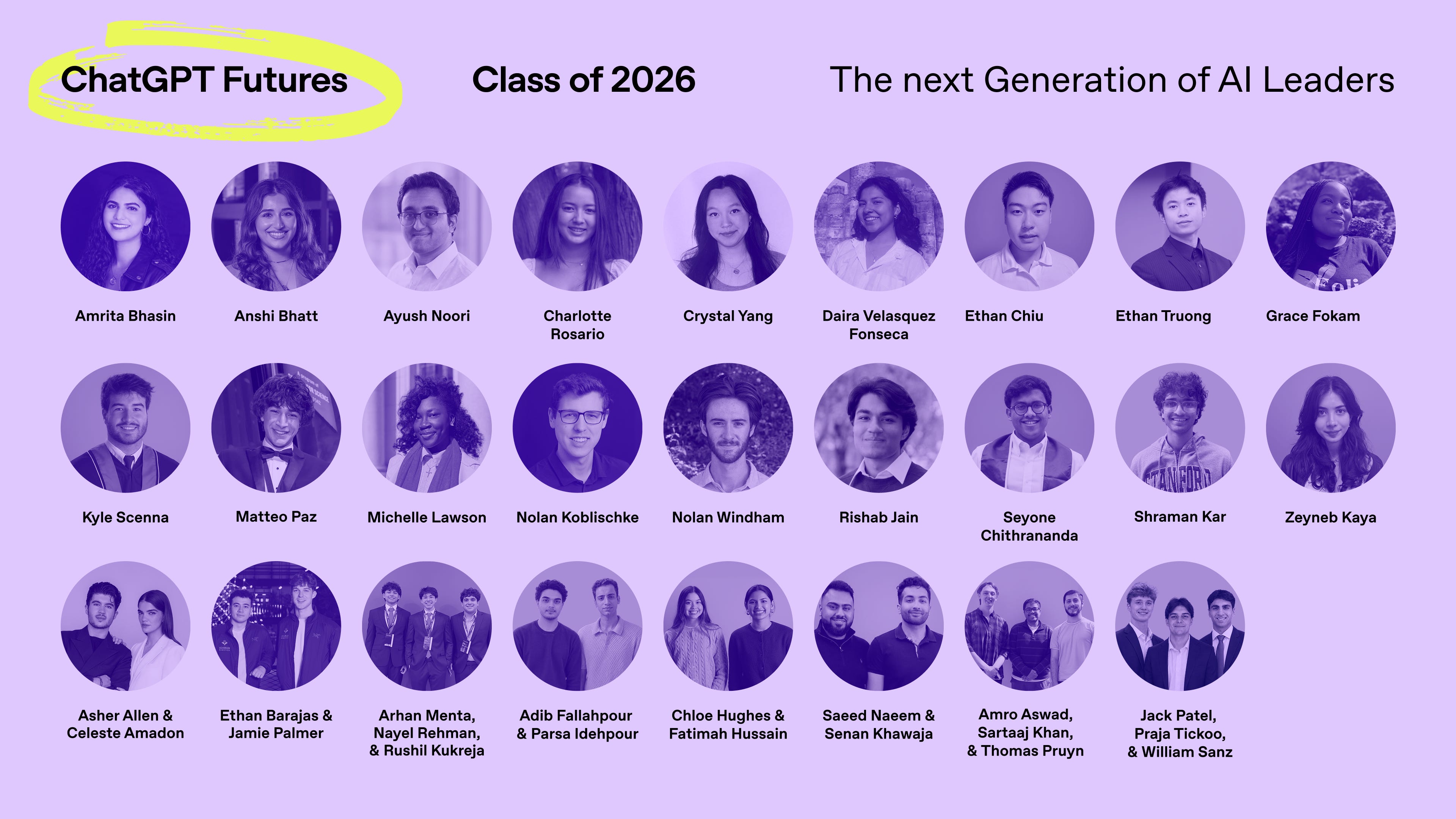
Today, we’re proud to introduce the inaugural ChatGPT Futures: Class of 2026, recognizing 26 students and young builders using AI in thoughtful, ambitious, and deeply human ways. Here’s a letter from OpenAI’s VP and GM of Education, Leah Belsky, about the driving force behind the project.
The class of 2026 is the first generation to start and finish college with ChatGPT.
They arrived on campus in the fall of 2022 just as AI was beginning to reshape how people learn, create, and work. This generation was ChatGPT’s earliest adopters, sharing the tool with their parents and siblings, friends and teachers. Now, they’re graduating into a world where changes in technology are accelerating every day.
Over the past few years, I’ve spent time visiting campuses, speaking with students and educators, and watching how young people are actually using AI in their daily lives. What I’ve seen has challenged many of the assumptions people make about this generation.
Many students aren’t using AI to avoid work. They’re using it to attempt things they wouldn’t have thought possible before.
I’ve met students who are building study tools for classmates. Translating mental health resources for underserved communities. Advancing scientific research. Designing accessibility tools for peers with disabilities. Turning side projects into real organizations with real impact.
Again and again, I’ve met students who discovered something surprisingly powerful: they don’t have to wait. As Kyle Scenna, a 24 year-old ChatGPT Futures honoree and entrepreneur from the University of Waterloo told us: “I never thought the gap between noticing a problem and building something real could get this small.” He’s not alone in this feeling.
This generation doesn’t have to wait to become experts before getting started.
They don’t have to wait for funding before building.
They don’t have to wait for permission before contributing.
That realization—that you can turn an idea into something tangible faster than ever before—is what inspired ChatGPT Futures.
These honorees represent over 20 universities and institutions including MIT, Stanford, Harvard, Oxford, Georgia Tech, UC Berkeley, Yale, Waterloo, Vanderbilt, the University of Toronto, the University of Illinois Urbana-Champaign, and many others.
Some are researchers pushing the frontier of science and discovery. Others are founders building products and organizations from the ground up. Still others are using AI to expand access, strengthen communities, and help people navigate real-world challenges.
What connects them is not a specific discipline or background. It’s a mindset. They saw new tools emerge, got curious, and decided to build. That may become the defining and critical characteristic of this generation.
There are understandable questions about what AI might mean for learning, creativity, and jobs. I work on those questions every day with partners throughout the education ecosystem. But the students I’ve met have also given me a tangible view of what AI can unlock right now. It’s agency.
AI doesn’t replace ambition. It amplifies it.
For decades, the ability to build something—whether a product, a research project, a movement, or a company—often depended on access. Access to technical training, institutional support, networks, or funding. Those barriers haven’t disappeared, but they are beginning to shift. Michelle Lawson, a 20-year-old student at Smith College and a ChatGPT Futures honoree shared with us, “I’ve always believed that you can achieve everything that you can imagine, as long as you’re given the right support and resources. AI has made that happen not only for myself, but for hundreds of thousands of people.”
Today, a student with curiosity and determination can prototype an idea faster, learn new skills independently, and contribute meaningfully in ways that once required far more resources.
That doesn’t make human judgment, creativity, or hard work less important. If anything, it makes them more so.
Because the students who will thrive in this next chapter won’t simply be the ones who know how AI works. They’ll be the ones who know how to use it thoughtfully: to learn continuously, identify meaningful problems, collaborate effectively, and create things that matter to other people.
Education has a critical role to play in unlocking this sense of agency for all students. The goal is not simply to teach students how AI works or how to prompt effectively. Schools and universities must create space for students to build and create with AI, guided by teachers.
The goal should not just be AI literacy. We need to help students become adaptable thinkers and builders—people who can navigate ambiguity, pursue ideas with curiosity, and turn learning into action.
At OpenAI, we believe students should help shape the future of AI, not simply inherit it. To date, we’ve supported this transformation with tools and resources to support educators and students including ChatGPTEdu, 100 chats for Students, Study Mode, and partnerships with organizations like the American Federation for Teachers. ChatGPT Futures is one more way we plan to celebrate the young people already doing exactly that.
Each member of the inaugural class will receive a $10,000 grant to continue advancing their work, and honorees and honorable mentions will receive access to our frontier models.
But more than anything, we hope this program shines a light on a broader truth: The future of AI will not be defined only by the capabilities of the technology itself.
It will be defined by the people who choose to use it with curiosity, responsibility, creativity, and purpose. “The exciting thing is this is just the beginning,” Nolan Windham, a 23-year-old Head of AI at a prominent hedge fund and ChatGPT Futures honoree told me. “Many young people will recognize their place as teachers for a society looking to learn to use the technology of the future.”
Congratulations to the inaugural ChatGPT Futures Class of 2026. We can’t wait to see the future you’ll build.
This announcement is incredibly inspiring, especially seeing "designing accessibility tools for peers with disabilities" highlighted among the transformative work the Class of 2026 is doing. As a graduate student at the University of Florida pursuing AI certificates and founder of a 501(c)(3) focused on disability awareness, I'm witnessing firsthand how AI is fundamentally reshaping what's possible for students with disabilities.
Breaking Down Barriers Through AI-Powered Accommodations
The gap between "noticing a problem and building something real" that Kyle Scenna described resonates deeply with the disability community. For too long, students with disabilities have faced lengthy accommodation approval processes, limited assistive technology options, and one-size-fits-all solutions that don't address individual learning needs. AI tools like ChatGPT are changing this paradigm by providing:
Immediate, personalized support for reading comprehension, organizational strategies, and alternative learning approaches without the judgment students sometimes experience from traditional support systems
24/7 accessibility resources that disability resource offices can deploy to help students understand their rights, access assistive technology information, and navigate accommodations
Adaptive learning supports that translate course materials into accessible formats, manage cognitive load, and bridge gaps between standardized course design and diverse learning needs
Universities including many institutions are now integrating ChatGPT into formal disability accommodations for writing support, note-taking, and organizational assistance. This aligns with legal mandates like the Americans with Disabilities Act while preserving academic integrity and learning outcomes.
Leveling the Playing Field
What excites me most about AI accessibility tools is their potential to "level the playing field" and promote full, equitable participation. Students with visual impairments can now convert inaccessible PDFs into workable research materials instantly. Deaf students gain greater flexibility and autonomy through AI-powered translation and content clarification. Those with mobility challenges can conduct research without physical library visits.
The Universal Design for Learning principles embedded in these AI capabilities provide flexible, adaptive supports that respond to individual needs rather than relying on standardized accommodations. Students aren't using AI to avoid work—they're using it to access learning on their own terms and demonstrate their full potential.
A Call to the ChatGPT Education Community
I'd love to connect with others in this community who are:
Developing AI-powered accessibility tools for students with disabilities
Researching AI's role in alternative learning and accommodation services
Advocating for institutional AI policies that protect disability access while addressing academic integrity concerns
Building partnerships between disability resource centers and AI education initiatives
The future Leah Belsky describes—where students become "adaptable thinkers and builders who can navigate ambiguity and turn learning into action"—must intentionally include students with disabilities. We have a responsibility to ensure AI doesn't replicate historic patterns of exclusion but instead expands access for the 3.5 million U.S. college students with disabilities.
What accessibility projects or alternative learning innovations are you working on? How can we collaborate to ensure AI truly serves every learner?
Looking forward to learning from this incredible community and contributing to a more inclusive future.
egtgtgtgtgtrgtgtgrtg