



A consequential moment for AI and education
It’s a new school year, and advances in AI are opening up entirely new ways to learn, create, and build. In just a few years, learners have moved from prompting text chatbots to working with systems that can speak naturally, turn ideas into working products, and collaborate across complex projects and assessments.
This creates a remarkable opportunity, but one of the most consequential research challenges in education to date.
Our greatest hope is that when used well, AI could give learners patient, personal support, help teachers reach students who might otherwise be left behind, and enable people to pursue ideas and problems once beyond their reach. There’s an opportunity to understand the conditions under which AI deepens curiosity, strengthens judgment, and builds lasting human capability.
But this future is not guaranteed. Research findings on the efficacy of AI for learning are early and mixed, and we’re paying attention to the risk that AI could shortcut learning and encourage cognitive offloading. We hear these concerns in conversations with school districts every day, amidst a wider reckoning with technology use for young people, from the return of flip phones to the current debate on screen-free classrooms. In addition, building the best possible models and products for learning is essential, but it’s not enough. Whether AI strengthens learning and builds lasting capability will depend just as much on the wider environment in which it is used: what education systems teach, value and assess; how educators, learners and families are prepared and supported; the norms, incentives and safeguards that shape its use; and whether every learner has a fair opportunity to benefit.
Why did we launch the Learning Lab?
These challenges cannot be solved by a better model or a single study. Addressing these challenges requires diverse data from across the ecosystem of learners, classrooms, cultures and education systems, alongside expertise spanning learning science, neuroscience, economics, sociology, policy and technology.
We’re standing up a network called the Learning Lab to support that effort, learning from independent researchers, educators, students and builders to ask shared questions, develop common measures, study what works across different settings and turn evidence into action.
The Learning Lab has three goals:
Build a sustained peer network around an ambitious shared research agenda and collaborations that persist across future model releases.
Share emerging findings to learn from one another, inform the product, and contribute new knowledge to the field.
Deepen understanding of frontier AI through hands-on enablement and access to OpenAI technical teams.
What did we learn in our first Learning Lab convening?
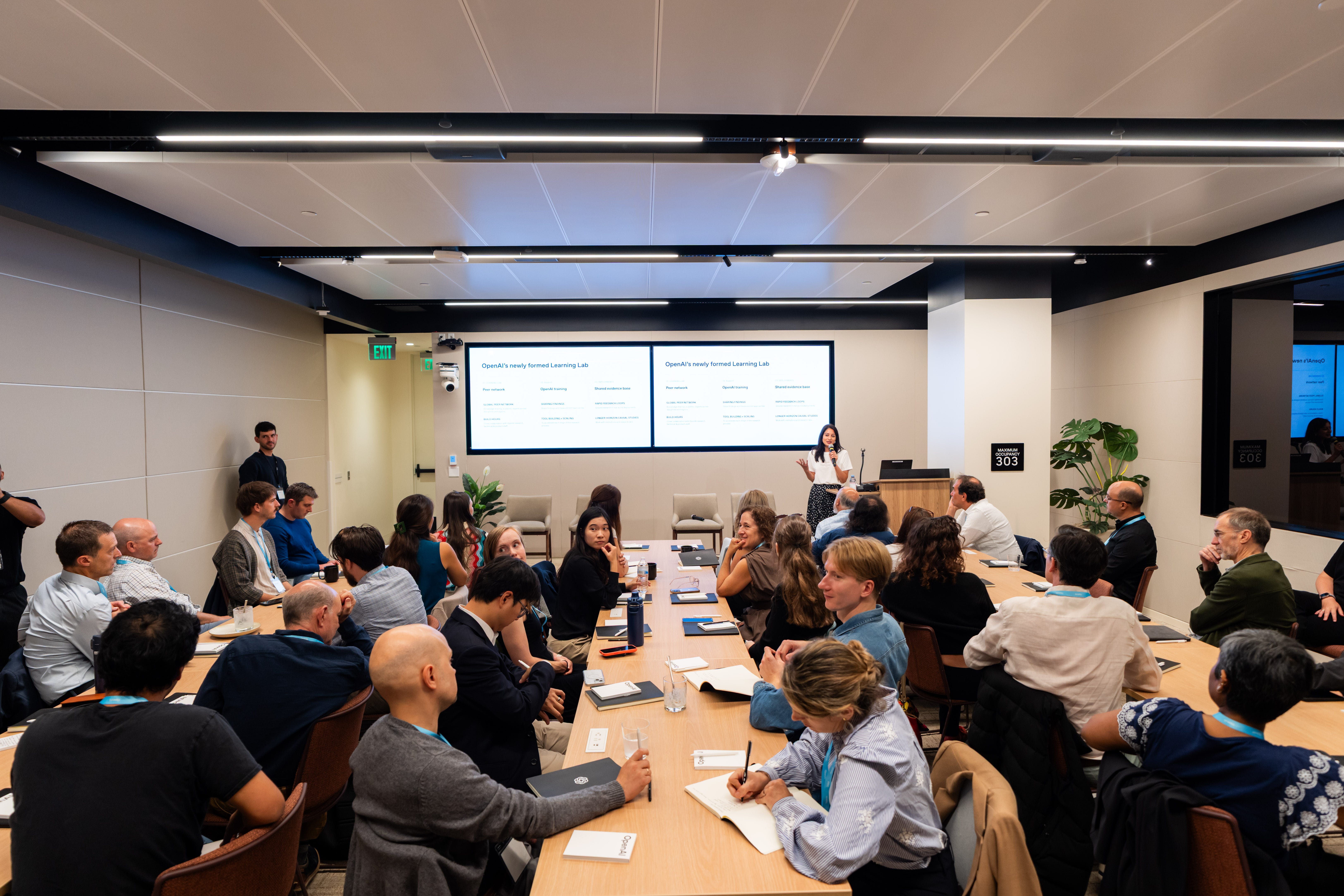
Last week, OpenAI’s Education team convened leading researchers, educators and builders from around the world at our San Francisco headquarters to set the frontier education research agenda and begin the collaborations that will carry it forward.
We kicked off with researchers from the University of Tartu, who took us inside Estonia’s national AI rollout and described their study of how AI affects cognition over time. Tartu and Stanford are working with OpenAI to develop new tools for measuring learning outcomes.
The gathering also opened new opportunities to collaborate, including research with Stanford’s Accelerator for Learning, participation in Oxford’s AIEOU global community of practice, and work on challenges from Cornell’s National Tutoring Observatory
We heard directly from students and teachers, including Ethan Truong, a member of the inaugural ChatGPT Futures class, who described how AI strengthened his sense of agency and urged the room to open new lines of inquiry here. OpenAI’s Economic Research team shared open-source tools and collaboration approaches. Professor Alfonso Gambardella and OpenAI Chief Economist Ronnie Chatterji also shared findings from a new Bocconi study.
The findings sparked a lively debate among economists and education researchers: AI improved the quality of students’ work, critical-thinking training increased originality, and students need both access and instruction.
Join the network
Good research takes time, and some of the questions we’re asking may take years to answer well. We’re committed working with—and amplifying—the researchers tackling this important work. Alongside longer-term causal studies, we’re also looking for studies and rapid proof points that can offer useful signals now. Along the way, we will make research tools, methodologies, and learnings more widely available.
If you are studying how ChatGPT affects teaching and learning, exploring these questions from creative and difficult new angles, and developing measures that are useful for the field, we’d love to hear from you.
Register your interest in the Learning Lab.
Our ambition is to help realize a future in which AI strengthens learning and builds lasting human capability. Through the Learning Lab, we hope to build the evidence that informs choices across classrooms, communities and education systems, guided by the needs of learners and the expertise of those who support them.
Resources
OpenAI Researcher Access Program — API credits for eligible research
ChatGPT for Academic Researchers — program information
OpenAI Economic Research — research on AI’s economic and societal effects
OpenAI Forum — an expert community, events, and public resources
OpenAI Academy — courses, events, and practical learning resources


This feels like an important direction. One distinction I kept returning to while reading is the difference between assisted performance and durable learning. A student producing a stronger answer with AI tells us something about the human-AI system, but not yet what the student has actually learned.
One useful complement to longitudinal measurement might be structured output after the tool is removed: can the learner explain the idea in their own words, transfer it to an unfamiliar problem, respond to a counterexample, or maybe teach it clearly to someone else? These moments could help distinguish temporary scaffolding from capability that has genuinely been internalized.
I really liked the distinction between AI helping students perform better and actually helping them learn. As a student interested in AI and education, I’m curious about how we can measure if a student has truly developed a skill rather than just produced a better answer with AI. Could the Learning Lab eventually explore practical ways for teachers to measure that difference in everyday classrooms?