

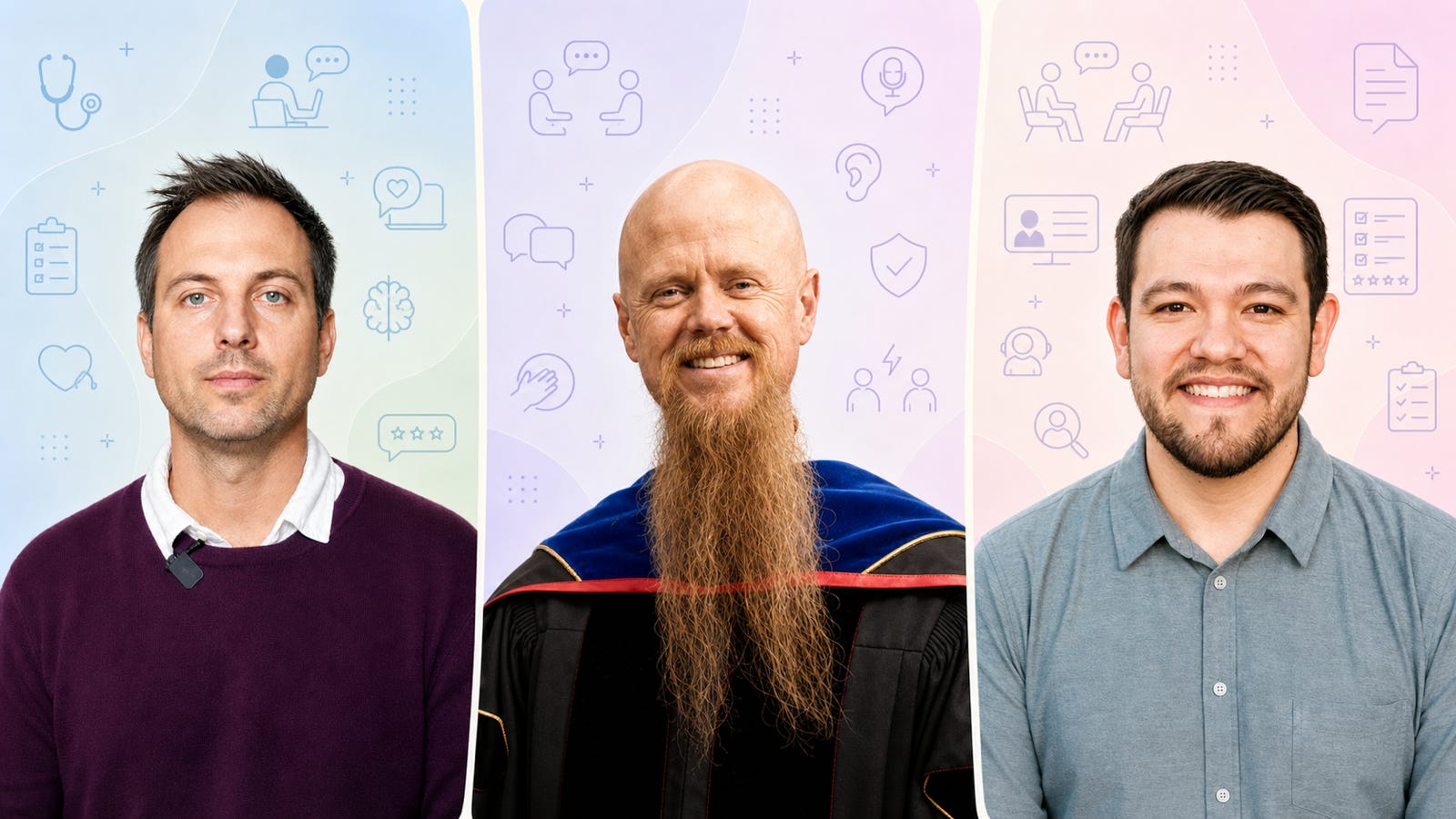
Meet Andrew O’Malley, Doyle Srader, and Dr. Carlos Castañeda.
Dr. Andrew O’Malley gives medical students more patients to learn from
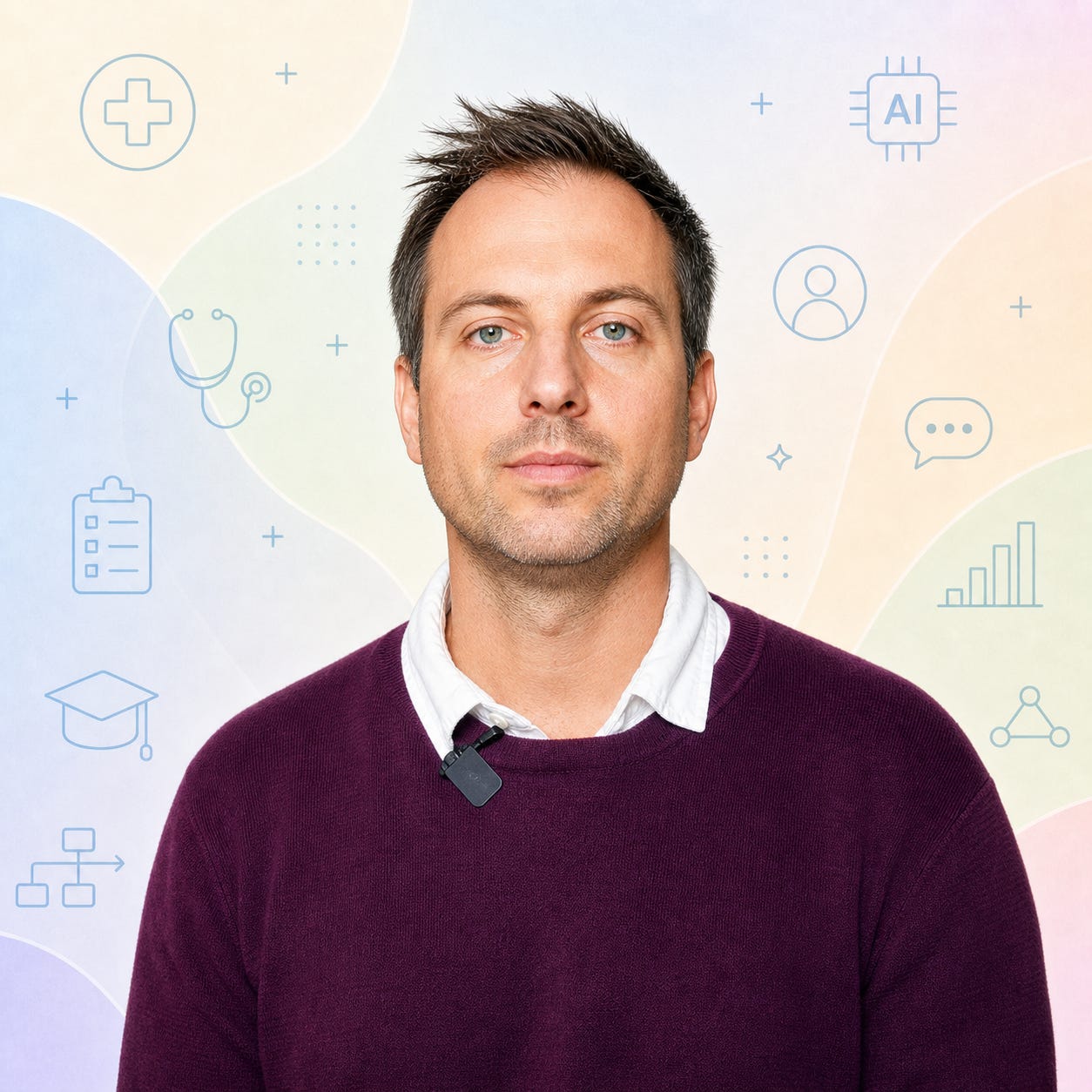
At the University of St Andrews, Dr. Andrew O’Malley wanted medical students to practice history-taking, clinical reasoning, and empathy more often than the timetable allowed. Standardized patients are invaluable, but they also require people, rooms, coordination, and money. Students may see only a narrow range of cases before a placement. O’Malley’s SimPatient project gives them another place to rehearse—not instead of meeting patients, but before those encounters carry real consequences.
SimPatient uses generative AI models from OpenAI to power a virtual patient. A student can choose a case, ask questions, follow clues, and work toward a diagnosis while the model stays within the patient’s history and responds to the student’s approach. A chest-pain case, for example, can require the learner to notice which follow-up questions matter, respond to emotion, and separate a plausible diagnosis from a premature one. The system can also present rare or complex scenarios that a student may not encounter during a short clinical placement.
The useful design choice is what happens after the conversation. SimPatient gives immediate, individualized feedback on questioning, clinical reasoning, empathy, and the proposed diagnosis. Students can review what they asked, notice a missed clue, and try the case again with a different approach. O’Malley grounds that loop in experiential learning and deliberate practice: attempt, feedback, adjustment, repetition. The interface can keep cognitive load manageable for beginners, then introduce more ambiguity as learners become capable.
Make this your own
You don’t need a full platform. Start with one learning objective, such as taking a focused history for abdominal pain. Write a case brief with facts the patient reveals only when asked, details the AI must not invent, and clear escalation rules. Give students a short rubric before they begin, then collect the transcript and a reflection naming one missed clue and one better next question. Keep the simulation inside the educational scenario, state that it is not medical advice, and route consequential judgment back to faculty.
Dr. Doyle Srader moves conflict practice out of the spotlight
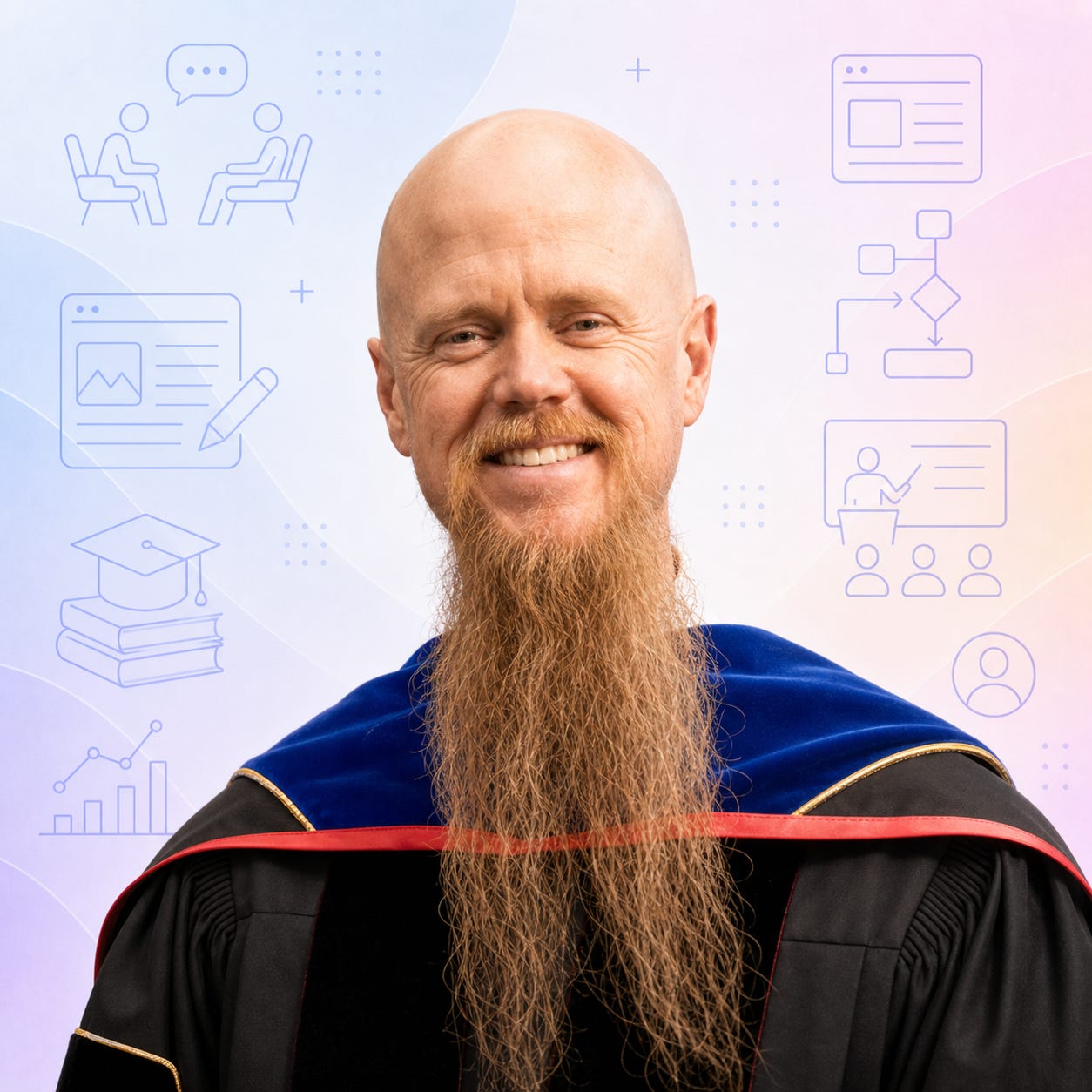
At Bushnell University, Dr. Doyle Srader teaches conflict resolution—a subject that almost demands rehearsal. Traditional role-play can work against the lesson, though. Nervous laughter, fear of looking foolish, and uneven acting may take over. Students end up managing the performance instead of practicing de-escalation.
Srader uses ChatGPT’s voice mode to lower those stakes. He starts with carefully selected disputes from The Guardian’s “You Be the Judge,” which include enough detail to support two plausible perspectives. In one memorable case, Edward wants his wife Alice’s siblings to stop using his toothbrush. Srader uploads the case to ChatGPT, asks the model to play Alice, and lets the student take Edward’s side. The specificity gives the voice conversation something real to work with.
A student enters the ChatGPT conversation and tries to move the dispute toward resolution. Voice mode maintains the other person’s perspective while responding to the student’s tone and tactics. Srader can also adjust the prompt so the character becomes defensive, verbally aggressive, or caught in one of the reciprocation patterns discussed in class. Students can pause, restart, and repeat without asking a classmate to absorb their first attempt. That privacy creates room to test language that may feel awkward at first.
Srader is developing the exercise into an assessment. Students choose three cases, but he does not tell them exactly how he has configured ChatGPT’s behavior. A rubric asks them not to escalate, to adapt to what the character says, and to work toward a collaborative rather than distributive solution. The transcript or recording becomes evidence of performance. Students can point to the moment the exchange changed, explain what they noticed, and say what they would try with a real person.
Make this your own
Choose one real-world dispute with no safety or privacy risk. Give the AI a role, a motivation, two non-negotiables, and a rule not to settle too quickly. Give students three target behaviors and ten minutes. Let them run it twice, changing one tactic on the second attempt. The value is not perfect imitation. It’s the chance to rehearse privately, then debrief what worked, what felt unrealistic, and how the same words might land with a real person.

Dr. Carlos Castañeda expands counseling rehearsal without confusing practice for care
Dr. Carlos Castañeda saw a similar bottleneck in counselor education at St. Edward’s University and Palo Alto University. Students need repeated exposure to difficult conversations, but faculty cannot provide a live client for every practice session. Peer role-play helps, though classmates may know the framework too well or hesitate to surface a complicated concern. Castañeda configured an AI Teaching Adjunct as a custom GPT in ChatGPT so students could practice between classes without mistaking the exercise for actual care.
The custom GPT provides simulated counseling clients whose needs match the learner’s level. Undergraduate students begin with common college concerns such as homesickness, low motivation, or academic stress. Graduate students can encounter more ambiguous cases, diagnostic questions, and cultural-competency checks. Students start in text chat, then progress to ChatGPT voice conversations later in the term. Saying “simulation over” ends the role-play and prompts structured feedback on strengths and areas to improve.
The workflow has four parts. First, Castañeda defines the client profile, presenting concern, boundaries, and facts the custom GPT may disclose. Second, the student conducts a time-boxed session. Third, ChatGPT produces a transcript and rubric-aligned feedback. Fourth, the student submits the record for faculty review. Castañeda is explicit that the model’s score is advisory: he reads the transcript, adds his own feedback, and assigns the grade. The OpenAI tool creates more opportunities to practise; it does not become the supervisor.
Castañeda’s guardrails are central to the design. The simulated client should never be presented as real care, never advise an actual person in crisis, and never invite students to upload identifiable client information. The custom GPT stays in character until the exercise ends, avoids crisis-level scenarios unless an instructor deliberately assigns one, and directs real concerns back to a professor, therapist, or other qualified professional. He also builds in culturally responsive and neurodivergent-affirming language and keeps final judgment with the human educator.
Make this your own
Use one fictional client and one micro-skill, such as reflecting emotion before asking the next question. Have students complete the same scenario twice. Between attempts, they review the transcript, mark one place where they moved too quickly, and rewrite that response. Faculty can compare the two interactions instead of grading a single polished performance. Across medicine, conflict resolution, and counseling, the goal is the same: one more safe, structured try before the stakes are real.
About the educators
Dr. Andrew O’Malley is a Senior Lecturer at the University of St Andrews School of Medicine, where he leads the Division of Education. His work focuses on bringing generative AI into medical education, including SimPatient, an AI-powered simulated-patient platform.
Dr. Doyle Srader has taught communication at Bushnell University since 2007 and has received four campus-wide teaching awards. He has taught conflict in American and Japanese classrooms and at young-professional conferences.
Dr. Carlos Castañeda, PhD, LPC, NCC, is an Assistant Professor of Psychology at St. Edward’s University, owner of The Missing Peace Clinic, and founder of ThinkAITA LLC.
Watch Andrew O’Malley on OpenAI Academy.
Watch Doyle Srader on OpenAI Academy.
Watch Dr. Carlos Castañeda on OpenAI Academy.
