

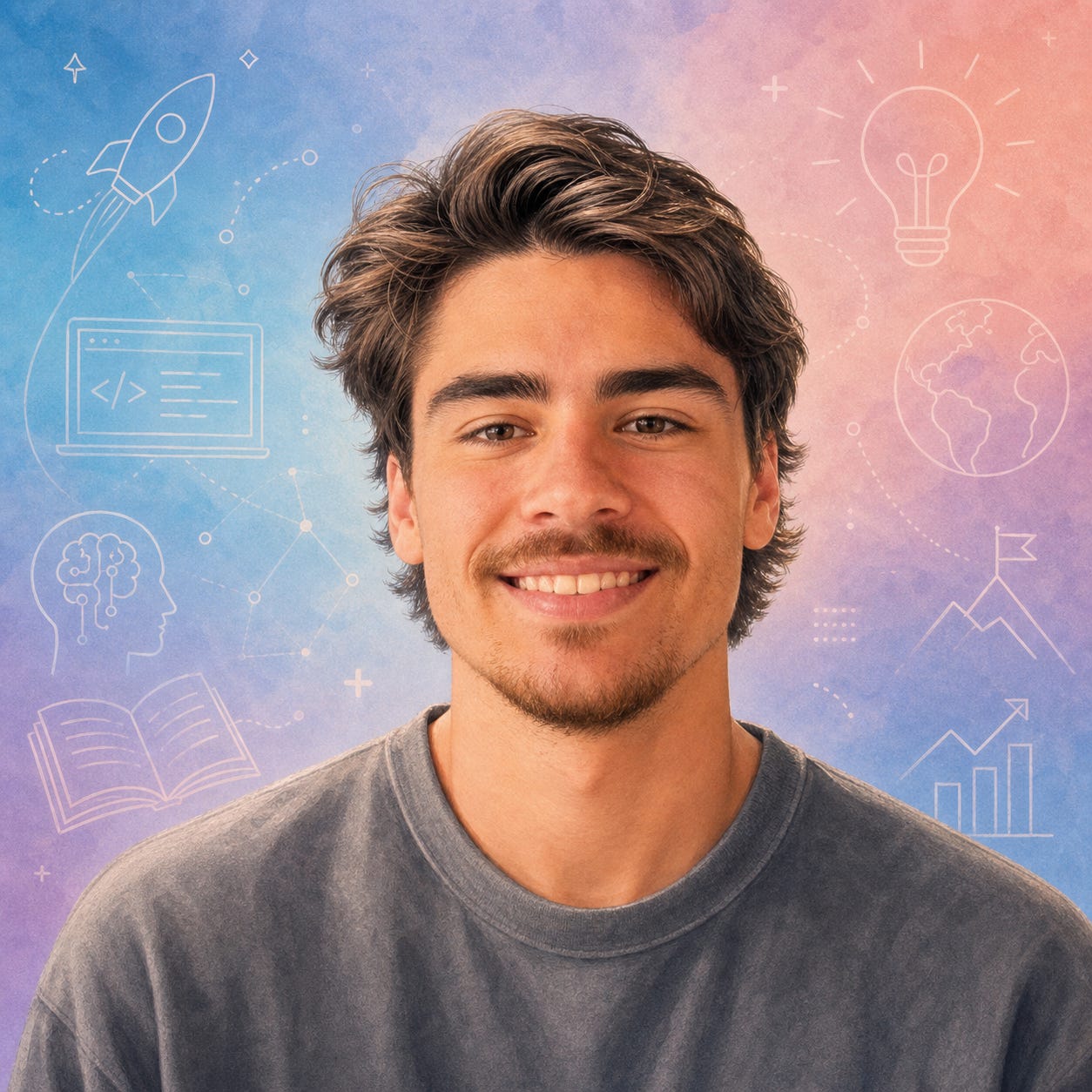
Joaquín Fernández Sande, MD, is a physician, educator, prompt engineer, and AI innovator specializing in medicine and large language models. In this interview, Fernández Sande discusses how generative AI and LLMs can help doctors reduce administrative burden, improve patient care, and become builders of the tools they use.
Source note: This is an edited interview adapted from a narrated video submitted to OpenAI. Watch the associated video in OpenAI Academy.
Intro
Modern medicine is at a crossroads: while technology has delivered remarkable advances, it has also burdened doctors with overwhelming bureaucracy and data overload. Dr. Joaquín Fernández Sande, a physician, educator, and AI innovator at the National Academy of Medicine of Buenos Aires, is pioneering a new approach: LLM-native healthcare.
His work centers on a simple but powerful idea: doctors should not only use AI tools, they should learn to shape them. In his words, doctors should become “vibe coders,” capable of translating clinical needs into working AI-assisted workflows.
Fernández Sande also works as a prompt engineer at Quadrivia, a startup building AI-powered workflow tools designed to reduce administrative burden in healthcare. Across his teaching, research, and applied work, his mission is to help clinicians use AI safely, ethically, and creatively while restoring attention to the patient-doctor relationship.
The Interview
Q: Dr. Fernández Sande, you’ve described the current state of healthcare as “information-centered” rather than “patient-centered.” What’s driving this shift, and what are the consequences for doctors and patients?
Fernández Sande: Over the years, our healthcare system has become dominated by data and administrative demands. Doctors now spend about half their working time not with patients, but in front of computers: writing medical records, reviewing information, handling bureaucracy. This has led to a burnout rate of over 43% among physicians. The real tragedy is that, while we’re drowning in data, we’re losing focus on the human beings in front of us. Medical errors, often caused by information overload and fatigue, are now estimated to be the third leading cause of death worldwide. We’ve lost sight of the core mission of medicine: caring for patients.
Q: How does your approach, what you call “LLM-native healthcare,” address these challenges?
Fernández Sande: LLM-native healthcare is about fundamentally redesigning how we practice medicine. Instead of forcing doctors to adapt to technology, we teach them to use large language models as clinical tools that can handle repetitive, error-prone, and bureaucratic tasks. This lets doctors refocus on patient care. It’s not just about using AI, but about mastering it: becoming fluent in prompt engineering and understanding how to deploy LLMs safely and responsibly within clinical workflows. We emphasize ethics, patient safety, and professional trust at every step.
Q: You’ve also been exploring the idea that “doctors should be vibe coders.” What does that mean in a medical context?
Fernández Sande: The idea is that doctors should be able to participate directly in creating the tools they need. They don’t necessarily need to become traditional software engineers, but they should understand how to work with AI systems, prompt them effectively, prototype workflows, and translate clinical expertise into useful applications. Doctors understand the real problems in healthcare because they face them every day. If they can use AI to build and adapt tools around those problems, they become active creators rather than passive users. That is where the concept of doctors as vibe coders becomes powerful.
Q: What does this look like in practice? Can you share some examples from your teaching?
Fernández Sande: Absolutely. One of our key goals is to turn doctors into tool makers. We teach them core programming concepts, without the burden of complex syntax, so they can build their own AI applications. For example, Dr. Enrique Diaz-Canton, our course co-director and a leading oncologist, created a custom GPT for oncology in Argentina. It acts as a clinical co-pilot, integrating the latest oncology databases and guidelines. This tool has reached over 3 million user interactions, with a 4.8 user rating, and ranks in the top 5% globally on OpenAI’s custom GPT platform. Another example is our synthetic data case generator. We built a custom GPT that creates realistic, privacy-compliant patient cases for students to practice their clinical skills before exams. It adapts to different specialties, like cardiology or pediatrics, and aligns with each university’s curriculum. This lets students safely practice diagnosis and treatment without using real patient data.
Q: What’s the impact of giving doctors these AI-building skills, rather than just teaching them to use off-the-shelf tools?
Fernández Sande: It’s transformative. When doctors can create and customize their own tools, AI becomes a natural extension of their expertise. They’re not just passive users. They’re innovators, able to address their unique challenges. This also means AI solutions are better tailored to real clinical needs, leading to safer, faster, and more humane care. Importantly, we’re seeing a rapid rise in adoption: two out of three physicians now use AI in their practice, a 78% increase from just a year ago. Our mission is to ensure they do so safely, ethically, and creatively.
Q: How do you balance innovation with the ethical and safety considerations that are so vital in medicine?
Fernández Sande: We never lose sight of the doctor’s responsibility to provide safe care. Ethics, patient safety, and trust are foundational. Every tool we build is designed with these principles in mind. We teach doctors not just how to use AI, but how to critically assess its output, understand its limitations, and ensure it serves the patient’s best interests. AI should fit the problem. It should never dictate the practice of medicine.
What Stands Out
Core idea: Dr. Fernández Sande’s approach re-centers medicine on the patient by teaching doctors to delegate bureaucracy and repetitive tasks to AI, freeing up time and attention for care.
Classroom design: His courses blend prompt engineering, core programming concepts, and ethical foundations, enabling clinicians to build and deploy custom AI tools tailored to their specialties.
Student impact: Doctors and students gain the skills to innovate, creating tools like clinical co-pilots and synthetic data simulators that support safer, more efficient, and more engaging medical practice.
Transferable lesson: Empowering professionals to become tool makers, not just tool users, unlocks creativity and ensures technology serves real-world needs, an approach applicable far beyond healthcare.
Bio
Joaquín Fernández Sande, MD, is a physician, educator, prompt engineer, and AI innovator specializing in medicine and large language models. He co-directs the Postgraduate Course in Artificial Intelligence for Medicine at the National Academy of Medicine in Buenos Aires. He is also a Computer Science Master at IE School of Science and Technology and works as a prompt engineer at Quadrivia, a startup developing AI-powered workflows to reduce administrative burden in healthcare.
https://substack.com/@calvinjonescinematheory/note/c-268255405?r=8dbojf&utm_medium=ios&utm_source=notes-share-action
https://substack.com/@calvinjonescinematheory/note/c-259537481?r=8dbojf&utm_medium=ios&utm_source=notes-share-action