

Dr. Marina Jovic teaches academic writing and linguistics at Gulf University for Science and Technology in Kuwait.
Source note: This is an edited interview adapted from a narrated video submitted to OpenAI.
Intro
When generative AI entered the writing classroom, Dr. Marina Jovic did not want to frame the choice as permission or prohibition.
Her question was more practical: if students are already using AI, how can instructors help them use it in a way that deepens judgment rather than replacing it? The result is VERIFY, a six-step framework designed to make students slow down, check claims, evaluate logic, question bias, and name their own contribution.
The Interview
Q: You begin from a stance that feels very different from the usual classroom panic about AI. What did you decide early on?
Jovic: I could not and did not want to ban AI in my classroom. Instead, I wanted to see what would happen if students used it thoughtfully, critically, and with purpose.
Academic writing is not only about producing text. It is a process of thinking, composing, questioning, revising, and developing judgment. My concern was that if students rely on AI without structure, some of that cognitive work can shift away from them. They may gather less, problem-solve less, or accept fluent output too quickly.
Q: So the goal was not just better AI use. It was protecting the intellectual work inside writing.
Jovic: Exactly. Generative AI can be useful for ideation, drafting, and feedback. But students need to learn how to manage and evaluate the tool. Novice writers especially need a framework because they may not yet know what to distrust.
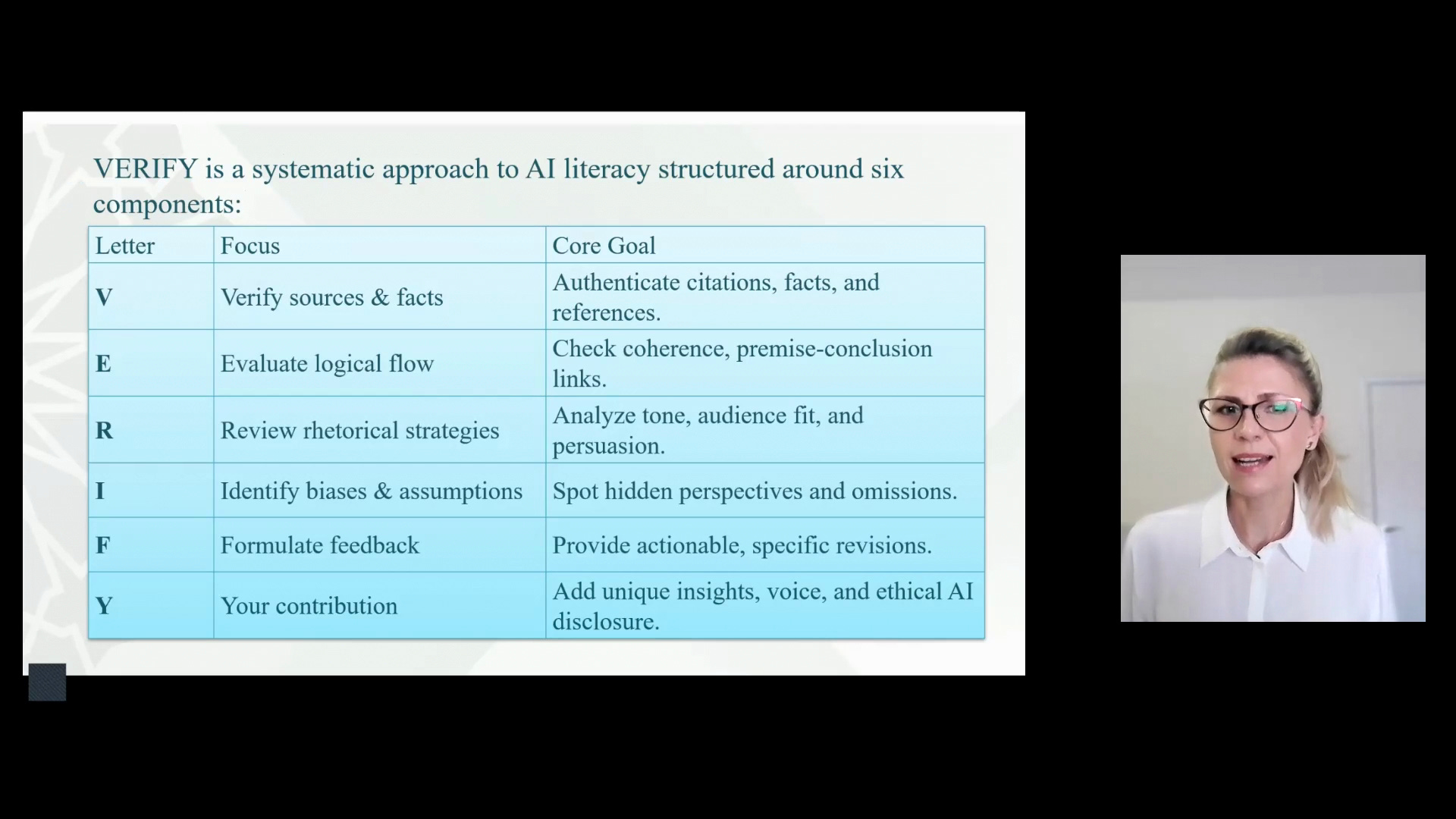
VERIFY gives students a repeatable process for checking AI-supported writing.
Q: Walk us through VERIFY.
Jovic: VERIFY stands for:
Verify sources and facts: Students check citations, claims, and evidence instead of assuming the AI is correct.
Evaluate logical flow: They look at how the thesis, claims, evidence, and transitions fit together.
Review rhetorical strategies: They examine tone, audience, purpose, and the persuasive choices in the writing.
Identify biases and assumptions: They ask what the AI may be taking for granted or leaving out.
Formulate feedback: They use AI and peer feedback, but they also evaluate the quality of that feedback.
Your contribution: They identify their own voice, ideas, and ethical responsibility in the final work.
Q: That last step feels important because it asks students to locate themselves in the writing.
Dr. Marina Jovic: Yes. Students need to understand that writing with AI still requires authorship. They can use AI support, but they should be able to explain what they contributed and why they made certain decisions.
Q: What does this look like in class?
Jovic: Students compare real and AI-generated citations. They cross-check factual claims. They map a thesis to its evidence. They use a custom GPT, the Argumentative Essay Tutor, but then compare AI feedback with peer feedback and instructor guidance. They also look for weaknesses in AI feedback, such as over-praise, hallucinations, superficial comments, or feedback that is not actionable.
Q: What did you learn from the first implementation?
Jovic: We studied a first-year academic writing section at GUST and compared it with a control section. Students using VERIFY showed stronger AI literacy and more practical strategies for mental engagement. They were more confident about using AI without handing over the thinking.
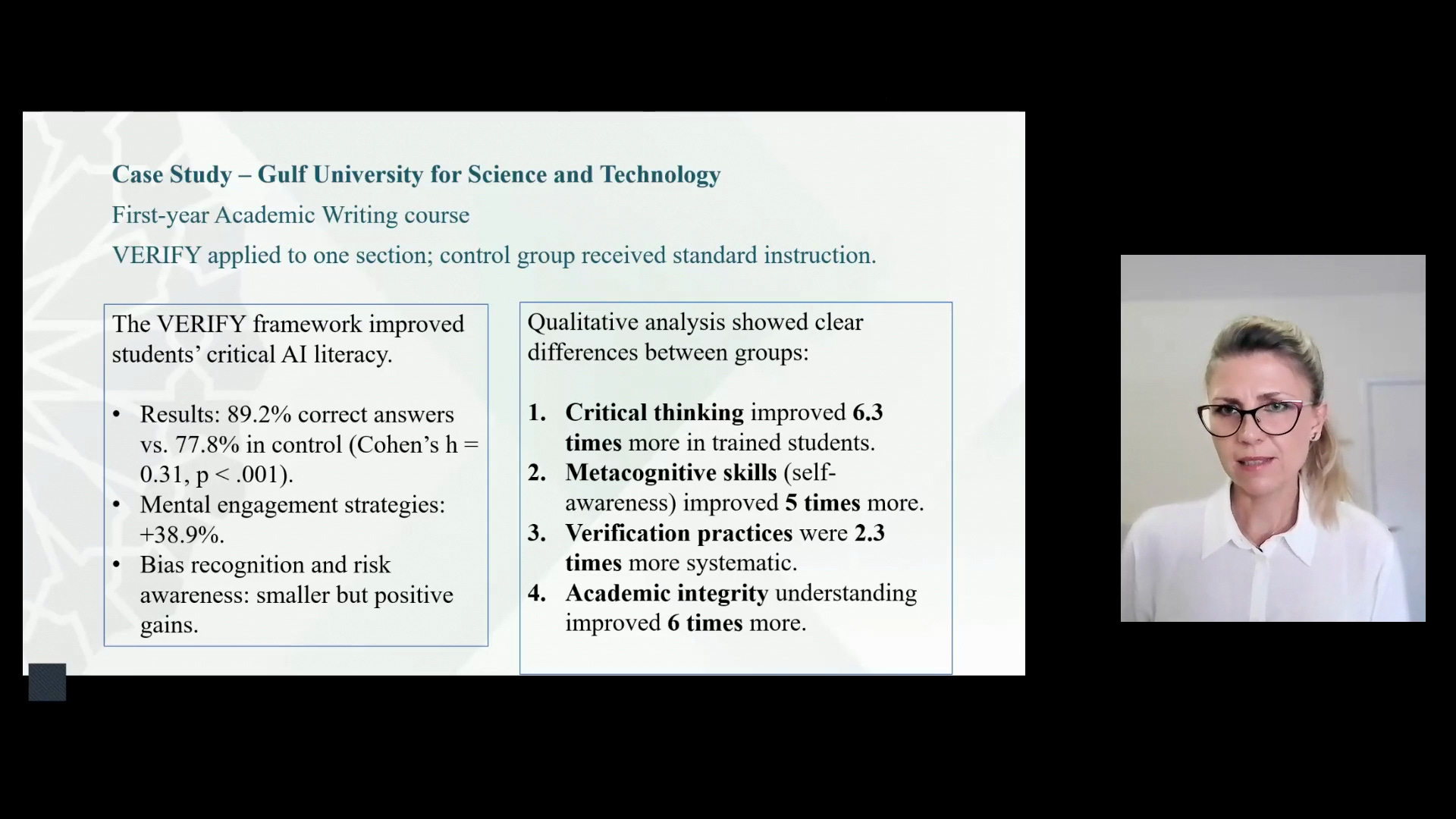
The pilot suggested gains in AI literacy, verification habits, and student confidence.
Q: What did students say?
Jovic: Students in the VERIFY section described AI as a help, but not as the writer. One student said it helped them, but the writing still had to be in their own words. Another said the framework taught them to ask why and how, rather than simply accepting an answer.
Q: What is the theory underneath the framework?
Jovic: The framework draws from constructivist learning theory. Students learn by actively constructing meaning, not by receiving finished answers. VERIFY also responds to AI-specific writing problems: hallucinated sources, coherence issues, rhetorical inconsistencies, and the fact that predictive AI does not truly understand meaning.
Q: What should other writing instructors take from this?
Jovic: We do not need to choose between banning AI and letting students use it without guidance. We can design structured practices that make students more critical, more reflective, and more accountable for their own writing.
What Stands Out
Core idea: AI writing support works best when students have a process for verification and reflection.
Classroom design: The framework turns AI from a shortcut into an object of analysis.
Student impact: Students reported greater confidence, stronger verification habits, and a clearer sense of their own authorship.
Transferable lesson: Instructors can teach AI literacy through the ordinary work of writing, feedback, revision, and source evaluation.
Bio
Dr. Marina Jovic is an Assistant Professor at Gulf University for Science and Technology in Kuwait, where she teaches academic writing and linguistics. Her research explores pragmatics, ESL writing, and the use of large language models in academic contexts. She developed the VERIFY framework to support critical thinking, metacognitive skills, and academic integrity in AI-assisted writing.
A generous, well-built framework. I'd like to add the frame from where I teach it. In a course on the economics and ethics of sustainable design, VERIFY reads less like a response to AI than like the recovery of something the discipline has always known. The core move is to stop treating thinking as a service the instructor delivers and start treating it as a stock we steward. Once we do, the whole vocabulary of sustainable design transfers with almost no loss.
Fluent AI output is a subsidized good. Its sticker price, a prompt and a few seconds, hides its true cost, which is not eliminated but displaced: onto the student's future self who never built the judgment, onto a profession that inherits practitioners who can produce work they cannot evaluate, onto a public sphere absorbing confident, unverified claims. That is precisely the externality structure sustainable economics exists to expose, and it is why we make designers do full-cost and lifecycle accounting instead of trusting market price. Read this way, VERIFY is not a study skill. It is an internalization mechanism, the cognitive equivalent of making the polluter pay, forcing the deferred cost back to the point of use.
The objection writes itself: a better model removes the friction, so verification becomes waste. Jevons' paradox is the answer. Efficiency in the use of a resource doesn't conserve it; it lowers the effective cost and expands total consumption. Make thinking frictionless and you don't get the same judgment faster… you get more offloading and less judgment exercised. The sustainable answer is never efficiency; it is sufficiency. The friction in VERIFY isn't a transitional inefficiency awaiting a better model. It is a designed-in limit, because the capacity it protects is destroyed precisely by making it frictionless. The ethics are simply Brundtland applied to cognition: meeting present needs, the deliverable, the deadline, the grade, without compromising the future capacity to think. An education that satisfies the present by depleting that capacity is unsustainable in the structural sense, not the sentimental one. Tony Fry would call it defuturing.
So, I'd put the point more strongly than the modest framing allows. This isn't a clever accommodation to a new tool. Sustainable design has always been about exposing who bears the deferred cost and accepting present friction as the price of an intact future. The cognitive case isn't an analogy to that argument. It is the same argument, run on the one resource students are most tempted to treat as free, because it is their own.
This is a good framework and Dr. Jovic is asking the right question. Most educators are still stuck on ban or allow. She moved past that. That matters.
Where I’d push further: a verification checklist gives students a process, but it doesn’t tell you whether the student actually changed. How do you know they internalized the habit versus performed the steps? Without measurement — before and after, scored, tracked — you’re trusting self-report and classroom observation.
I’ve spent over 20 years teaching chemistry and physics across eleven schools. For the last two years I’ve been building a cognitive development program that measures exactly this — whether a student owns their reasoning or outsources it. Five scored dimensions. Pre and post assessment. A six-week cohort where the student has to defend their thinking out loud, not just check a box.
The diagnosis in this article is right. The architecture needs to go deeper. If OpenAI’s education team ever wants pedagogy from a teacher who’s built the implementation layer — not just the awareness layer — I’m easy to find.
Syd Malaxos
Thinking Labs by Temple Academy
smalaxos.substack.com