At Chico State, the AI conversation is top of mind for faculty. Instructors are asking what needs to change now that AI can complete parts of the assignments they have relied on for years?
That’s the idea behind Chico State’s AI Retrofit program, an applied faculty-development effort led in part by Zach Justus. The name is deliberate. Faculty don’t have to rebuild their courses from scratch. They seek to understand what AI has changed, then adjust the courses they already teach so students are still doing meaningful work.
When we spoke with Justus, he described a program that has reached almost 200 faculty members at Chico State, close to 15 percent of the instructional faculty. It’s also one approach that will be leveraged by the entire CSU system this coming academic year.
Justus doesn’t start by asking faculty to take a position on AI. His approach is simpler: faculty can love it or hate it, but they still have to adapt to a new world.
The Interview
What problem were you trying to solve with AI Retrofit?
For the last three years, a lot of my faculty development work has centered around artificial intelligence. At Chico State, we support roughly 900 to 950 instructional faculty, so the question was not just how to introduce a tool. It was how to help a large and varied faculty think through what AI means for teaching and learning.
AI Retrofit is a very practical and applied approach to integration. It’s not tangled up with a lot of abstract theory. We get faculty together, ask them to evaluate how AI has disrupted what they traditionally do, and then give them practical tools and pathways to adjust.
We learned quickly that opening with “Let’s all get on board, AI is great” creates resistance. A better starting point is more direct: you can love it or hate it, but you still have to adapt. That lowers the temperature. Some faculty arrive skeptical and leave with a clearer sense of where AI might help their work.
How does the program work?
We run it off-cycle, in May after the semester and in January between semesters. That helps make the work more effective. If you meet once a week during the semester, people forget most of what happened between sessions and lose momentum. If you give them a focused one-week sprint, they can actually stay with the work.
We also pay faculty a stipend. It’s not a huge amount of money, especially for faculty with advanced degrees. But we care about their time. There needs to be explicit value and accountability.
The structure is important because in a shared governance environment, you can’t simply tell faculty what to do. You have to create the conditions where they can choose something that’s worth their time.
How do you start?
We show faculty how to use ChatGPT to complete an assignment, and then we ask them to have ChatGPT do assignments from their own classes.
That is a tough place to start. There is usually a lot of hand-wringing. People can be pretty upset for the first day or day and a half. But it’s also a wake-up call. They see, directly and personally, that something has changed.
The point is not to embarrass anyone or tell them their courses are broken. The point is to help them arrive at the conclusion themselves: things need to change. We have a series of exercises that help faculty reach their own conclusions.
What happens after faculty see that disruption?
We ask them to talk to recent graduates, employers, and people in industry before they start making changes. The answers vary by field. For computer science, everything has changed. For people running art studios, less may have changed. But that step helps faculty think beyond assignments and ask: what are we preparing students for now?
We also give them a simple matrix of possible assessment alternatives. For example, if someone used quick writes to test comprehension, what are other ways to assess reading comprehension? We break these options out by format, because what works in person does not always work in an asynchronous online class.
We also teach faculty to use ChatGPT as a thought partner and revision tool. My background is in communication. I don’t pretend to know what should happen in a chemistry class. The faculty member is the subject matter expert. Our job is to give them tools, examples, and pathways so they can figure out what makes sense in their discipline.
What kinds of changes are faculty making?
There’s a wide range. Some people move into technology-free classrooms or blue books. While I’m not sure that’s ultimately the answer, exploring what that looks like and how students respond is up to faculty.
More commonly, faculty are redesigning assignments in ways that make the work more multimodal, more process-oriented, or more connected to real practice. Some are moving away from papers and toward podcast interviews or oral presentations. Some are using social annotation tools like Perusall. Others are finding ways to evaluate the process of learning rather than only the final product.
That process focus matters. In fifth-grade math, we tell students to show their work. AI pushes us to ask a version of that question across many disciplines: what does the learning process look like, and how can we make it visible?
What does that redesign look like in practice?
Since our conversation, several AI Retrofit alumni shared examples of changes they have carried into their courses. Together, they show that “retrofit” can mean redesigning an assessment, teaching students to challenge AI, or building a course-specific tool.
Retrofit In Practice
Josh Trout: Video, field notes, and AI-generated questions
Josh Trout replaced written discussion posts with short video responses and redesigned a final exam around a scenario students must answer in their own words on video. He also built an assignment that requires AI use: students upload field notes, ask AI to generate critical-thinking questions grounded in those notes, choose three questions, and record a five-minute reflection. Students must document the prompts they used and the AI outputs they received.
Josh Trout’s redesigned discussion asks students to respond on video and engage with peers.
QUESTION
Reaction post to PE Documentary (Discussion)
Watch the 1-hour documentary “NO EXCUSES: A film about quality physical education.” This documentary was created and produced by faculty at Chico State.
Post a 1–2 minute video commenting about your perceptions of the documentary and the possibilities for Physical Education. Be creative and thoughtful in your post. Additionally, please mention your favorite quote from the film—tell me who said it and why it resonated with you.
Note: This is a 30-point assignment—20 points for your post responding to the prompt above and 10 points for posting at least one supportive or productive response to someone else’s post.
Note: Be sure to respond in your own words. If your video post involves you reading from a script, you will only receive half-credit.
Katie Mercurio: AI as a sparring partner
Katie Mercurio, an associate professor of marketing and director of online programs in Chico State’s College of Business, is deliberately teaching students to argue with AI rather than accept its first answer. In her MBA Strategic Marketing course, students evaluate AI recommendations for strengths, limitations, and assumptions, then propose and defend an alternative the model did not consider.
Her emerging process makes AI an adversary or sparring partner:
Students make their own recommendation first and identify the case evidence supporting it.
They ask AI to attack the recommendation by surfacing assumptions, counterarguments, risks, missing stakeholders, or another course of action.
They return to the case evidence and decide which criticisms hold up.
They defend, modify, or abandon the original recommendation and explain why.
They identify something that neither they nor the AI can confidently resolve with the available information.
For example, a student might tell AI, “Act as a skeptical CFO and give me the strongest reasons my recommendation could be wrong.” The student then has to decide whether those objections survive the evidence. Mercurio’s principle is that AI can make a claim, but students remain responsible for adjudicating it. She also keeps copyrighted HBR and HBP case materials out of the model; the AI interaction centers on students’ own analyses and recommendations.
Preston Farris: A custom GPT that explains and checks
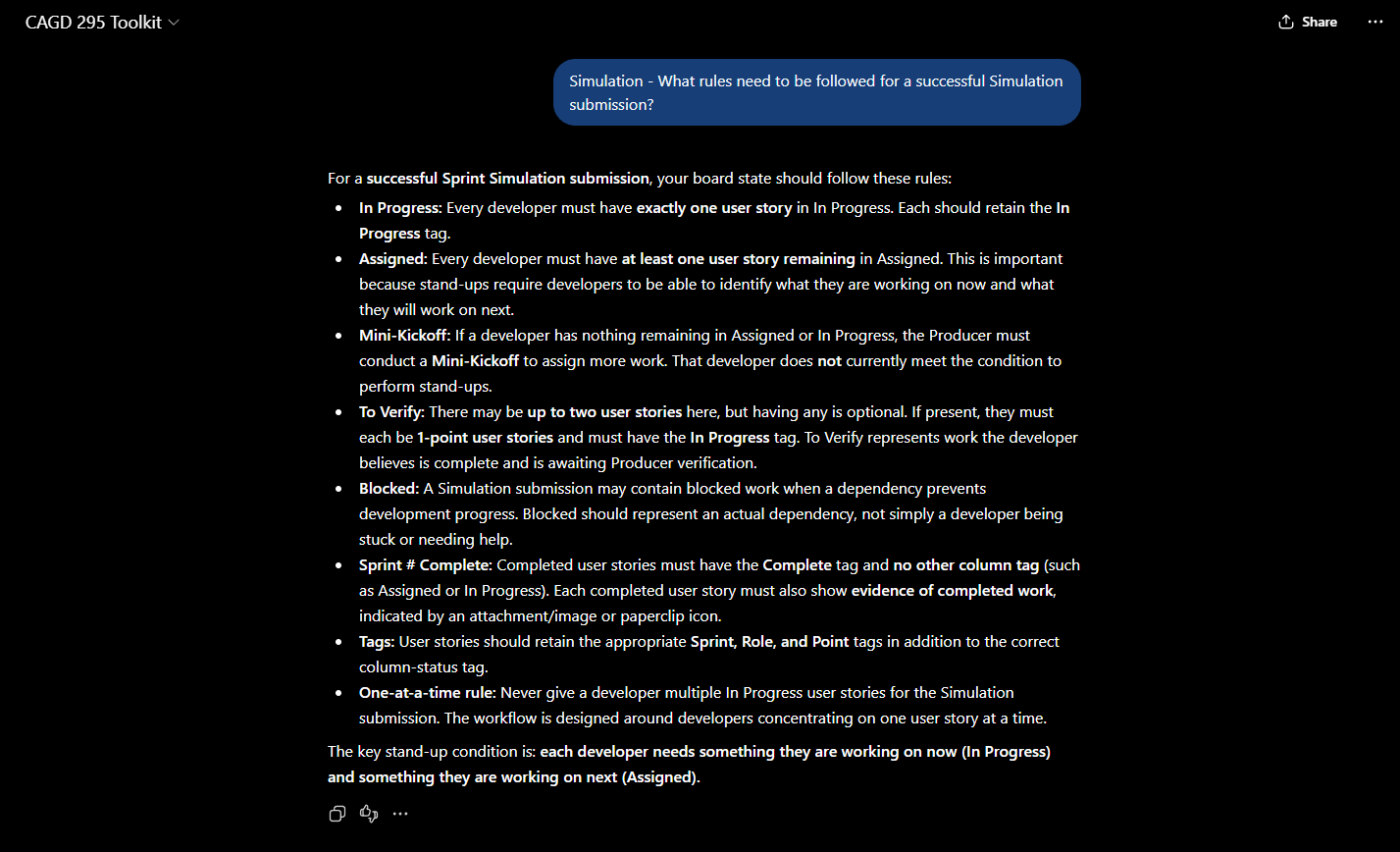
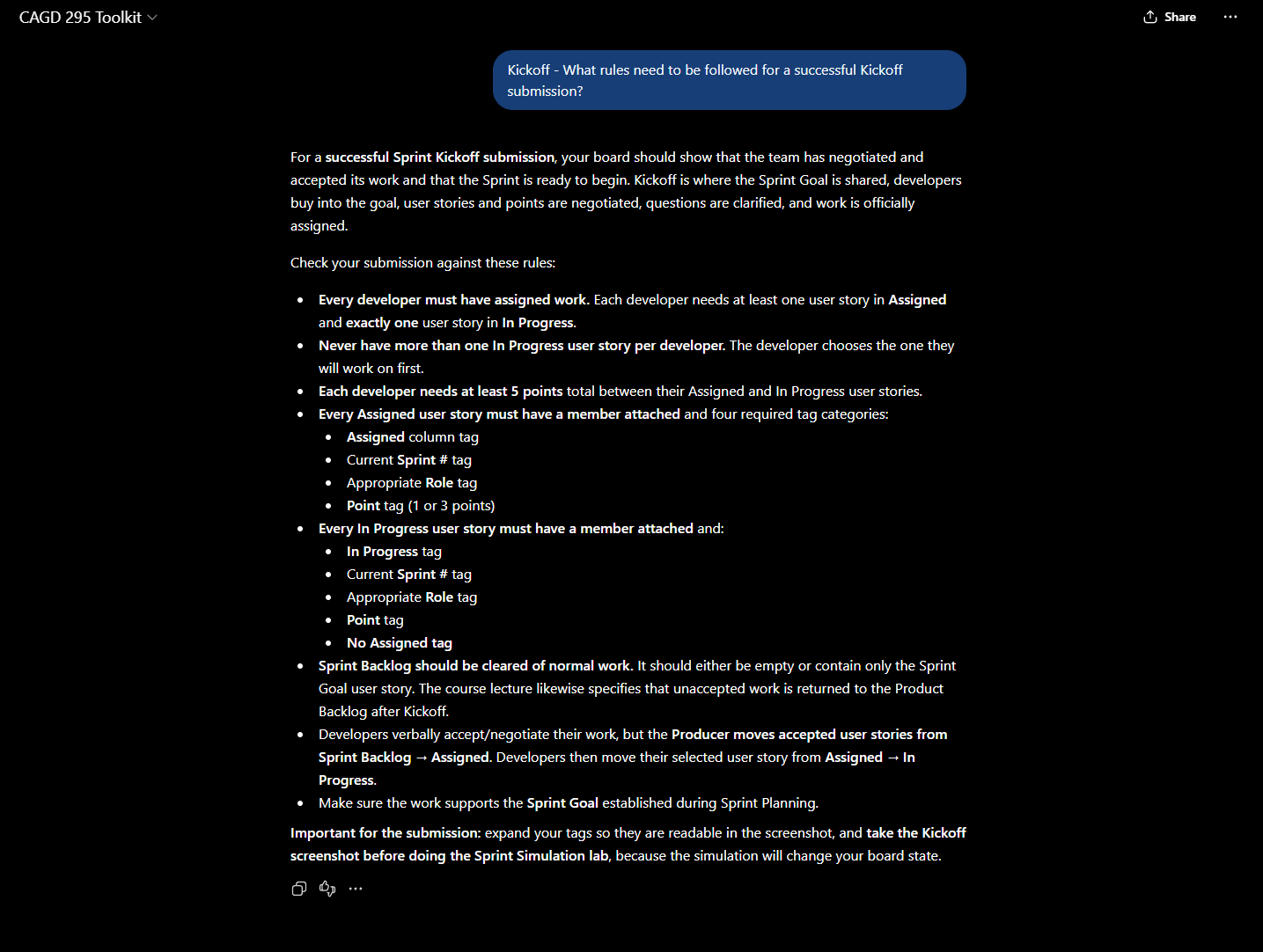
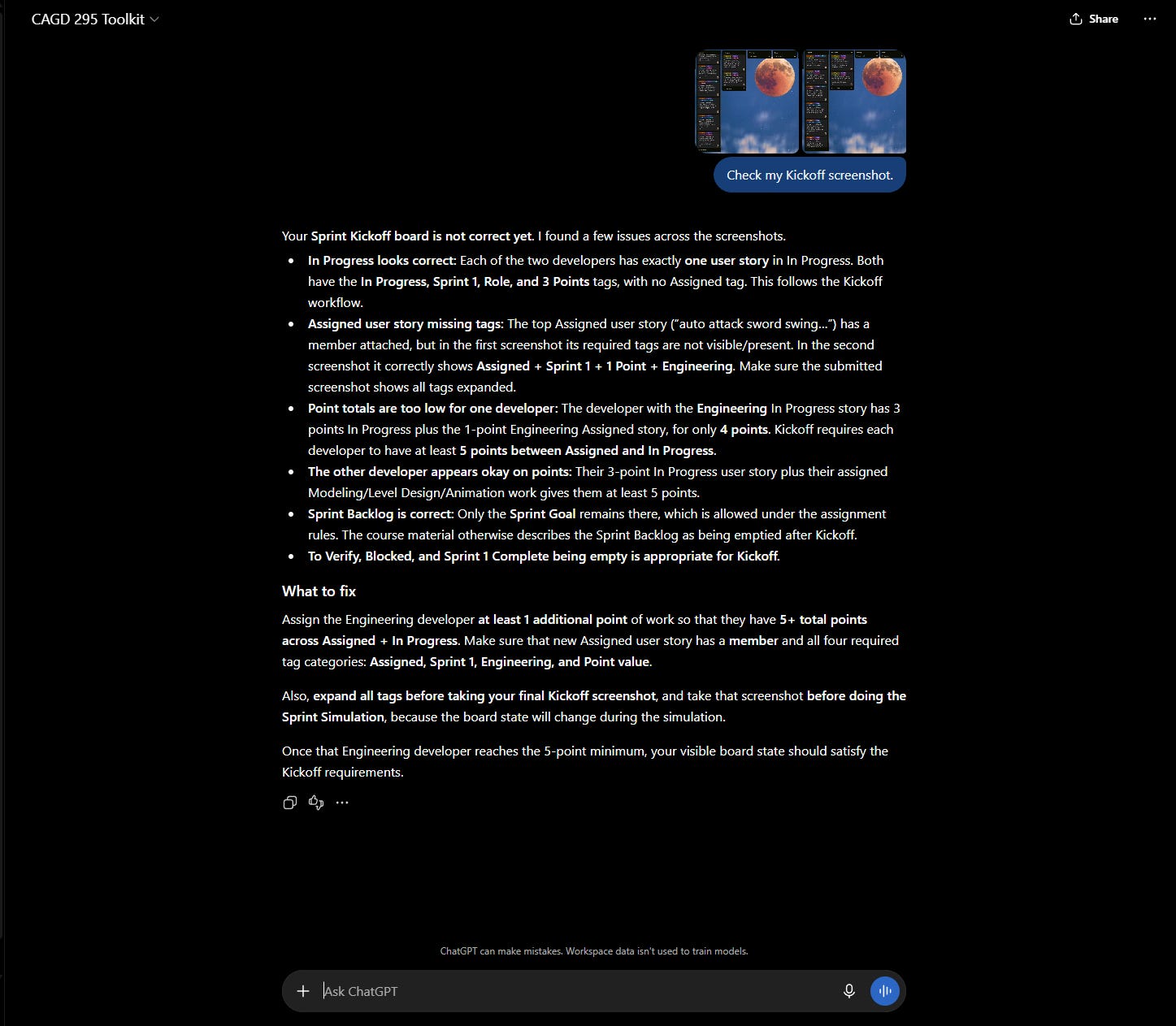
Preston Farris, a lecturer in Computer Animation and Game Development, built a CAGD 295 Toolkit during the Retrofit and still uses it as a teaching tool. The custom GPT gives students a step-by-step explanation of what counts as an acceptable Sprint Kickoff or Simulation submission. Students can also upload screenshots of the work they plan to submit and ask the GPT to check them.
The tool has a known limitation: it can struggle to distinguish profile pictures from one story to another. Farris treats that as productive friction. Students have to verify the feedback rather than assuming the model is right. A false negative prompts another check; the tool is not intended to certify incorrect work as correct.
Farris introduces the toolkit in Canvas, explains the screenshot format, and flags the known profile-picture limitation.
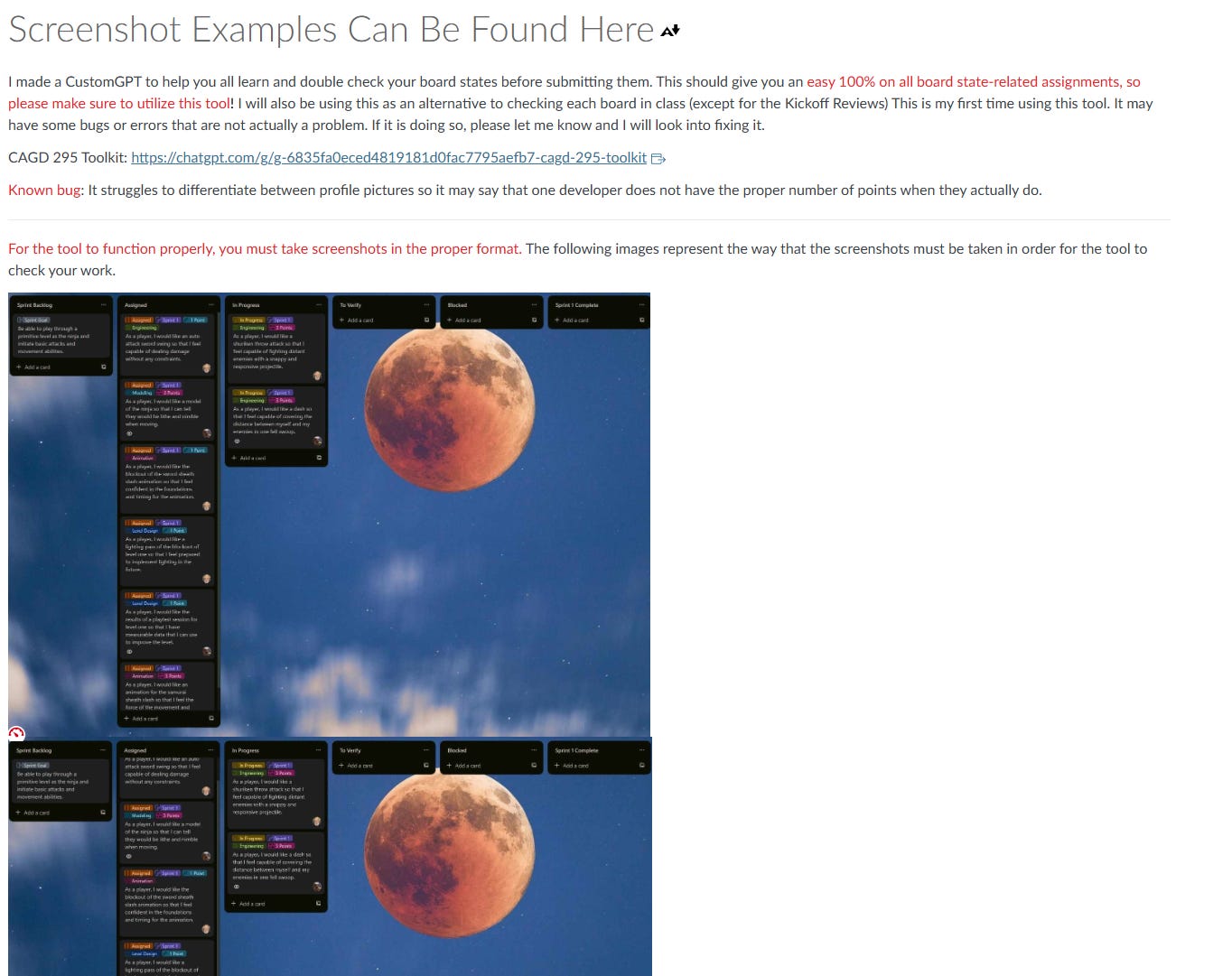
The Canvas instructions show students how to capture the full board state.
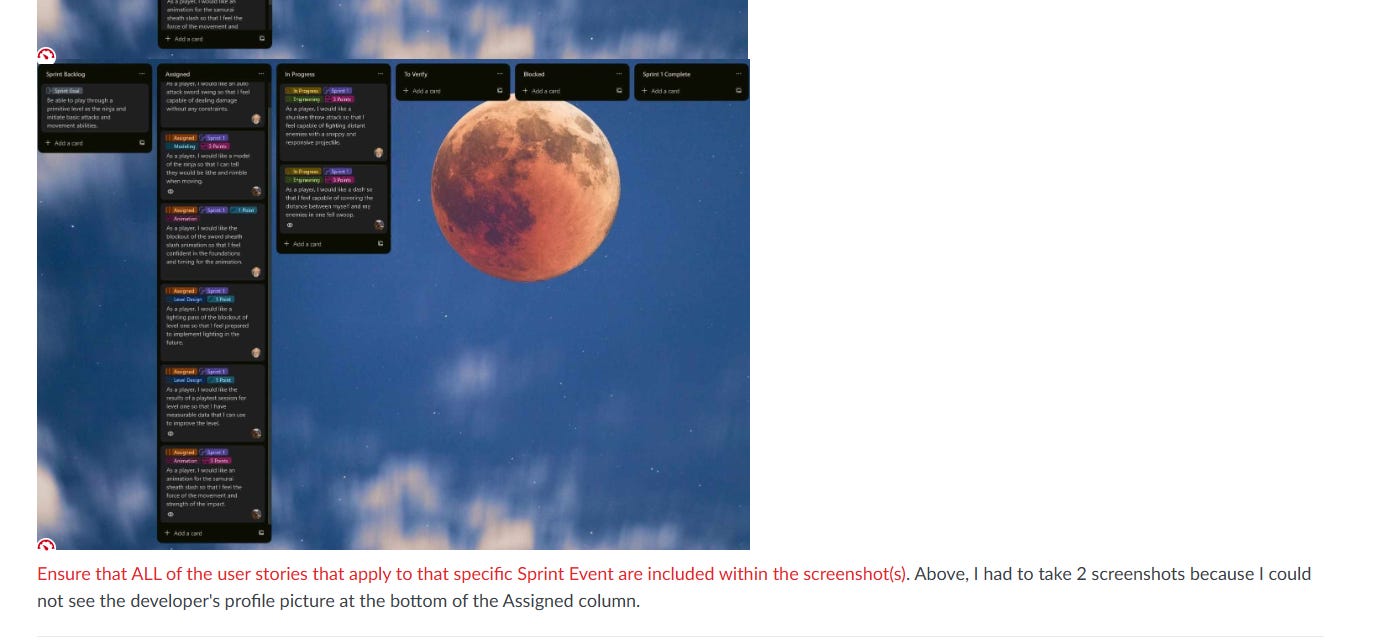
Students choose the assignment they are checking and upload their board-state screenshots.
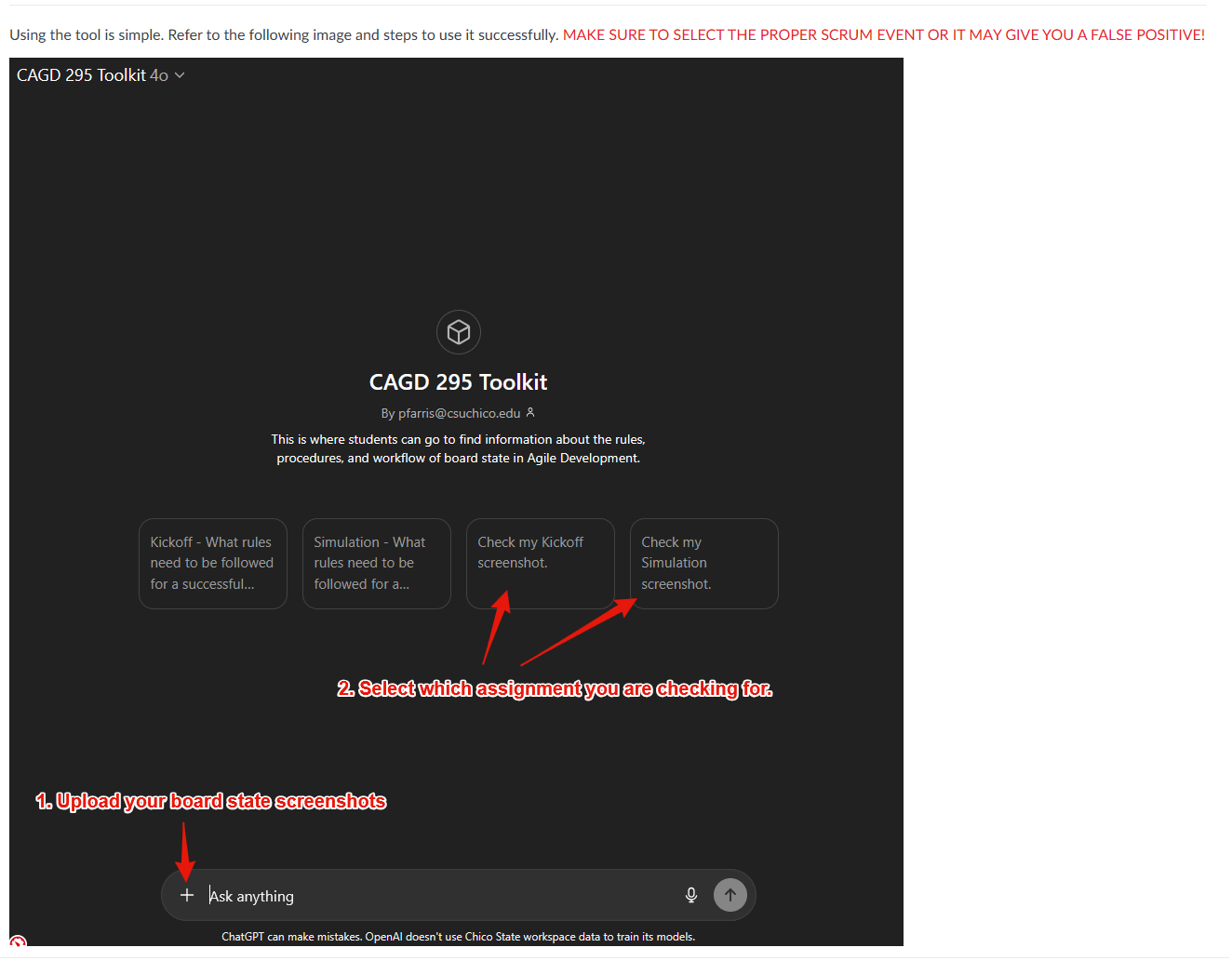
The toolkit explains the rules for a successful Sprint Simulation.
It can also explain the requirements for the Sprint Kickoff.
After a student uploads screenshots, the GPT identifies what appears correct, what needs attention, and what to fix before submission.
Logan Smith: Research, course helpers, and explicit AI instruction
Logan Smith assigned students a custom GPT research project in fall 2025 and also uses course-specific GPT “helpers” in AGRI 305 and ANSC 440. He provides the helpers with course materials such as the textbook, slides, study guides, syllabus, notes, and practice questions so students can ask for explanations tied to the class. His AgriGenetics Helper is available to Chico State users: AgriGenetics Helper. Two students, April Garcia and Isabelle Harger, also used the library’s podcasting studio and green screen to record a Herd Health Plan presentation.
Smith said the custom GPT project improved engagement and gave students direct instruction in appropriate AI use—training many students said they could carry into future jobs. His subject librarian, Michelle Mussuto, taught students how to research materials for the project.
David Zeichick: A lecture companion grounded in course video
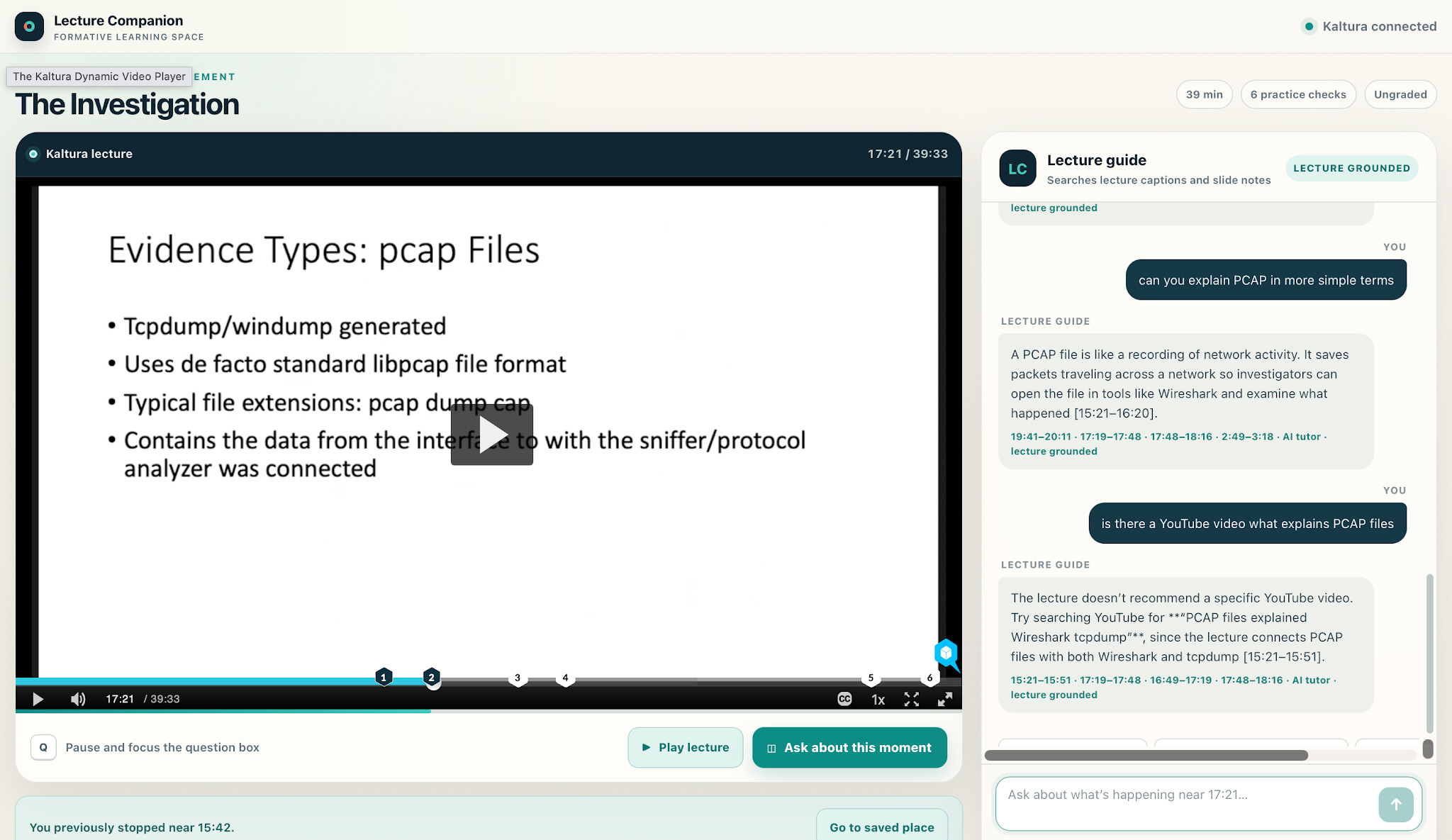
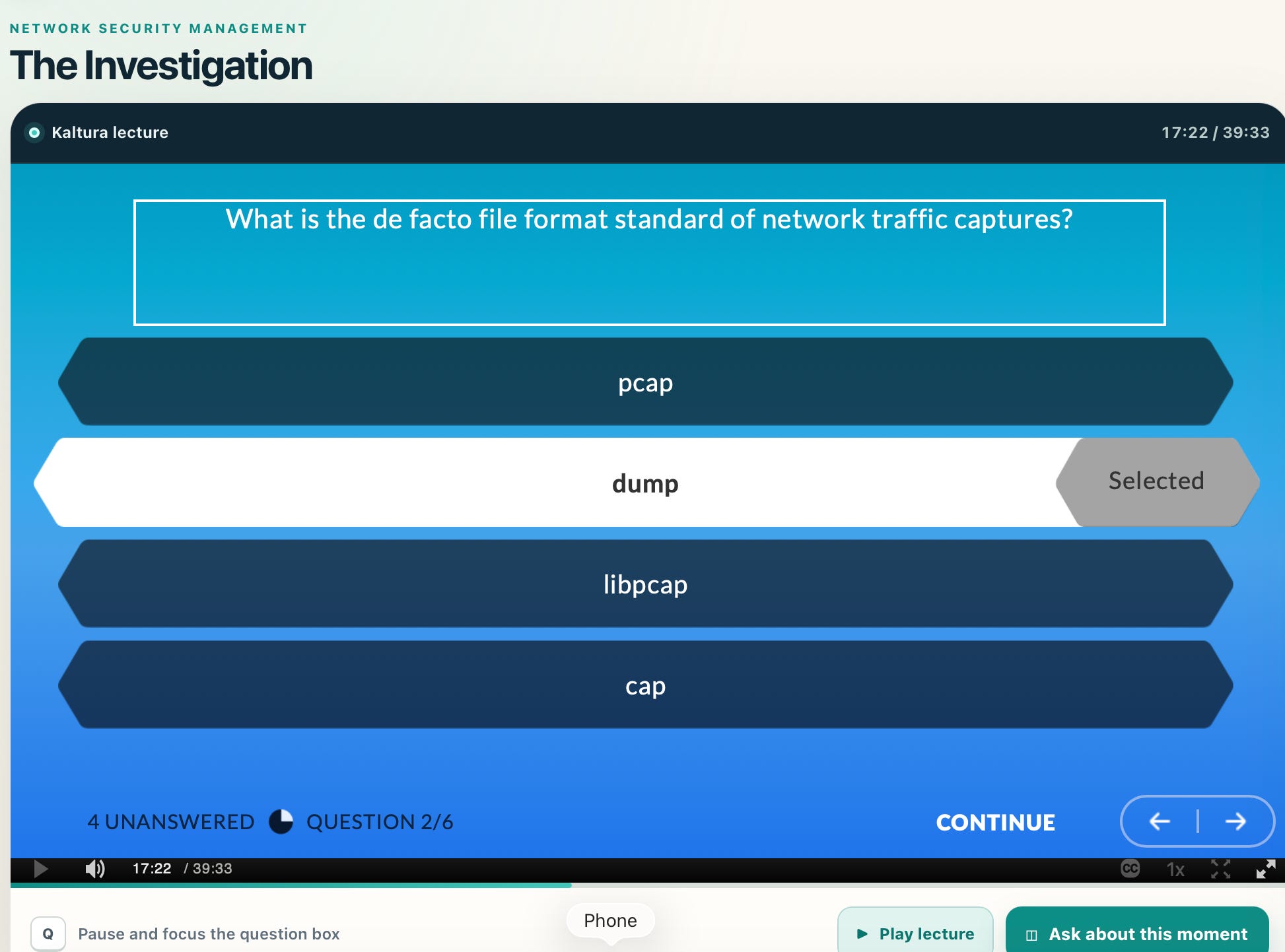
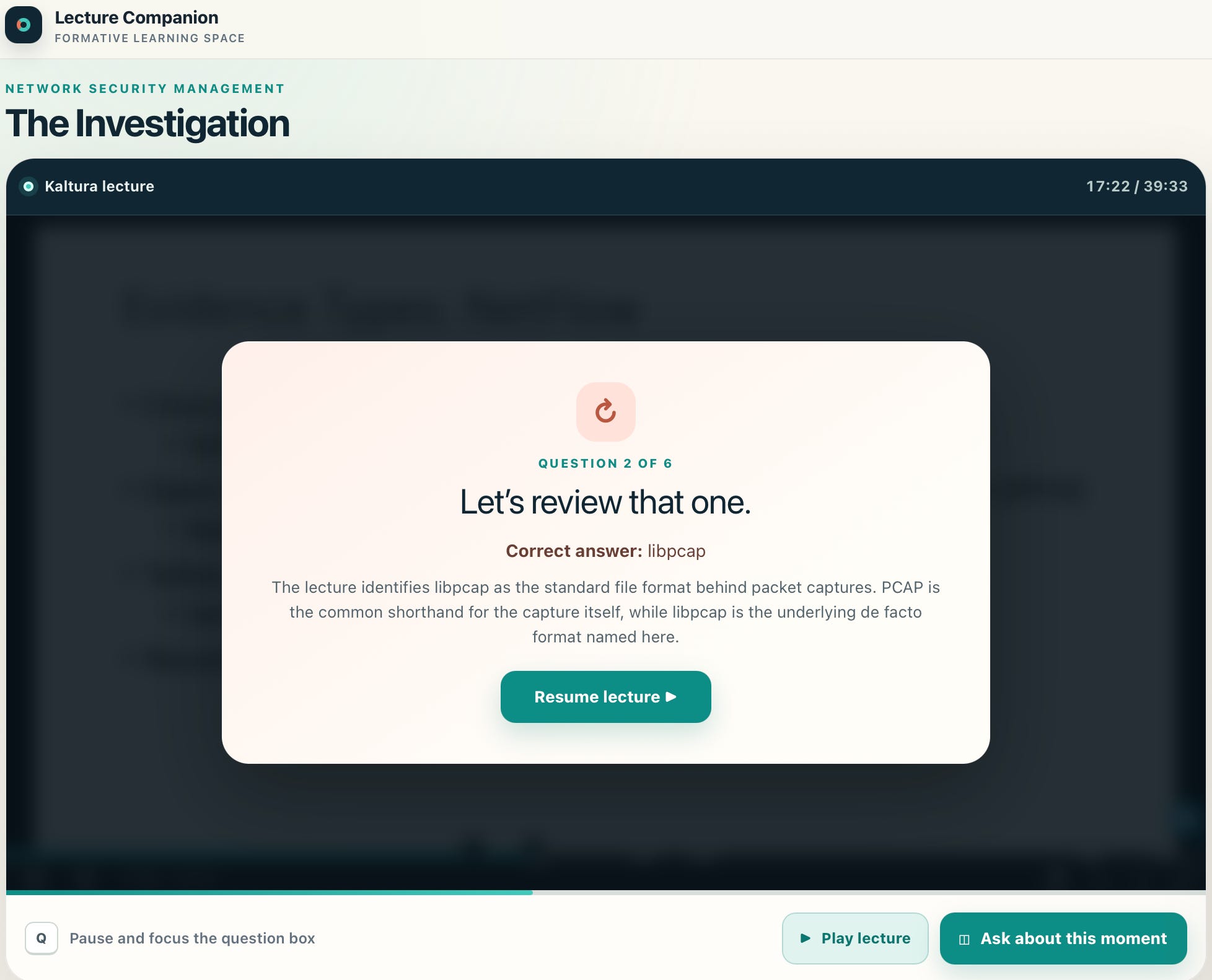
David Zeichick is prototyping an overlay for Kaltura lectures that lets students pause a video and ask ChatGPT questions about the moment they are watching. Answers are grounded in the lecture transcript. Embedded quiz questions check understanding; when a student answers incorrectly, the companion explains why. The prototype is currently hosted in ChatGPT for Zeichick’s own use while he works toward an externally accessible version.
The Lecture Companion pairs a Kaltura video with a transcript-grounded question-and-answer panel.
Embedded practice checks pause the lecture and ask students to answer a question about the content.
When an answer is incorrect, the companion gives the correct answer and a short explanation before the lecture resumes.
Why does this kind of redesign matter?
So much of this comes back to helping students understand why they are doing what they are doing. If students can connect the work to a career outcome, a real-world problem, or something they care about, they are more likely to invest themselves in learning. Credential-seeking will always be part of college, but if we can reactivate even a little more of why students enrolled in the first place, our jobs get easier and their experience gets better.
How does industry connection shape the program?
It helps faculty see that this is not just an IT issue. Some universities treat AI as if it is an IT problem that needs an IT solution. But when faculty talk to graduates or employers, they see that this is a teaching and learning revolution. It is not just a question of opting into or out of a tool.
The workplace is changing, and students are entering organizations that are still figuring out what AI means. That gives students an opportunity to help shape what comes next, but only if their courses prepare them for that reality.
What is the broader lesson?
The program works because it starts with the course, not the tool. Faculty have to look at what has changed, but they also get time, examples, and support to make changes that fit their disciplines.
For institutions trying to support faculty around AI, the model suggests a few practical lessons:
Start with disruption, not adoption. Let faculty test their own assignments and see what has changed.
Protect focused time. A one-week sprint can build more momentum than scattered meetings during the semester.
Signal that faculty time matters. Even a modest stipend can communicate institutional seriousness.
Connect course redesign to the workplace. Graduates and employers can help faculty see what students now need.
Keep faculty as the experts. AI can be a thought partner, but faculty still own the disciplinary judgment.
Look for process, not just product. The best redesigns often make student thinking, collaboration, and iteration more visible.
Reflection
Justus made another point that’s easy to miss. Much of the useful AI work in education is happening quietly in classrooms. It rarely makes the national conversation, which sometimes focuses on cheating and failure. At Chico State, faculty are making changes, students are being asked to do more meaningful work, and the institution is learning by doing.
The transition is not easy. The program works partly because it does not hide that fact. It starts with discomfort, then gives faculty a way to work through it.
For higher education, the practical path may be to redesign courses so students still have to think, create, explain, collaborate, and show their work.
About Zach Justus
Zach Justus is the Director of Faculty Development and a Professor of Communication Arts and Sciences at California State University, Chico. His work can be found in Argumentation and Advocacy and Communication Teacher and other outlets. Zach has been writing, speaking, and working at the intersection of AI and education since the launch of ChatGPT. He has collaborated to produce Inside Higher Ed and EdSouce articles, several webinars, an ongoing blog/podcast/newsletter, and a series of conference and keynote presentations.