

Issue 7: October 22, 2026
This week: Stefano Puntoni on the effort that helps us learn, an interactive idea to try with students, and new ways to put AI to work.
Contents
Feature: Stefano Puntoni and the effort worth keeping
OpenAI Education in the news
Product Corner: New ways to work, research, and learn
Try This: Make sample size visible
Around the World: George Osborne at Oxford
Offer: Four free months and a mission to build
Learning with OpenAI: Guiding Student Success webinar series

Feature: Stefano Puntoni and the effort worth keeping

What effort helps us learn?
In our conversation, Wharton professor Stefano Puntoni explores how AI can remove tedious friction while preserving the effort that builds understanding. His examples range from a syllabus bot that answers routine questions to using AI to rehearse an assignment before giving it to students.
Watch the conversation with Stefano
OpenAI Education in the news
Forbes: Why learning matters in the age of AI
In Forbes, education contributor Ray Ravaglia speaks with OpenAI’s VP of Education Leah Belsky about AI as a “curiosity amplifier” and the role educators play in helping students find a reason to learn. They explore why assessment needs to reveal students’ reasoning and learning process. The article also highlights Duke professor Scott Dyreng’s use of AI to examine team discussions and OpenAI’s Learning Outcomes Measurement Suite.

Product Corner: New ways to work, research, and learn
GPT-6.1 Sol. Stronger document understanding and multistep work can help with tasks such as reviewing a packet of materials or building a tool. Available in ChatGPT Work and Codex.
GPT-Rosalind. For life sciences researchers, this specialized model supports work such as literature synthesis, hypothesis development, and experiment planning. Access is available to eligible organizations through a trusted-access program.
Intelligent UI. In GPT-6 Chat, explanations can include controls that let learners change inputs and explore what happens. The example below turns sample size into something students can test.
Track all product updates here.

Try This: Make sample size visible
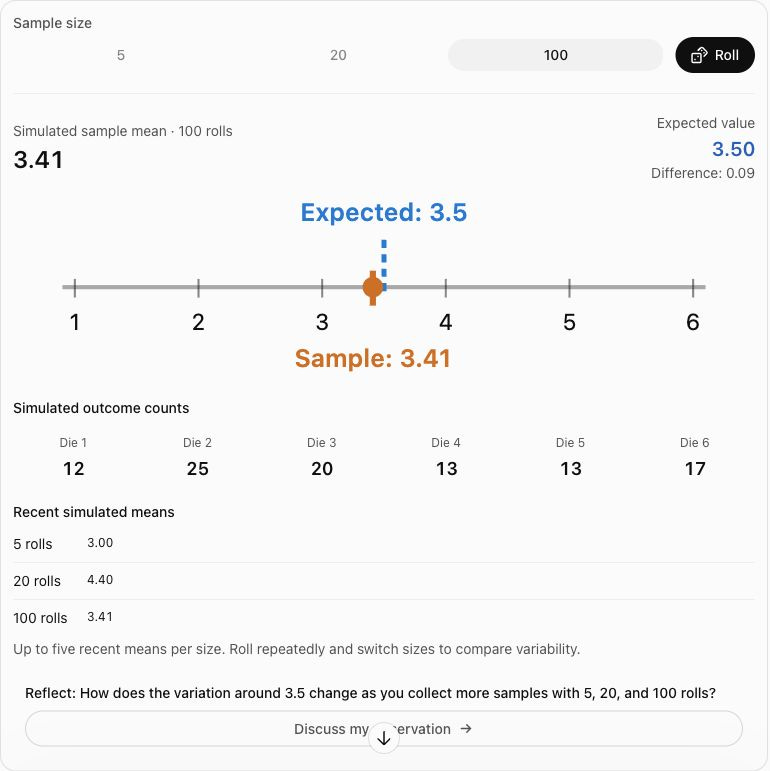
Example shown—paste the prompt below into ChatGPT to try it.
Ask students to predict which sample size will produce the most stable mean. Then choose 5, 20, or 100 die rolls, press Roll, and compare the results. Repeat each size several times before drawing a conclusion.
Try this prompt in GPT-6 Chat:
Create an interactive explanation of how sample size affects the stability of a sample mean for an introductory statistics class. Use a fair six-sided die, whose expected value is 3.5. Let me choose 5, 20, or 100 rolls, then click Roll to draw a new random sample. Show the six outcome counts and the sample mean, with 3.5 clearly marked as the expected value. Label the results simulated. Include one short prediction question before I roll and one reflection question afterward. Keep it compact and use working controls directly in this chat.
Open ChatGPT and paste in the prompt. Choose a supported reasoning setting such as High. Intelligent UI is not available in Work, Voice, or the Pro reasoning setting. See availability.

Around the World: George Osborne at Oxford
On October 15, George Osborne, Managing Director and Head of OpenAI for Countries, joined Professor Sir Nigel Shadbolt for a fireside conversation at the Oxford Generative AI Summit. His message: Britain can build on its strengths in research, technology, and life sciences by broadening access, skills, and adoption.
“Wishing away new technology is not a solution,” he said. For educators, the conversation raises a practical question: how can we give learners more opportunities to try AI, develop judgment, and put it to use?
Read the highlights from Oxford
Offer: Four free months and a mission to build
Four free months of ChatGPT Plus for eligible U.S. college students. The offer includes ChatGPT Work and is available to claim through October 31, 2026. Enrollment verification and a payment method are required; after four months, the subscription renews at $20 per month unless canceled. See eligibility and terms.
Learn more and claim the student offer
Then give students a mission to build. OpenAI’s multiplayer game mission on Handshake’s AI Skills Studio guides learners through making design decisions, building a game with ChatGPT Work, testing it, and improving what doesn’t work. The guided mission takes about 45 minutes and requires a ChatGPT account with Work mode.
Try the 45-minute game mission
Know a student who could use this? Share the offer and mission with them.
Learning with OpenAI: Guiding Student Success webinar series
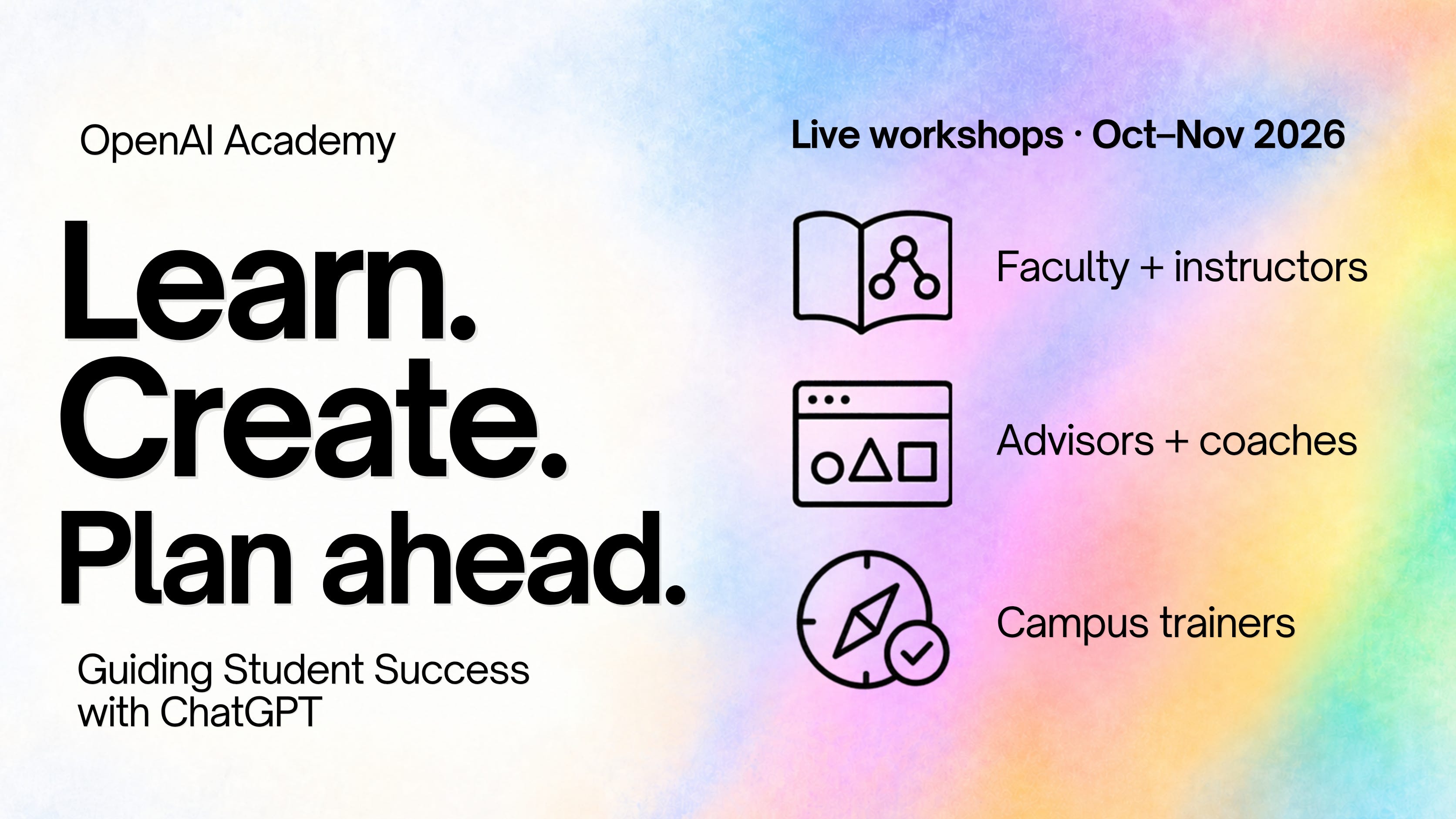
Help students make the most of ChatGPT. These are practical sessions built for advisors, campus trainers, and faculty. Bring a student need and leave with prompts and approaches you can adapt.
Tuesday, October 27, 10–11 a.m. PDT: Help Students Learn and Create with ChatGPT
Wednesday, October 28, 4–5 p.m. PDT: Help Students Plan College, Careers, and Life with ChatGPT
Thursday, October 29, 11 a.m.–noon PDT: Lead Practical ChatGPT Workshops on Campus for Students
Monday, November 2, noon–1 p.m. PST: Lead Practical ChatGPT Workshops on Campus for Students
Wednesday, November 4, 3–4 p.m. PST: Help Students Learn and Create with ChatGPT
Thursday, November 5, 10–11 a.m. PST: Help Students Plan College, Careers, and Life with ChatGPT
See all dates and register for individual workshops.
What effort is worth keeping?
Where could AI remove a routine task—and where do you want students to do the thinking themselves? Reply with one example. Your answer will help shape a future issue.

The effort worth keeping is the first attempt. I teach high school chemistry and physics. My students try a problem alone before any tool touches it, then use AI to test and extend what they built. The attempt that comes before the answer is where a student finds out what they actually know. Remove that and you get a correct page and an empty student. I wrote about the mechanism this summer in a preprint called Local Minima, on EdArXiv.
Syd Malaxos, Thinking Labs
For me, productive difficulty in learning is not simply about preserving effort. It is about making that effort appropriate to the learner’s current abilities — challenging enough to encourage growth, yet achievable enough to support continued progress.
I often explain this principle through running. If my goal is to run 5 kilometres, I would not necessarily start with 5. I might begin with 800 metres. Once I can comfortably manage that distance, I would set myself a new challenge: 1,000 metres. Just 200 metres more. It requires additional effort, but feels realistically achievable. Each accomplishment then becomes the foundation for the next challenge.
The same principle can guide AI-supported learning. Imagine a student who can confidently calculate the perimeter of a rectangle when given its length and width. The next challenge could reverse the problem: the perimeter is 26 cm, and one side is 8 cm. How long is the other side?
AI could help generate appropriately sequenced exercises and provide feedback, while leaving the reasoning to the student. If the learner struggles, instead of revealing the answer, AI might ask: “If two sides are 8 cm each, how much of the perimeter is left for the other two sides?”
In this way, AI does not eliminate meaningful effort. It helps make that effort manageable, purposeful, and supportive of growing independence.
So perhaps the question goes beyond which effort we should preserve: how do we design the right challenge for each individual learner?