

APIs are technical. The value is human.
OpenAI just introduced three new realtime voice models in the API: one for voice reasoning, one for live translation, and one for live transcription. That may sound like developer infrastructure, because it is. Students and teachers are not likely to “use the API” directly.
But they may soon feel the impact through the education products built on top of it.
Think tutoring tools, classroom platforms, accessibility services, language-learning apps, advising systems, student support centers, and professional learning tools for educators.
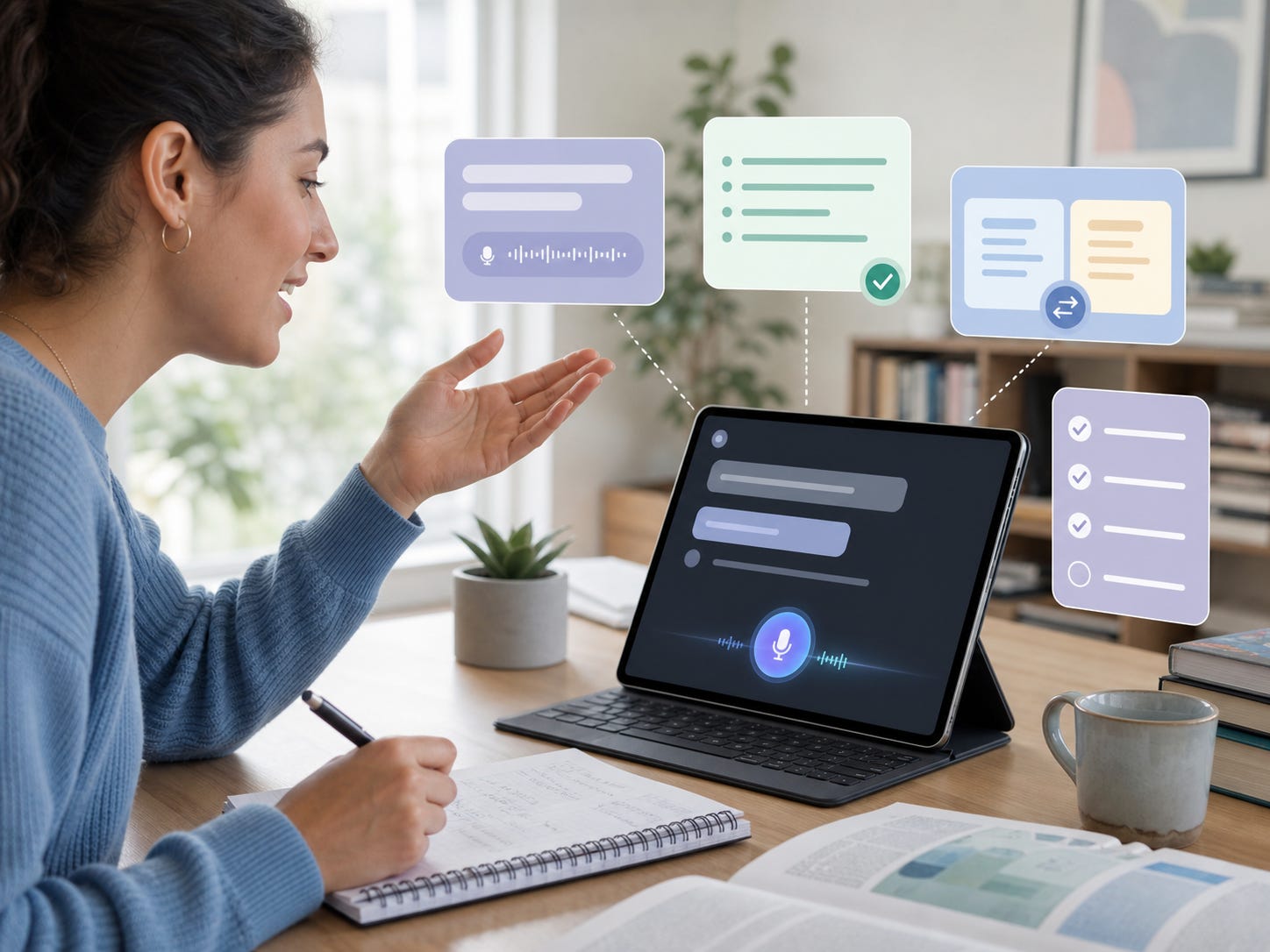
The shift is simple: AI learning tools may start to feel less like typing into a chatbot and more like having a natural, real-time conversation.
How is this different from what already exists?
Voice tools already exist in education. We have dictation, captions, lecture transcription, language translation, screen readers, voice assistants, and AI chatbots with speech modes.
The difference is that many of those tools are still separate, limited, or mostly reactive.
A transcription tool can capture what was said, but it may not understand the learning context.
A translation tool can convert language, but it may not help a student ask a better follow-up question.
A chatbot can explain a concept, but the student often has to stop, type, wait, and reframe the question.
A voice assistant can respond to commands, but it may not reason through a multi-step academic task.
What is changing is the combination: voice, reasoning, translation, transcription, context, and action happening closer to real time.
Realtime voice reasoning
What it means for education: Students can talk through problems instead of typing everything out.
Specific example: A student working on algebra can ask, “Why did I move the variable to the other side?” and get a spoken explanation that adapts as they respond.
Live translation
What it means for education: Multilingual learners and families can participate more fully.
Specific example: A parent-teacher conference could include real-time translation so families can ask questions in their preferred language.
Live transcription
What it means for education: Classes, meetings, and study groups can become captions and notes instantly.
Specific example: A lecture could generate live captions, then produce a study guide with key terms, misconceptions, and follow-up questions.
Voice-to-action
What it means for education: Education tools can help complete tasks, not just answer questions.
Specific example: An advisor tool could help a student compare course options, degree requirements, and schedule conflicts in one conversation.
What could this look like?
A high school student working on algebra could say, “I don’t understand why I moved the variable to the other side,” and get a spoken explanation that adapts as they respond.
A college student in a biology lab could talk through an experiment, ask for clarification on a procedure, and get help connecting what they are seeing to the underlying concept.
A multilingual learner could listen to a classroom discussion in their preferred language while still participating in the original conversation.
A student with dyslexia, low vision, or limited mobility could rely more on voice and less on typing, making AI support easier to access.
A teacher could finish a class discussion and have a draft summary, key misconceptions, vocabulary list, and follow-up questions generated from the live transcript.
An academic advisor could use a voice-enabled support tool to help a student compare course options, degree requirements, and scheduling constraints in one conversation.
Why this matters for education
Education is already conversational. Learning happens through questions, corrections, explanations, pauses, confusion, repetition, and practice.
That is why voice matters.
When students have to stop and type, they often simplify the question. When teachers have to manually turn class discussion into follow-up materials, valuable context gets lost. When multilingual families need support, translation delays can become participation barriers.
Realtime voice AI can reduce some of that friction.
Less friction for the student who learns better by talking it out.
Less friction for the teacher trying to turn a live class into useful next steps.
Less friction for multilingual families trying to engage with a school.
Less friction for learners who need accessibility support built into the experience from the start.
When will students and educators get this?
The models are available now for developers through OpenAI’s Realtime API. That means the education impact will come as schools, institutions, and edtech companies build these capabilities into the products people already use.
So the answer is not: students should go use an API.
The answer is: the next generation of education tools can now be built with more natural voice interaction, faster transcription, live translation, and task completion at the center.
The biggest opportunity is not replacing teachers. It is making learning tools better match how learning actually happens: in conversation, in context, and in real time.
Read more from OpenAI: Advancing voice intelligence with new models in the API
This is exciting and dangerous in equal measure. Voice AI is a genuine unlock for students who already think well but struggle with the interface. A dyslexic student who knows what they want to ask but loses it while typing? This changes their life. But a student who never learned to formulate the question in the first place? Voice just makes the shortcut faster. The friction of typing was the last speed bump between a student and a borrowed answer. Remove it and you accelerate learning for the kids who own their thinking. You also accelerate dependency for the kids who don’t. The tool is neutral. The readiness of the student is everything.
In your opinion, will the teacher’s role become more important in the future, or will AI take the lead?