
Source note: This is an edited interview adapted from a narrated video submitted to OpenAI.

Dr. Doreen Mayrell, an adjunct professor at Collin College, teaches dual-credit college algebra to 11th and 12th graders. One approach, the flipped classroom, moves the lecture outside the classroom, so that time in class can be used for problem-solving and application. But for that to work, all students need access to certain resources. With the arrival of AI, she saw a way to provide that missing support and make the flipped model work for everyone.
Intro
After years of hearing students ask when they would ever use math, Dr. Doreen Mayrell redesigned the flow of her course.
In her flipped classroom model, AI tutors support direct instruction outside class. Students arrive with guided notes, questions, and early practice behind them. Then class time is reserved for the work that benefits most from being together: paper-and-pencil problem solving, misconceptions, applications, and examples that connect math to students’ lives.
The Interview
Q. You teach everything from developmental math to calculus. What problem were you trying to solve?
Dr. Doreen Mayrell: I have heard “When will I use this?” many times. I wanted students to see math as something connected to their world, not just symbols on a page.
I built a flipped classroom where the AI tutor supports the lecture portion. Students complete guided notes at home, work at their own pace, and fill prerequisite gaps before they come to class.
Q. What happens in the classroom?
Dr. Doreen Mayrell: In class, we use paper, pencil, and calculators. No screens and no AI. That time is for complex problems, questions, and working together.
Interviewer: How did you design the tutors?
Dr. Doreen Mayrell: I created custom GPTs for each lesson and trained them on my materials: textbook sections, objectives, and the way I teach the concept. The structure follows an “I do, we do, you do” model. The notes help students, but they also help train the AI around the exact lesson.
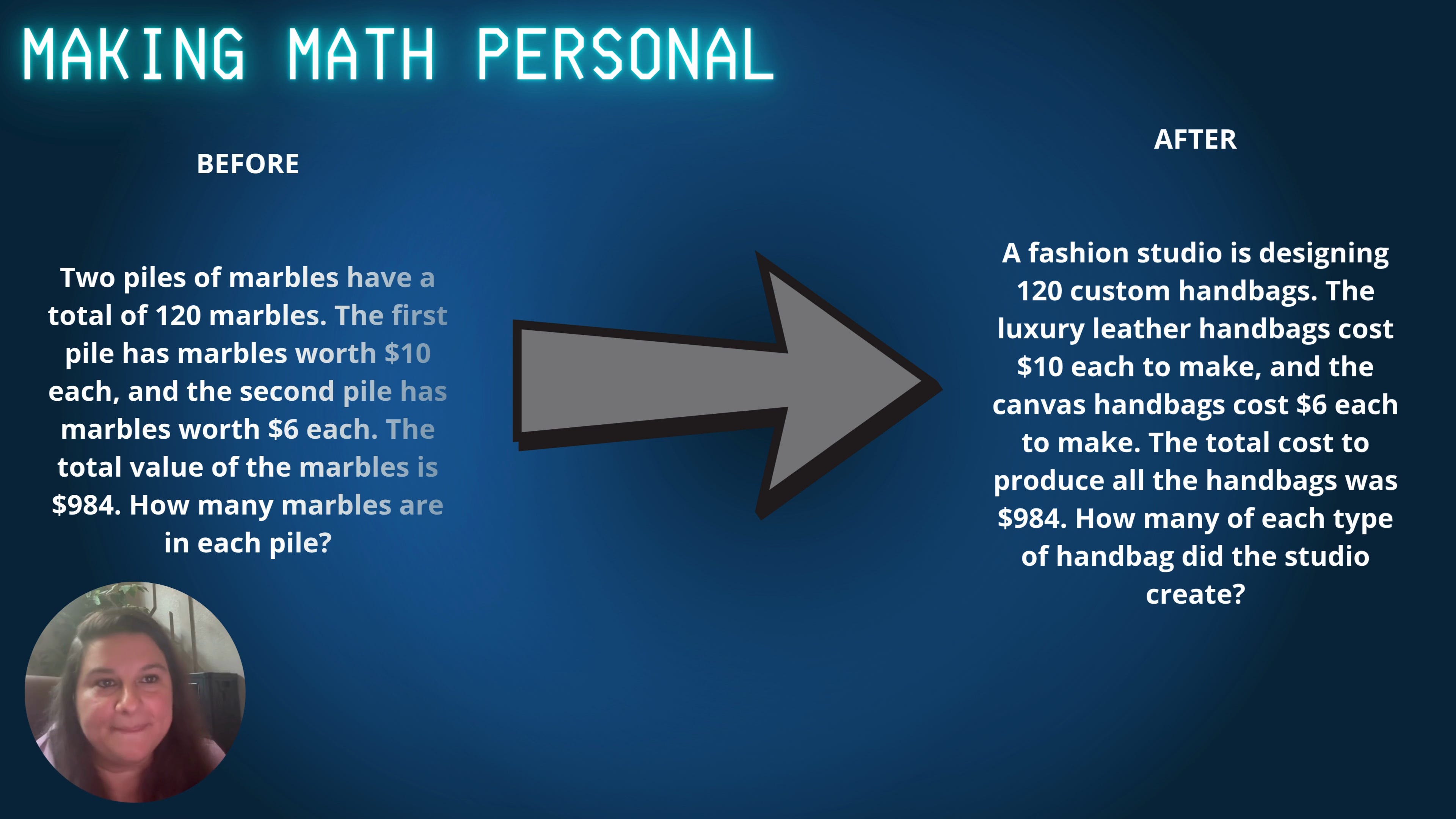
The same math structure can be rewritten around student interests, from shopping to games to music.
Q: One of the strongest parts of your example is how the problems become personal.
Dr. Doreen Mayrell: Yes. A standard math problem can be recontextualized around a student’s interests, career goals, sports, television, or music. The math is the same. The steps are the same. But the context makes the problem feel more relevant.
For example, a problem about marbles can become a problem about handbags. A gaming student can work with legendary items, epic items, and gold coins. A Taylor Swift fan can work with floor and balcony tickets.
Q: What changes when feedback is immediate?
Dr. Doreen Mayrell: Students do not just learn whether they were right or wrong. The tutor can point to where their thinking went off track and create a personalized study guide with new questions.
Q: What did you see in the results?
Dr. Doreen Mayrell: Students came to class with better questions. They got instant feedback. Math started to feel more connected to the world. In one college algebra course, the pass rate was 96 percent, the average course grade was 92, and the average and median final exam score was 86.
Q: What should other instructors take from this?
Dr. Doreen Mayrell: AI can help move routine instruction and feedback outside class, but the purpose is to make class time more human. It lets us focus on misconceptions, applications, and the moments where students need a teacher and a community.
What Stands Out
Core idea: AI can support direct instruction so class time can focus on deeper practice.
Classroom design: Students prepare with guided notes and AI support, then work without screens during class.
Student impact: The course reported a 96 percent pass rate and stronger engagement with applied problems.
Transferable lesson: Personalization works best when it preserves the math while changing the context.
Bio
Dr. Doreen Mayrell teaches mathematics at Collin College and leads academics at LearnWith.AI. Her work focuses on practical AI-powered curriculum design, flipped learning, and helping students connect mathematical concepts to meaningful real-world contexts.
It's amazing that math teachers can make math aproachable
The detail that stands out is what she kept out of the model, no screens or AI during class time itself, just to support the parts that benefit most from repetition. That is close to how we've approached AI in our own math and science tracks: use it to generate extra practice sets and catch gaps before students walk in, but keep the actual instruction and correction human. The pass rate jump is a strong data point for that kind of narrow, well scoped use case rather than a general purpose classroom AI rollout. We've written about drawing a similar line for AI in curriculum design at The Foundations Press (thefoundationspress.com). Has she or anyone at LearnWith.AI published the custom GPT prompts themselves, or is that proprietary to the course?