



Dan Wang, Lambert Family Professor of Social Enterprise at Columbia Business School, is the co-founder of CAiSEY, a voice-first AI discussion partner that deepens student learning. He has received multiple awards for teaching classes on technology and strategy over 14 years at Columbia.
For many discussion-based classes, preparation follows a familiar rhythm: students read, write a short response, and arrive with whatever thinking they managed to do alone.
Dan Wang wondered what might happen if that preparation became more interactive.
His course centers on competition, ambiguity, judgment, discussion, and debate. When ChatGPT became publicly available in late 2022, he watched many educators either ignore AI or ban it. He chose a different route: invite students to use it, ask them to disclose how they used it, and study what happened.
What he saw surprised him. Students were more hesitant to use AI than expected. And when they did use it, many were not simply outsourcing the work. They were using it as a thinking partner.
That observation eventually became CAiSEY, a voice-based GPT-powered learning tool designed to help students practice one-on-one conversations with course materials before they enter the classroom. The work moved from written assignments, to text chat, to voice conversation. Each shift changed the learning experience.
Voice, Wang says, unlocked a different kind of engagement.
Johanna Chouraqui, CAiSEY’s product lead, sees the tool as something distinct from a replacement for reading, writing, or classroom discussion. “It’s something new,” she explains: a way for students to have a live conversation with their materials before class.
The Interview
What was the classroom problem that led to CAiSEY?
Wang: I teach technology strategy at Columbia Business School. The class is about how business leaders make big decisions under competition and ambiguity, so a lot of it is discussion based. That is not unique to my class. Many MBA classes that involve judgment use some version of the Socratic method, discussion, and debate.
Our students are smart and rigorous, but they are also careful with their time. If they think a class isn’t worth their time, they’re not shy about saying so.
The motivation behind CAiSEY was to make the classroom experience sharper and more memorable, so students take something away when they enter the real world. But that starts in preparation. If students come in better prepared to discuss, challenge, and revise their thinking, the classroom can become much richer.
What did you do when generative AI first arrived in the classroom?
Wang: When ChatGPT was released in November 2022, everyone suddenly experienced generative AI in a newly accessible form. The first thought was excitement. The second thought, for educators everywhere, was existential fear.
My sense was that most instructors took one of two paths. Some ignored it and hoped it would go away. Others banned it. A small group of us decided to embrace it.
For written assignments in my class, I encouraged students to use ChatGPT. All I asked was that they tell me how they used it.
Two things came from that experiment.
First, students were far more hesitant to use it than I expected. I thought 90% or 100% would use it. In reality, on any given homework assignment, it was more like 20% to 40%.
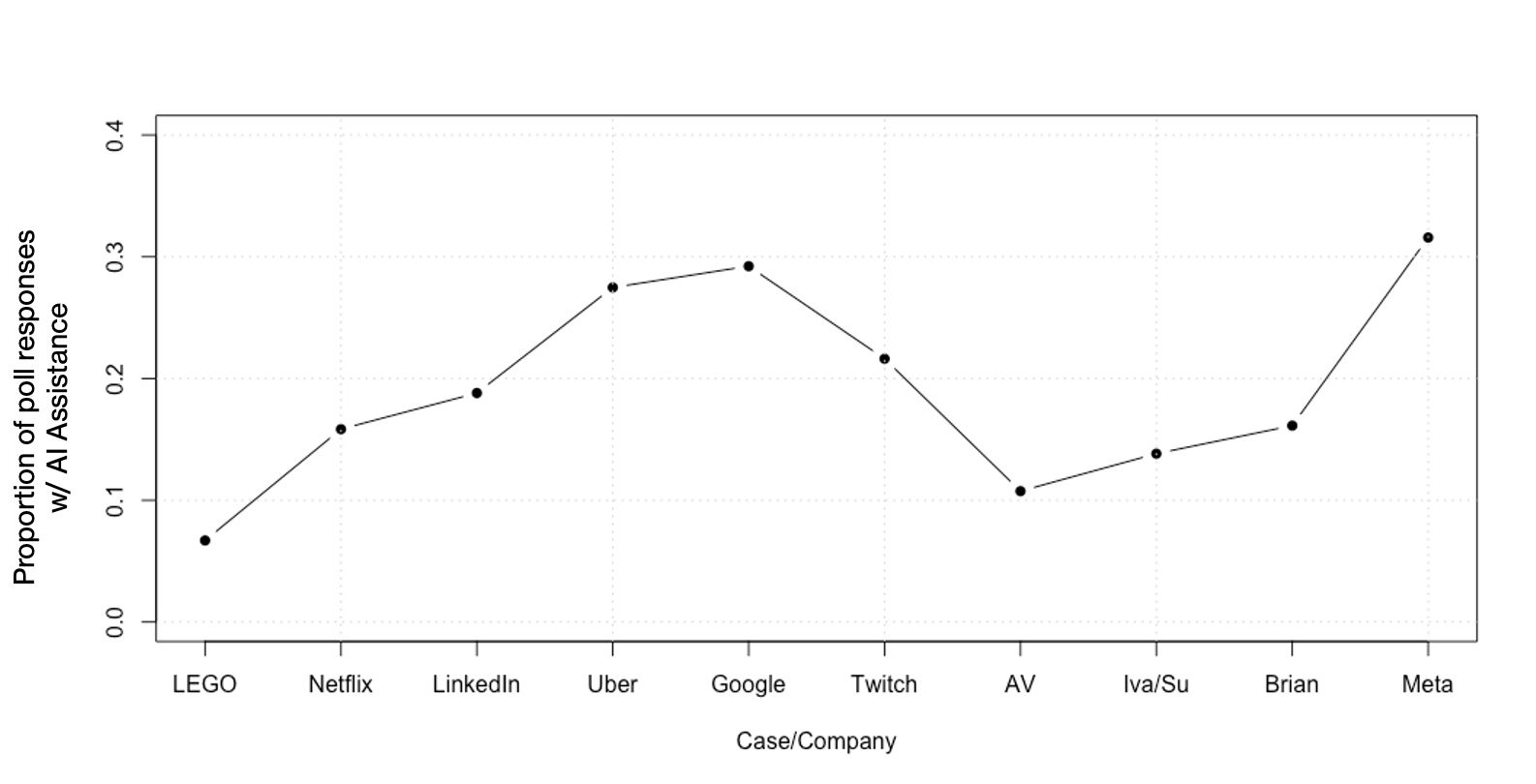
Wang: Second, when students did use it, they often used it in a way that made learning more involved, not less. I thought it would become a copy-and-paste exercise. Instead, students documented back-and-forth conversations where they used ChatGPT to craft and refine their thoughts.
The written homework in my class was simple: two to four sentences to help students come to class prepared. But ChatGPT was turning even that into a more dynamic thinking process.
How did that become a product idea?
Wang: After that first experiment, I worked with a former MBA student, Johnny Lee (who became CAiSEY’s cofounder), to create something more dynamic. Rather than asking students to answer prompts through a written assignment, we built a rough custom GPT that engaged them in a discussion about those same prompts.
By today’s standards, it was a pretty basic chatbot. But in fall 2023, it felt striking. Students were no longer submitting a one-way response. They were having a written dialogue.
What I realized was that students learned more. The quality of class discussion was higher. Because they had experienced pushback and had a real conversation, their minds changed during preparation. And that was after just two to five minutes of interaction.
Why move from text chat to voice?
Wang: In 2024, when OpenAI’s Realtime API became available, another former MBA student, Jill Cohen (CAiSEY co-founder), and I looked at each other and said: we should build a voice debate. We should build a voice agent.
With only hours to spare, we deployed it in my class the next semester. There were 222 students. From that class, students submitted 1,300 conversations as part of their CAiSEY assignments. Specifically, before a given class session, students had the option to engage in a CAiSEY discussion, tailored to that session, to prepare for class. They were only required to select six sessions out of 20 for which to prepare using CAiSEY. I was unsure of how it would all go down, but students embraced it and many did more than I required them to do.
The difference between a passive written assignment and a text-based chatbot was huge. But the difference between a text-based chatbot and a voice-based conversational agent was even greater.
It engages students differently and activates a different type of thinking. In a new working paper with a Postdoctoral Fellow, Neelam Jain, we analyzed CAiSEY transcript data across almost 1,000 submissions, half of which were submitted as a voice-based conversation and the other half as a text-based conversation. With voice, students spoke more, used more filler words, and tended to iterate and repeat themselves more. But that doesn’t mean their thinking became less sharp.
Instead, we found that a voice-based conversation led to more divergent ideation–that is, more creative reasoning and a broader array of ideas generated–compared to an equivalent text-based conversation, even one that was around the same length in word count.
What does the student experience look like?
Wang: After a CAiSEY conversation, students come to class more committed, more confident, and more connected. In fact, in class, they often reference their CAiSEY conversations when they contribute to class discussions. My interpretation is that this means that the mode of interaction–a voice-based conversation–left a deeper impression in my students’ minds because of the productive friction they experience through CAiSEY.
It is not a written assignment or a reading assignment. It is a live, one-on-one, real-time practice discussion. It may take 10 to 15 minutes, but the density of knowledge exchanged in that time is high compared with a traditional written or reading assignment. From the student’s point of view, when instructors deploy CAiSEY in their classes, students treat it as part of the class requirements, like just another homework assignment. Except, in this particular assignment, a student will be interacting live with an AI-powered interlocutor focused on reacting to their ideas and pushing their ideas further.
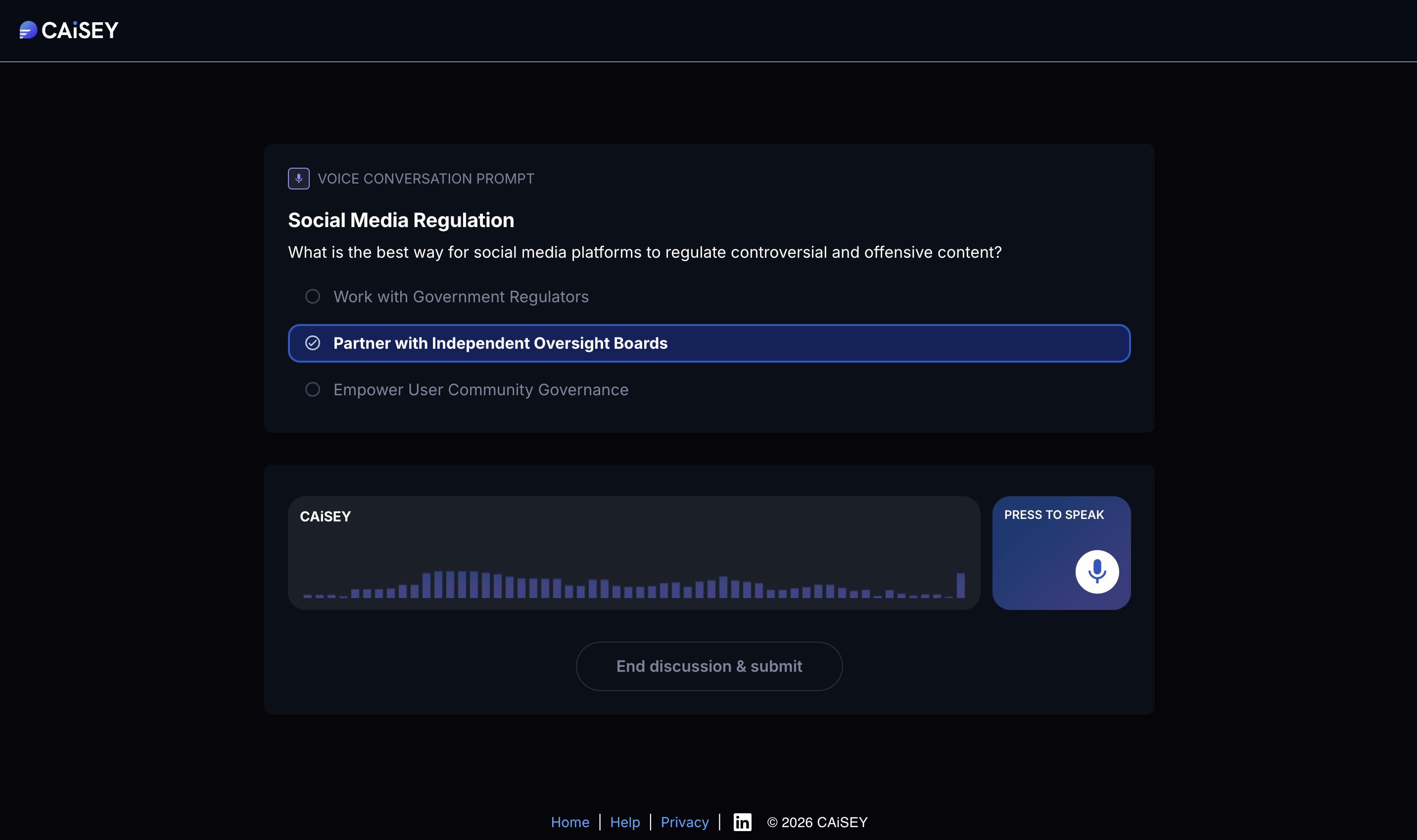
In terms of deployment in a class, a student logs into their CAiSEY account which has been registered to their class. Upon logging in, students select an assignment, which then leads them to initiate a conversation about the topic of the assignment, framed typically around a specific discussion question that the instructor has set up. Instructors sometimes assign a reading for the student to absorb prior to the conversation as preparation. Conversations range anywhere from 10 to 20 minutes, after which CAiSEY prompts the student to end. Many students often choose to extend the conversation after being alerted by CAiSEY to end.
That CAiSEY has been effective in engaging students does not replace the role of reading and writing. CAiSEY is complementary. CAiSEY adds value because students come to class more motivated to say something because they have done it before. They have considered alternatives. They have had the experience.
We see this especially with students who tend to be shy or for whom speaking up is a challenge. They appear to benefit the most. This is based on direct feedback from instructors who observe this pattern in their classes after students have used CAiSEY. This also aligns with systematic evidence based on some early results from a large field experiment across over 1,000 students who were randomly assigned to use CAiSEY.
They also come in with more confidence because the material is closer to them. They have talked through it. They remember it. They are not just willing to speak; they have something they are willing to share.
You also mentioned accessibility. What have you observed there?
Wang: One thing we observed anecdotally, and then saw in the data, was that students who reported liking CAiSEY and benefiting from it most often included students who spoke English as a second language and students who later revealed learning conditions such as dyslexia or dysgraphia.
That made me think harder about written assignments. We often assume the written word is a proxy for cognition. But that may not work for a meaningful share of students.
So voice matters. It can give students another way to engage with ideas, practice their thinking, and arrive in class ready to contribute.
Johanna, from the curriculum and operations side, what does CAiSEY make possible for instructors?
Chouraqui: I keep coming back to the question of what this opens up for instructors and students.
The instinct with AI is often that it replaces something: reading, discussion, writing. What is interesting about what we have built is that it is not really substituting for a form of preparation or discussion. It is something new that has not existed before: a conversation at home with your materials.
Can you walk through one course example?
Chouraqui: One recent example came from outside the business school. An instructor at Columbia Climate School first encountered CAiSEY when his partner was using it nearby. He asked what it was, got interested, and reached out.
His idea was to help students practice difficult climate conversations. He liked the brainstorming, open-ended questions, and debates CAiSEY could support, but he wanted to know whether students could practice conversations through different personas.
He sent us course materials, a framework, and chapters from the books students were reading. We brainstormed together and decided to build a different role play for each of six personas. Students would have conversations with these different people throughout the course.
I built out the questions, and we iterated together to make sure it sounded like him, came from his class, reflected his learning objectives, and met the needs he had for the course.
Once he approved it, students received a link, registered for the course, and saw their assignments in CAiSEY. They completed the assignments according to the instructor’s guidelines, with due dates managed through the learning management system.
When an assignment was submitted, students received feedback and a summary of their conversation. The instructor could see each transcript and summary, then go into the next class understanding what worked well, what trends appeared, and what common feedback students received.
How do you keep the conversations from narrowing student thinking?
Wang: A lot of what CAiSEY is good for involves ambiguity and judgment. The underlying system instructions are designed to create guardrails and structure, but also to stimulate divergent thinking.
That can happen through a debate, where there are clear opposing positions, or through open-ended brainstorming. CAiSEY looks simple from the outside. It can look like a voice chat. What you don’t see are the years of iteration around flows, structures, and sensitivities that make the conversations engaging, pedagogically meaningful, and useful. The input materials that inform CAiSEY’s system instructions come from hundreds of pages of teaching notes, recorded discussions and debates, and distilled best practices from decades of discussion-based teaching at Columbia Business School.
These ideas also largely align with the principles that have been thoroughly researched and expressed in widely available scholarship on difficult conversations. Julia Minson, who has also been featured in this Substack, explores similar principles in How to Disagree Better. We were also careful to make CAiSEY’s persona explicit to the student and instructor. Rather than being a tutor, TA, or teacher, students know that they are entering a conversation with an adversarial yet friendly peer who is informed about the class materials.
In other words, students know going in that they will be challenged. Whatever position they take, there will be some prodding and poking. The terms of the conversation are set and shared. But they also know what they are buying into.
What have you learned about voice and divergent thinking?
Wang: We wrote a paper about this because I was interested in whether CAiSEY stimulated original ideas.
We compared voice and text-based conversations. We took the data we had and used computational linguistics to analyze semantic markers, embeddings, and different ways of interpreting reasoning and thought.
For the same conversation about the same topic, at the same length, controlling for student background, demographics, and other factors, we found that voice produced about 70% more divergent thinking on average.
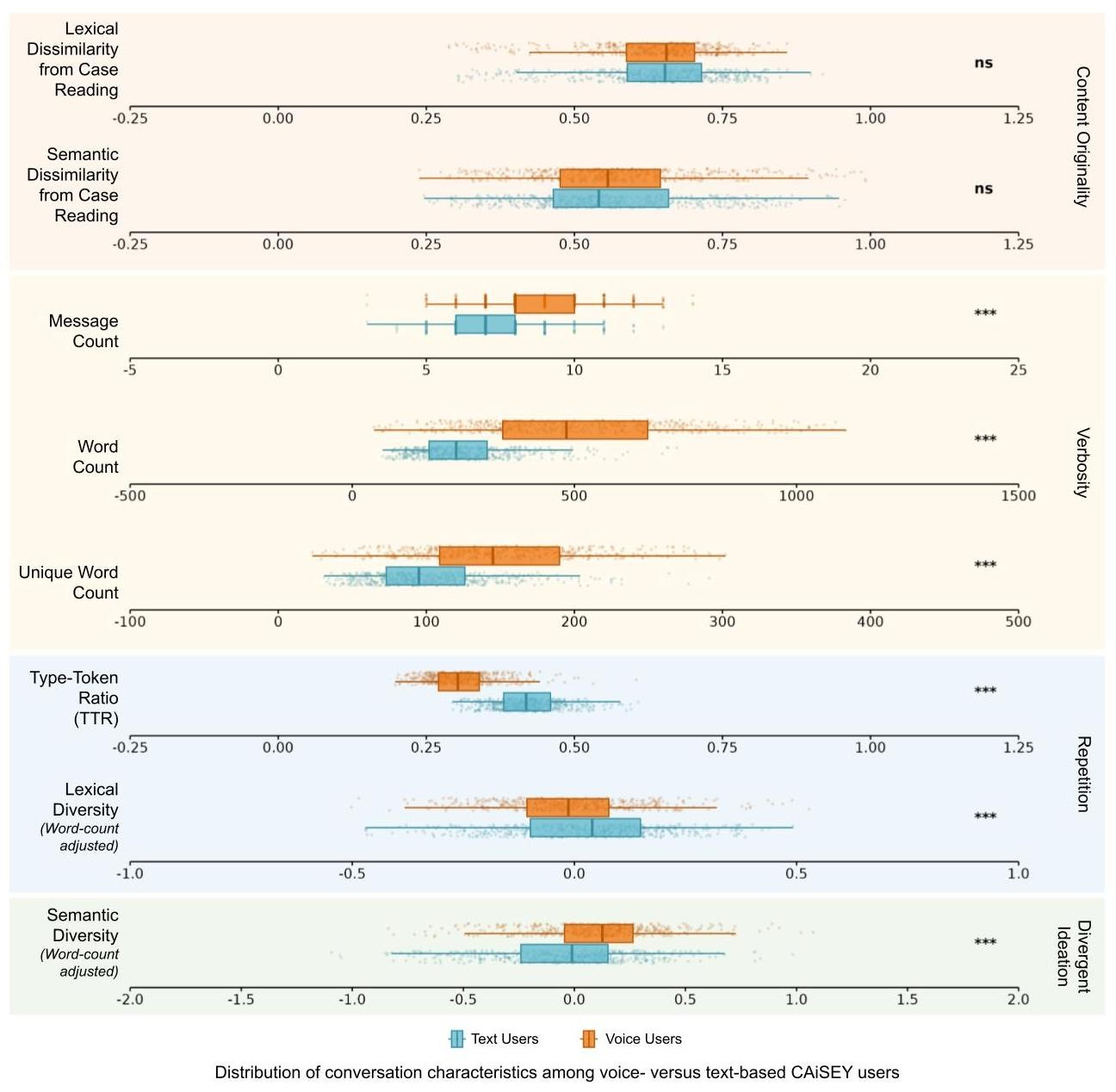
That was measured by semantic diversity in students’ thoughts. It was not lexical diversity, or the range of words used. In fact, lexical diversity is lower in voice because we are speaking in real time and are usually less polished than when we write. But semantic diversity, which is a measure of cognitive flexibility and breadth of thought, was much higher in voice than in text.
How have model improvements changed the product?
Wang: During the time CAiSEY has been around, the Realtime model has undergone significant upgrades. Each time, we have had to adjust on the fly.
That has created learning opportunities. In my technology strategy class, I teach students how to interact with an AI ecosystem. When you have dependencies, that changes how you think about which technology to adopt, what is relevant, and what the best use case is. Experiencing that firsthand gives me something concrete to bring back to students.
With newer voice models and GPT-Live, conversations are even more natural sounding and follow instructions better.
Chouraqui: We noticed that after updates, some of the prompting we had used was no longer needed. For example, we had a behavior prompt telling the model to speak very slowly, in three to five words, so the conversation would feel natural and useful for learning. With the newer real-time model, it did that more naturally on its own.
What is CAiSEY’s scale?
Wang: Since that classroom deployment, mostly through word of mouth and talks I have given, CAiSEY has expanded to about 24 institutions, mostly business schools, and has reached roughly 4,000 to 4,500 students.
The team has collected about 2,000 hours of conversation. Students want more specific feedback on how they handled moments in the conversation. Instructors see value in a new kind of classroom signal, but they also need help making sense of many long transcripts. New beta features are meant to help students apply what they learned and help instructors identify key tensions before class.
What is the larger story you want educators to understand?
Wang: The story is not that AI should replace class preparation or classroom discussion. It is that AI can create a new mode of preparation that makes the discussion better.
Students can come to class more committed because they have already practiced. They can come with more confidence because they have talked through the material. And they can feel more connected because the mode of interaction may work better for students who are less well served by writing-only preparation.
For instructors, it can also make the classroom more valuable. They don’t have to spend as much time reteaching what students should have worked through at home. They can do the work of teaching in the classroom. Because they have unprecedented visibility into how their students are thinking about the very problems that animate the class, instructors can also stage more tailored classroom discussions and activities that tailor the classroom experience to their students’ needs.
End Note
CAiSEY points to a practical shift in how educators can think about AI.
The question is not only whether AI helps students write faster. It is whether AI can help students rehearse their thinking before it matters publicly: before the case discussion, before the debate, before the moment when they need to explain an idea clearly to someone else.
For discussion-based learning, that may be the important opening. A student does not just submit an answer. They try an idea out loud, get challenged, revise it, and arrive in class with more to say.
Technical Notes
CAiSEY uses OpenAI’s Realtime API to power voice-based discussion and debate. Its text-based assignment option and instructor/student feedback workflows use OpenAI language models to generate summaries, surface key tensions, and support follow-up reflection.
Interested instructors can learn more on the CAiSEY website, where they can demo a CAiSEY assignment as a student and contact the CAiSEY team to create a CAiSEY assignment based on their own class materials.
Estoy haciendo lo mismo le digo achagpt que escuche la clase y me de el feedback
Voice may matter because it exposes unfinished thinking. Writing encourages polish; conversation exposes uncertainty, forces iteration, and reveals gaps in reasoning. That's a different cognitive process.